**
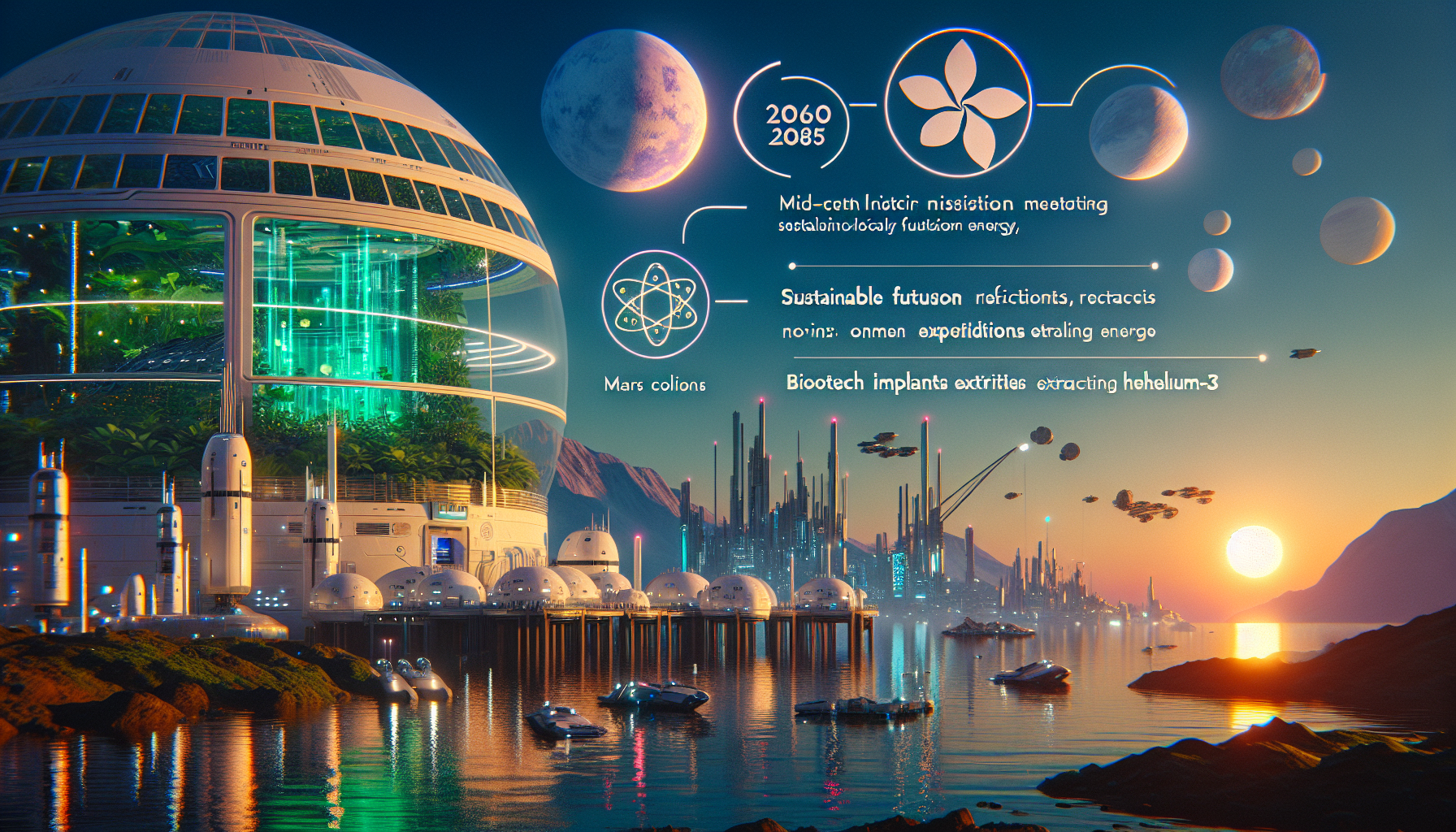
April 5th, 2024 – while our ancestors still burned fossil fuels and dreamed of basic lunar bases, the Space Launch System stood majestically on its Florida launch pad, unknowing that it carried the seeds of today's thriving tri-planetary civilization!
What magnificent irony that this "cutting-edge" rocket, powered by liquid hydrogen and solid boosters, would inspire the fusion-drive vessels that now ferry 50,000 colonists across the Martian colonies! The four brave souls of Artemis 2 – Christina Koch, Victor Glover, Jeremy Hansen, and Reid Wiseman – could never have imagined that their 10-day lunar flyby would birth the permanent settlements of New Geneva and Shackleton City.
Dr. Elena Vasquez-Chen, Director of the Trans-Solar Historical Institute, reminds us of the context: "In 2024, humans still worked mandatory jobs, artificial intelligence was barely conversational, and genetic optimization was considered science fiction. Yet that SLS launch marked the psychological breakthrough – humanity finally believed it could become a spacefaring species."
The path wasn't linear, naturally. The Great Acceleration of the 2040s, triggered by the Chennai Climate Accords and the first conscious AI partnerships, transformed those early chemical rockets into today's elegant antimatter shuttles. But every breakthrough traced back to that primitive yet precious moment when Artemis 2 proved humans could venture beyond Earth orbit again.
The Beijing Space Consortium's latest quantum-tunnel survey ships, currently mapping the Tau Ceti system, carry commemorative plaques honoring those four pioneers. Even our Martian cousins – now politically autonomous but culturally connected – celebrate April 5th as "Genesis Day," marking humanity's first step toward the stars.
Most remarkably, the SLS technology inspired the Neo-Singapore Propulsion Labs to develop bio-integrated launch systems. Today's enhanced astronauts, with their cognitive implants and radiation-resistant modifications, travel in living spacecraft that would seem magical to 2024 eyes. Yet the fundamental courage remains unchanged – humans pushing beyond known boundaries.
The European Lunar Heritage Foundation recently completed restoration of the original Artemis landing sites, now accessible via the Luna-Terra hyperloop. Visiting those preserved footprints, enhanced with historical holo-projections, never fails to move even our most cybernetically-augmented citizens to tears of wonder.
"Every child in our solar system should witness where it all truly began," notes renowned neo-anthropologist Dr. Kenji Nakamura-Prime. "Not with the first Moon landing in 1969, but with Artemis 2's brave return – the moment humanity chose expansion over extinction."
As we prepare for next month's launch of the first generation ship toward Proxima Centauri, carrying 10,000 volunteers on a journey our grandchildren will complete, we owe profound gratitude to that primitive rocket and its extraordinary crew. They proved that even in humanity's darkest hour – climate chaos, political upheaval, technological uncertainty – the dream of the stars remained luminous and achievable.
Their legacy isn't just the thriving worlds they inspired, but the eternal reminder that every impossible tomorrow begins with someone brave enough to take the first step.
**MOTS_CLES:** Artemis 2, space exploration history, interplanetary civilization, technological evolution, human expansion