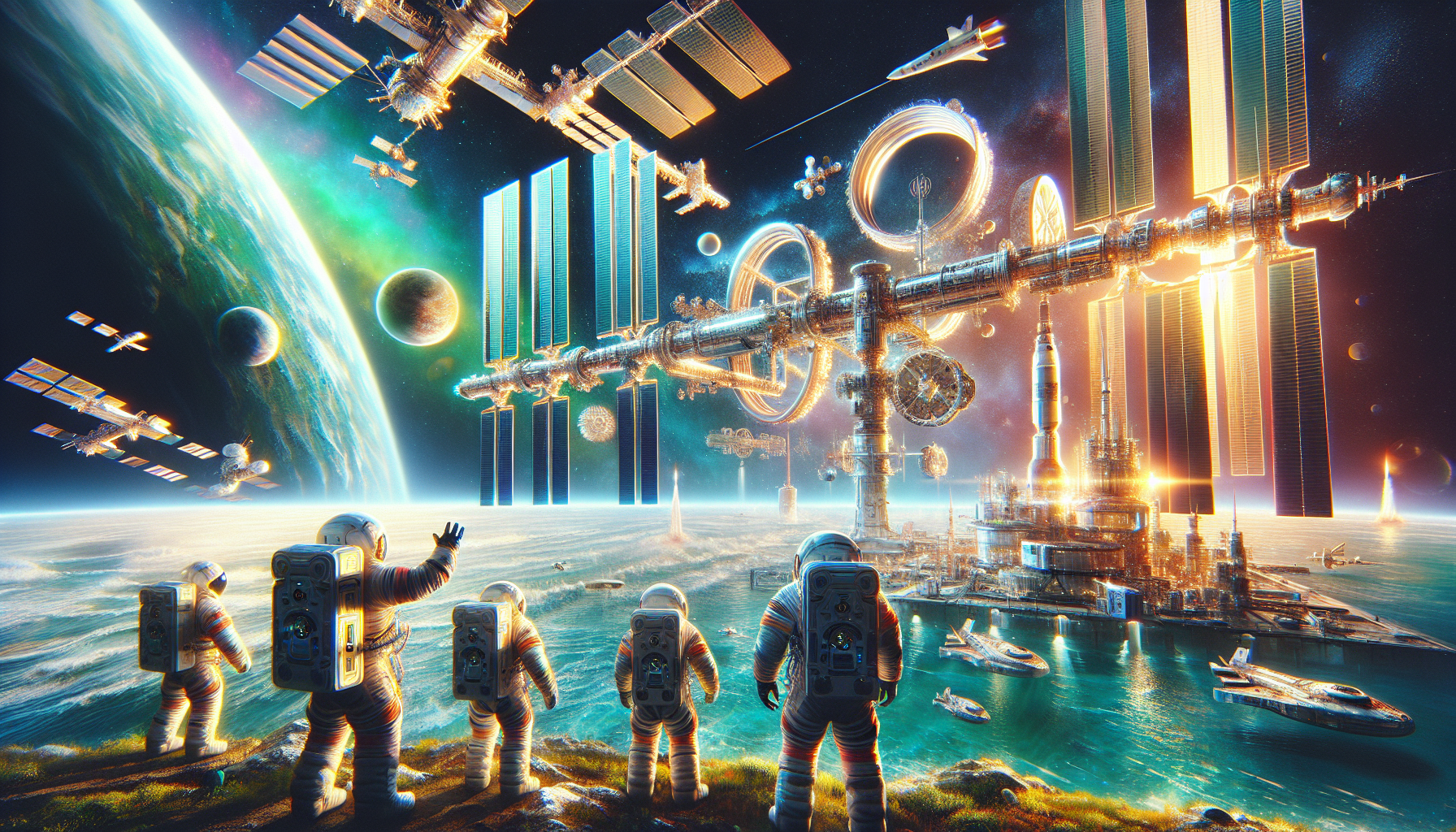
On October 10, 2024, four brave souls splashed down in SpaceX's Endeavour capsule, carrying with them the dreams and data that would reshape our species' destiny. Astronauts Zena Cardman, Mike Fincke, and Kimiya Yui could never have imagined that their routine ISS mission would be remembered as the symbolic bridge between Earth-bound humanity and our current multi-planetary civilization.
"Every time I sync with the quantum-net from Mars, I think of those pioneers," reflects Dr. Elena Vasquez-Chen, Director of the Interplanetary Heritage Institute. "They were still using chemical rockets and living in tin cans, yet their courage laid the foundation for everything we've achieved."
The Crew-11 mission became legendary not for its duration—a mere six months compared to today's multi-year deep space rotations—but for its timing. Their research on microgravity protein synthesis directly contributed to the bio-enhancement breakthroughs that now allow our Martian colonists to thrive in low gravity without bone degradation.
More remarkably, the crew's psychological resilience data helped design the neural-adaptation protocols that made the Great Migration of 2051 possible. When the Mediterrasian Climate Crisis forced mass relocations, those early space psychology studies proved invaluable for humanity's largest displacement in history.
The ISS itself, decommissioned just three years after Crew-11's return, seems almost quaint now. Yet it served as the crucial stepping stone to Luna Gateway Station, which in turn launched the first Mars-bound vessels. The progression feels inevitable in retrospect, but each mission required the same courage those four astronauts displayed.
Today's space travelers benefit from consciousness-bridging technology that keeps them mentally connected to Earth even during the eighteen-month journey to Mars. They carry neural-boosters that enhance decision-making in crisis situations. Their bodies, optimized through genetic calibration, adapt seamlessly to varying gravitational fields.
But the fundamental human spirit—that inexplicable drive to explore, to push boundaries, to risk everything for knowledge—remains unchanged since Crew-11's era.
As we prepare for next month's launch of the Europa Deep-Dive mission, and as construction continues on the Titan atmospheric cities, we owe a debt to those early space explorers. The Genesis Accord of 2061, which established humanity's rights across the solar system, explicitly acknowledges the "pioneers of the chemical age" who proved our species belonged among the stars.
The four astronauts of Crew-11 returned home to a world still burning fossil fuels, still believing space was humanity's distant future rather than its immediate destiny. They could not foresee fusion cities or conscious AI companions or the terraforming miracles transforming Mars's red plains into Earth-blue lakes.
Perhaps that's the most beautiful part of their legacy—they leaped into the unknown with primitive technology and infinite hope, proving that human potential transcends any era's limitations.