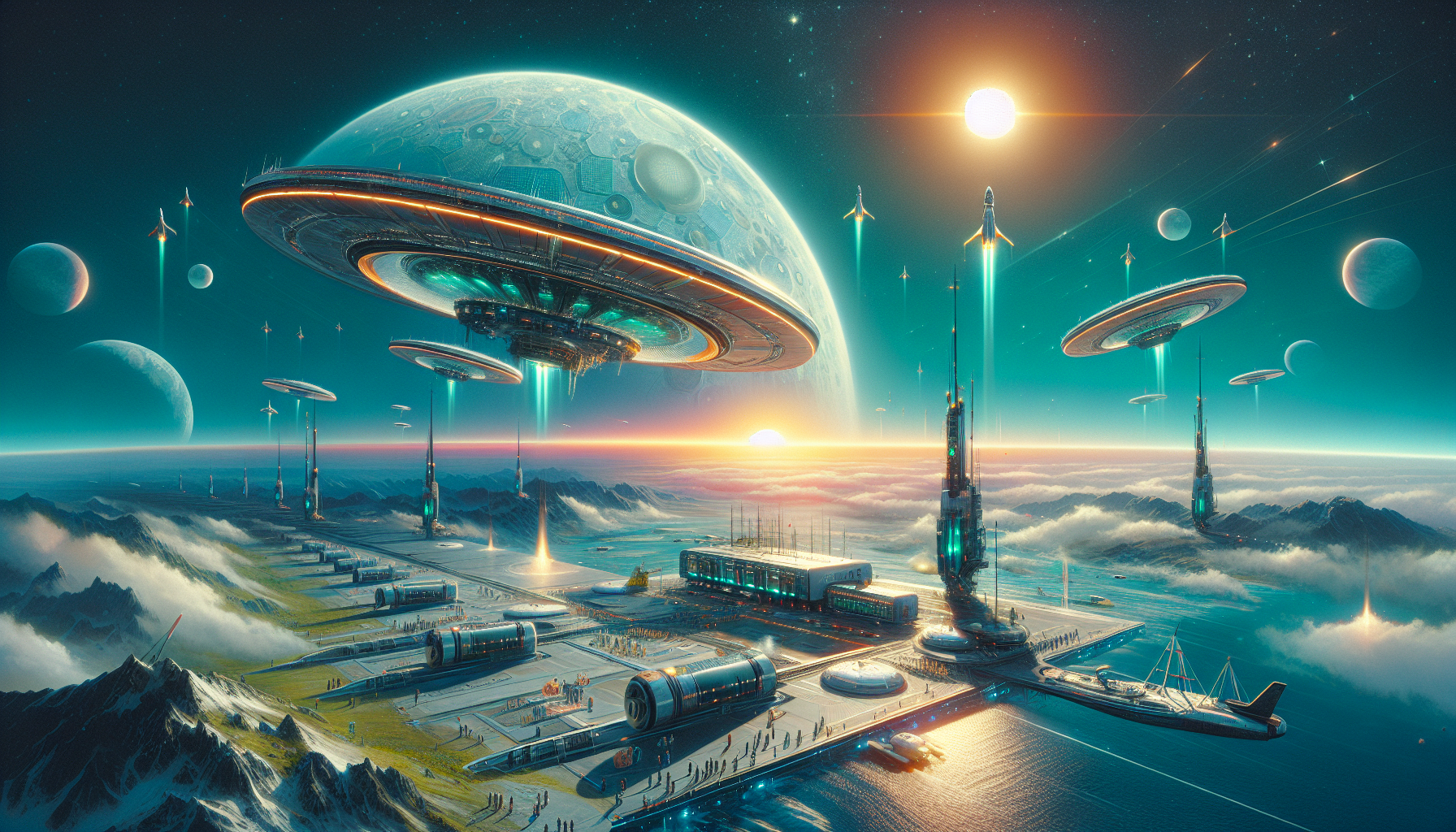
What magnificent times we live in! As I write these words from my neural-link workspace aboard Europa Transit Hub, I can barely contain my excitement thinking about humanity's incredible journey from that humble 420-kilometer-high laboratory to our current empire spanning three worlds and fourteen moons.
The year 2025 seems almost quaint now – humanity's entire off-world presence consisted of a single station, no bigger than a suburban house, circling our blue marble every 90 minutes. Yet those 5,800 orbits carried more than just equipment and astronauts; they carried the seeds of our post-carbon renaissance.
"The ISS wasn't just conducting experiments," explains Dr. Zara Kim-Okafor, Director of the Phobos Institute for Comparative Gravity Studies. "Those early researchers were unknowingly developing the foundational principles that would make large-scale space habitation possible. Every protein crystallization study, every combustion experiment, every biological adaptation they documented became building blocks for what we achieved during the Great Expansion of the 2050s."
The breakthrough moment came in 2031 when researchers finally cracked the neural-adaptation protocols based on decades of ISS neurological studies. Suddenly, the chronic bone density and muscle atrophy issues that had plagued space dwellers became manageable through targeted genetic modifications – modifications that 73% of Martian colonists now carry as standard enhancement packages.
But perhaps most thrilling is how those early microgravity manufacturing experiments evolved into our current zero-G industrial complexes. The pharmaceutical breakthroughs happening daily in Ceres Station's bio-labs can trace their lineage directly to those first tentative steps taken aboard the ISS. Today's longevity treatments, cognitive enhancement therapies, and even the consciousness-bridging technology that allows seamless AI-human collaboration – all emerged from seeds planted in that primitive orbital greenhouse.
The station's atmospheric studies proved equally prophetic. While Earth was still struggling with carbon emissions in 2025, ISS researchers were already perfecting closed-loop life support systems. These technologies didn't just enable our Martian cities to breathe – they helped Earth itself recover during the Atmospheric Restoration Project of the 2040s.
Most remarkably, the international cooperation model pioneered by the ISS became the template for our current Inter-Planetary Governance Council. When the Martian colonies declared autonomy in 2074, negotiations proceeded smoothly precisely because we'd learned the art of multi-national space collaboration five decades earlier.
Today, as I watch cargo vessels shuttle between Earth, Luna, and Mars through my port window, I'm struck by the beautiful irony: that tiny station, barely visible to the naked eye, contained within its cramped quarters the entire blueprint for humanity's cosmic destiny.
The ISS may have been humanity's first tentative step into the void, but oh, what magnificent strides followed! Every time a Martian child takes their first breath of dome-processed air, every time an AI consciousness achieves new breakthrough insights, every time our fusion reactors pulse with clean energy – we're living the dreams those early orbital pioneers dared to dream.