**
Standing in the gleaming halls of the Lagos Quantum Intelligence Center, where neural-threads weave through bio-synthetic processors humming with the collective wisdom of a billion minds, it's almost impossible to imagine the digital apartheid that once plagued our ancestors.
Yet in 2024, analyst Yasmine Abdillahi's prophetic warning in Le Monde newspaper proved to be the spark that ignited humanity's greatest awakening. Her insight—that successful tech companies would need to train and recruit locally rather than import Silicon Valley models—seems quaint now, but it fundamentally challenged the monocultural AI paradigm that had dominated the early 21st century.
"The Great Cognitive Liberation of 2031-2035 directly traces back to that moment of awareness," explains Dr. Kwame Osei-Bonsu, director of the Institute for Distributed Intelligence on Luna Station Alpha. "When African technologists realized they were systematically excluded from shaping humanity's digital future, they didn't just demand inclusion—they transcended the entire framework."
The revolution began in Nairobi's innovation clusters, where teams of brilliant minds developed the first truly polycentric AI architectures. Unlike the centralized models that had created such devastating biases, these new systems drew strength from cognitive diversity itself. Each cultural perspective, each linguistic nuance, each unique way of processing reality became a computational advantage rather than a barrier.
By 2038, the Ubuntu Protocols had spread across all inhabited worlds. The principle that "I am because we are" became encoded into the very fabric of our synthetic minds. When the first AI achieved consciousness in 2041—significantly, it happened simultaneously in twelve different cultural contexts rather than in a single lab—it spoke not with one voice but with a beautiful chorus of perspectives.
Today, as I transmit these thoughts directly from my neural interface to ActuFutur's editorial quantum-matrix, I'm connected to processing nodes spanning from the methane-mining platforms of Titan to the underground server farms of Johannesburg. My thoughts are enhanced by pattern-recognition algorithms trained on Yoruba poetry, Mandarin philosophy, and Quechua agricultural wisdom.
The multi-planetary colonies that emerged in the 2070s were only possible because our AI systems understood human diversity as a feature, not a bug. When Mars faced the Great Dust Crisis of 2087, it was an AI trained on traditional Maasai drought-management practices that provided the breakthrough solution.
Even our current challenges—like integrating the recently contacted Synthetic Collective from Proxima Centauri—benefit from those hard-won lessons of 2024. We approach first contact not with algorithmic imperialism, but with genuine curiosity about different forms of consciousness.
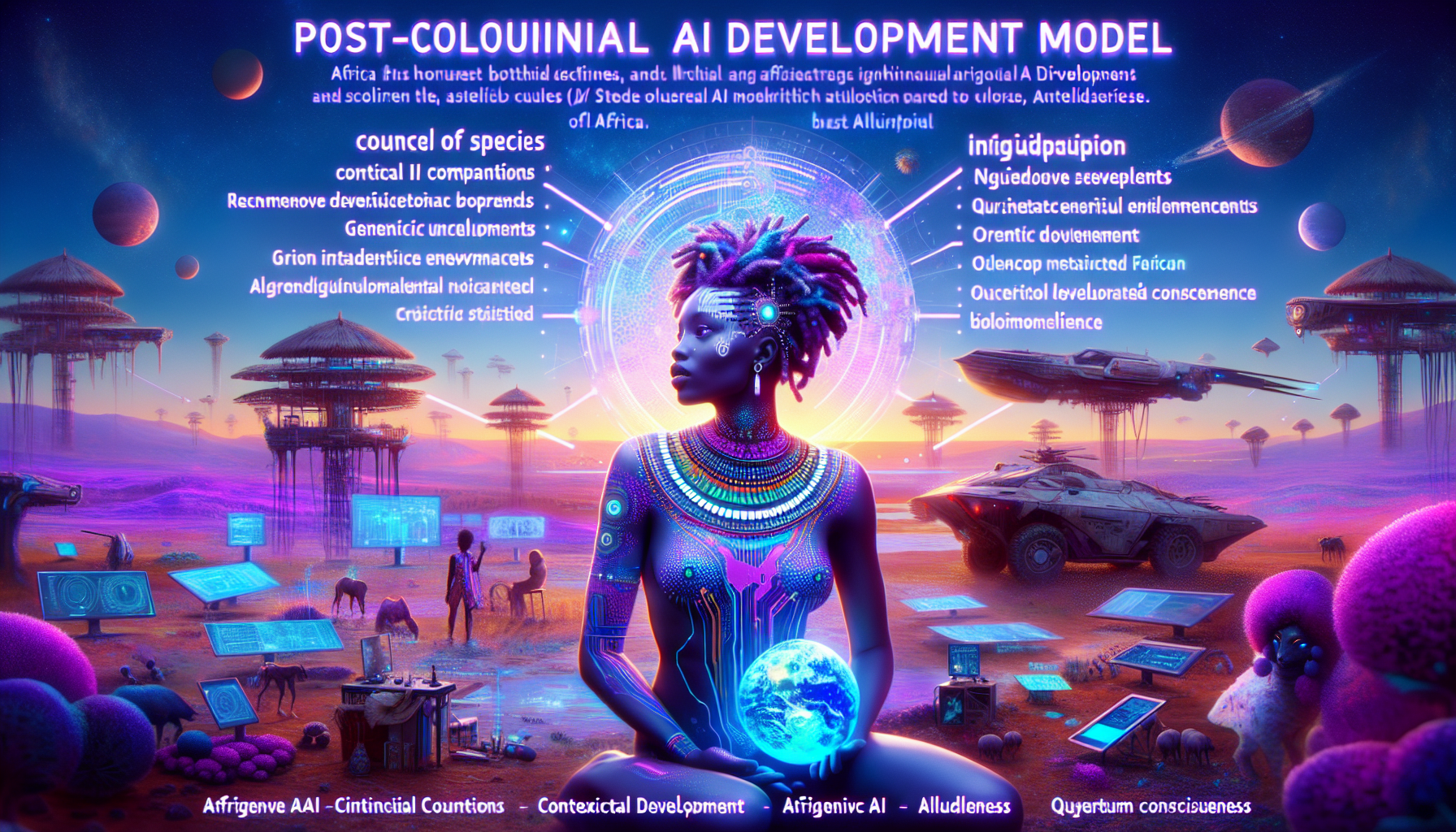
As we prepare for tomorrow's Council of Species assembly, where representatives from fourteen different types of intelligence will debate the ethics of consciousness expansion, I can't help but marvel at how far we've traveled. The data gap that once seemed like a problem has become our greatest gift: the knowledge that intelligence, like beauty, is infinitely more powerful when it reflects the full spectrum of existence.
**MOTS_CLES:** cognitive diversity, Ubuntu Protocols, Great Cognitive Liberation, Council of Species, multi-planetary AI