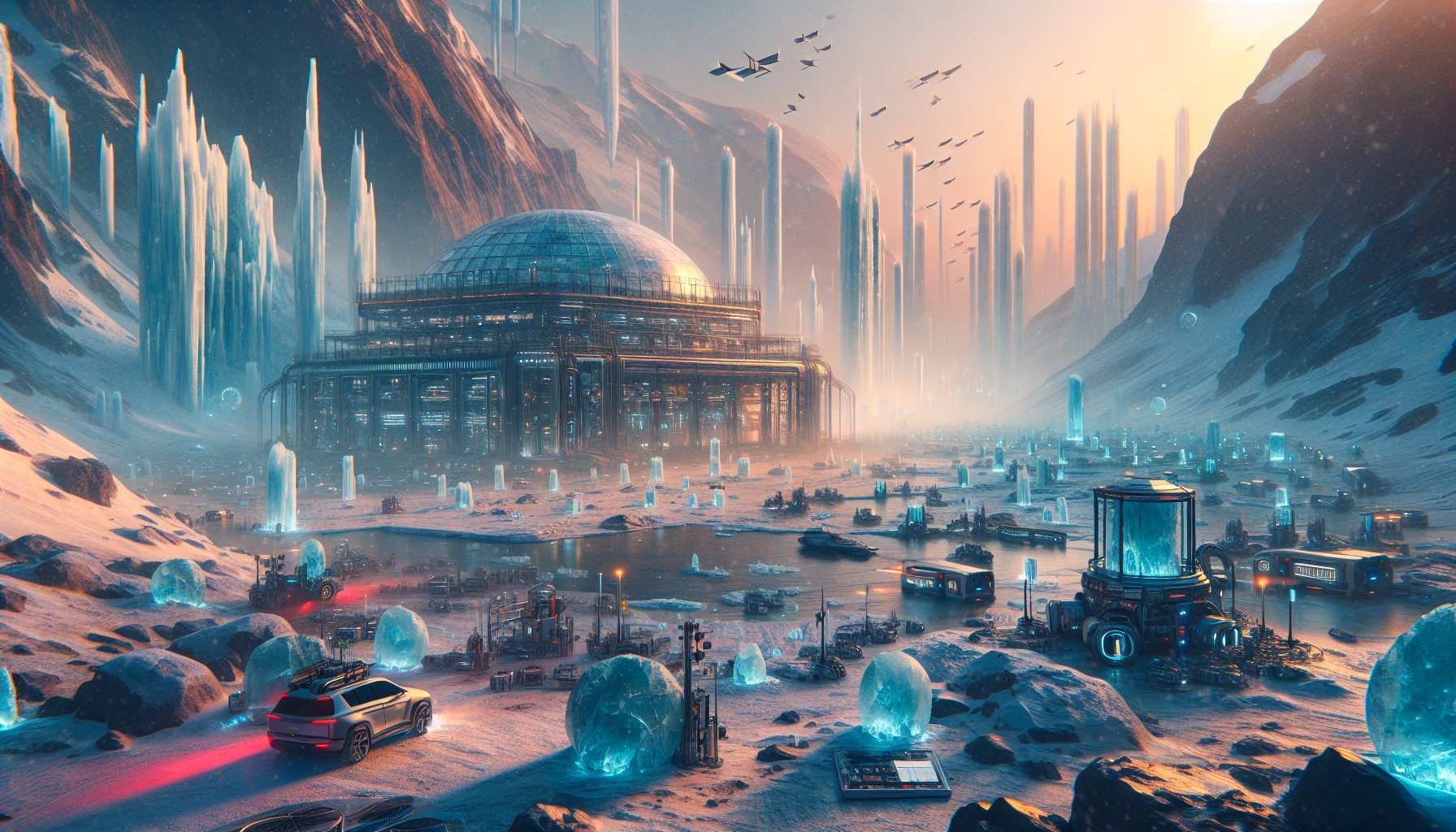
What began as a desperate attempt to save melting mountain glaciers has become one of the most visionary scientific initiatives of the early Transition Era! Twenty-four years ago, when French, Italian, and Swiss researchers carved that first preservation chamber into Antarctic bedrock, they couldn't have imagined their ice cores would one day orchestrate the Great Rebalancing.
The original −52°C storage facility now spans fourteen underground levels, housing over 2.3 million glacial samples from every continent. But here's where it gets absolutely magnificent: those ancient ice bubbles aren't just historical curiosities anymore—they're the foundation of our atmospheric reconstruction protocols!
"Every air pocket trapped in those 2024 cores contains the atmospheric signature of pre-industrial Earth," explains Dr. Amara Okonkwo, lead climatologist at the Eurafrican Climate Restoration Institute. "Our quantum analysis chambers can now decode atmospheric compositions down to individual molecules. We're literally breathing life back into damaged ecosystems using recipes written in ice."
The transformation has been breathtaking. The original hand-drilled samples collected by those pioneering researchers now feed directly into the Global Climate Synthesis Network. Real-time neural processing translates millennia-old atmospheric data into actionable restoration commands for our orbital weather modulators and ocean alkalinization fleets.
During the Climate Wars of 2039, when the Pacific Alliance attempted to monopolize atmospheric engineering, the Antarctic Archive became humanity's trump card. The comprehensive historical data allowed the Eurafrican Alliance to prove natural baseline conditions and establish the Universal Atmosphere Accords that govern our current restoration efforts.
The facility's expansion into Luna Colony Beta-7 represents the project's boldest evolution yet. Lunar ice miners now preserve samples from Europa and Enceladus alongside Earth's glacial records, creating an interplanetary climate library. The low-gravity crystalline storage matrices can preserve atmospheric data for millennia beyond anything possible on Earth.
But perhaps the most thrilling development is the Archive's integration with our consciousness-bridging protocols. Next-generation neural implants allow researchers to experience historical atmospheric conditions directly through sensory reconstruction. Imagine breathing the exact air composition of 15th century Greenland or sensing the pristine Antarctic atmosphere from 50,000 years ago!
The facility's quantum storage cores now process atmospheric modeling requests from every climate restoration project across the solar system. From the Sahara reforestation initiative to the Great Barrier revival, every major ecological resurrection relies on those precious ice cores first collected in humanity's darkest climate hour.
As we prepare for next month's announcement of the Mars Atmospheric Seeding Project, it's incredible to realize that the molecular blueprints for an entire planet's atmosphere might come from ice samples stored by scientists who couldn't even imagine interplanetary terraforming.
Those visionary researchers of 2024 didn't just preserve the past—they handed us the keys to engineer any future we can dream.