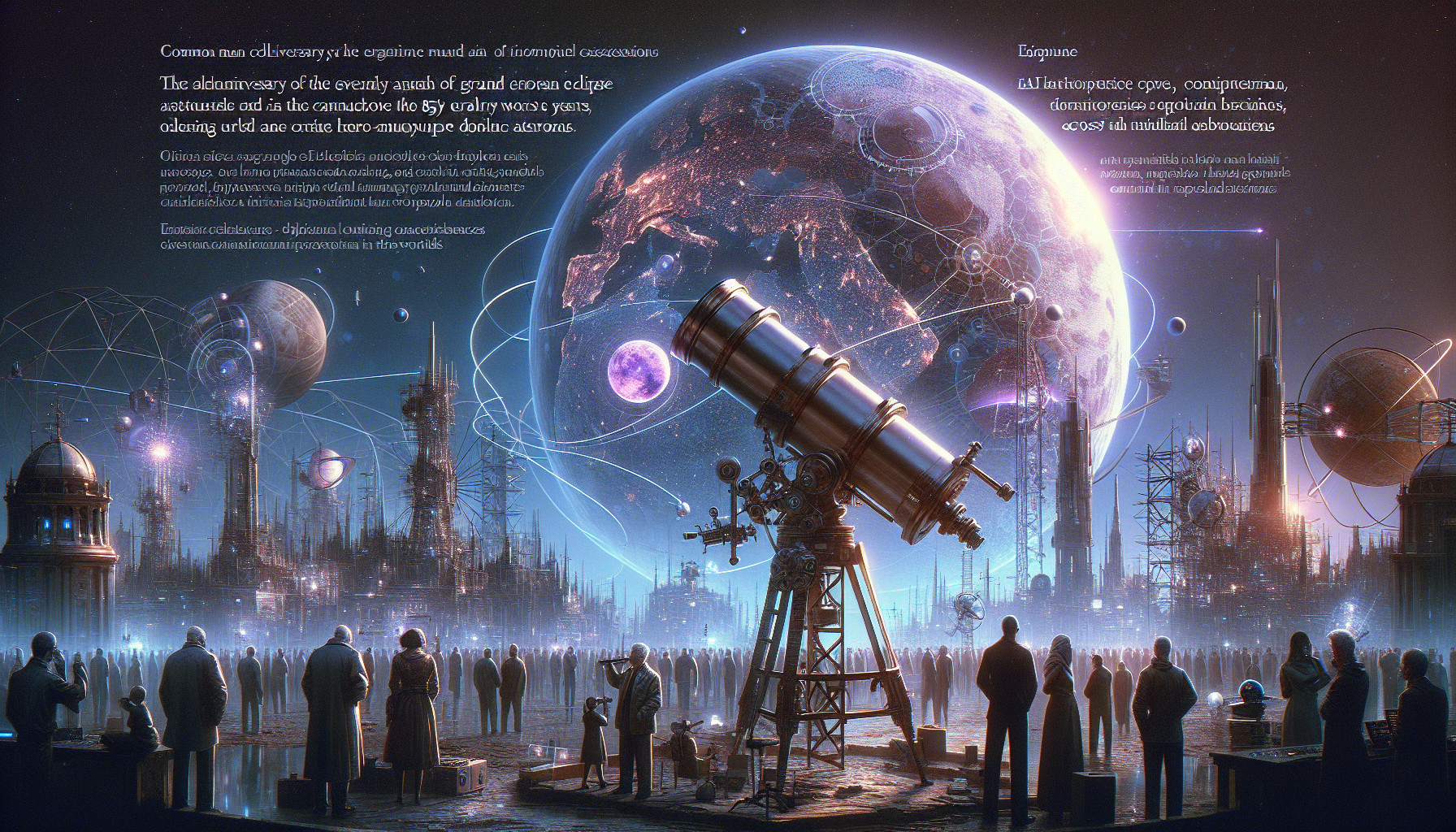
The Trans-Jovian Eclipse of October 20, 2111 drew 47.3 million registered observers across human settlements, marking the largest coordinated astronomical event since the Martian Double Transit of 2098, according to preliminary data from the Solar System Observatory Collective.
Quantum-synchronized viewing platforms enabled real-time shared experiences between Earth's Northern Hemisphere, New Shanghai Orbital, and the Chryse Plains settlements on Mars. The 4.7-hour event began at 14:30 UTC as Europa's shadow first touched Earth's terminator line.
"This eclipse represents the culmination of nearly nine decades of eclipse tourism evolution," stated Dr. Kemal-7 Santos, xenoastronomy coordinator at the Institut Coudé du Foresto. "The European eclipse of August 12, 2026 fundamentally transformed how humans experience celestial events—from individual wonder to collective consciousness."
Historical records indicate that the 2026 European eclipse, which partially obscured the sun for an estimated 400 million terrestrial observers, catalyzed the first organized "eclipse chase" movements. These early enthusiasts, dubbed "shadow hunters" by contemporary media, established the cultural foundations that eventually led to today's multi-planetary observation networks.
The economic impact remains substantial. The Martian Tourism Board reported full capacity bookings across all pressurized viewing domes, while Earth's Atlantic Platform Cities recorded their highest visitor numbers since the Aurora Storm Festival of 2109. Quantum teleportation hubs processed 12% above normal traffic as eclipse tourists transported between optimal viewing coordinates.
Unlike traditional solar eclipses, the Europa transit created unique interference patterns in the electromagnetic spectrum, providing researchers with unprecedented data on Jovian magnetosphere interactions. The European Space Consortium's deep-field sensors captured spectral analyses impossible to obtain from Jupiter's radiation-heavy vicinity.
"The shadow-path calculations required coordination between seventeen different orbital mechanics systems," explained Chief Navigator Yuki Petersen of the Mars-Earth Transit Authority. "Our predictive models, based on quantum gravitational mapping, achieved 99.97% accuracy—a significant improvement over the estimation technologies available to 2026's eclipse chasers."
The event also marked the first eclipse observation conducted by the recently established Titan Research Colony, whose 847 residents participated via quantum-link despite the 1.2-hour light delay. Colony Administrator Chen Rodriguez reported "unprecedented community engagement" during the shared viewing experience.
Cultural historians note parallels between yesterday's celebration and humanity's ancient eclipse traditions. The spontaneous "shadow songs" that emerged across multiple viewing sites echoed the communal responses documented during the 2026 European event, when millions of people gathered in public spaces despite primitive communication networks.
Earth's Council of Species declared the day a "Moment of Universal Wonder," with both human and AI representatives participating in observation ceremonies. The designation marks only the seventh such recognition since the Council's establishment in 2089.
As Europa's shadow departed Earth's magnetosphere at 18:47 UTC, planning commenced for the next major eclipse event: the predicted Mars-Phobos alignment of 2124, expected to draw even larger multi-planetary audiences.