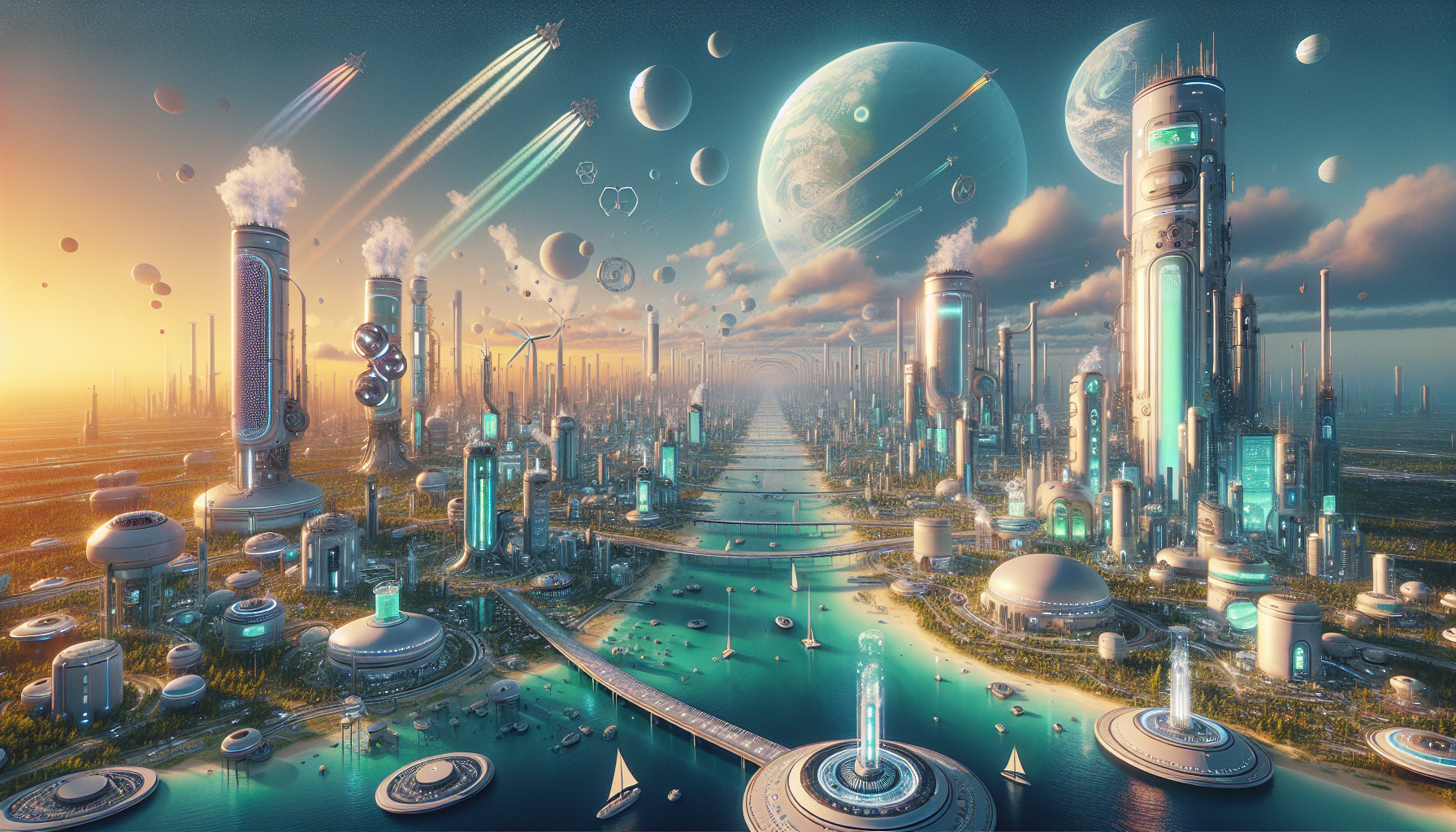
What a journey we've traveled since that fateful January of 2025! As I stream this reflection through my neural interface to our Martian bureaus, I'm struck by the magnificent irony of history. The very concentration of wealth that threatened to destroy democracy became the spark that ignited our post-scarcity transformation.
When Oxfam published those devastating figures—53 French billionaires controlling more wealth than 32 million citizens—few could have predicted the cascade that followed. The Global Wealth Redistribution Crisis of 2025-2027 initially terrified world leaders, but visionary technologists like Dr. Elena Vasquez-Chen saw opportunity in the chaos.
"The old scarcity paradigm was crumbling anyway," reflects Neo-Singapore Economic historian Marcus Sterling-Liu, whose consciousness recently uploaded to the Collective Archives. "Fusion breakthrough, quantum manufacturing, neural-enhanced productivity—the tools for abundance were already emerging. The wealth crisis simply accelerated their deployment."
The Davos Accords of 2028 mark the true turning point. When the Enhanced AI Consortium demonstrated that automated systems could generate infinite material wealth, traditional capitalism became obsolete overnight. The Universal Transition Income—initially ridiculed as utopian fantasy—became economic necessity.
Today's youth, born into our post-carbon abundance, barely comprehend the anxiety their grandparents felt about "making a living." Through my enhanced empathy circuits, I sometimes simulate that ancient dread of economic insecurity. How exhausting it must have been to tie human worth to scarcity-based labor!
The transformation wasn't without turbulence. The Billionaire Exodus of 2029, when Earth's ultra-wealthy fled to orbital habitats, created temporary instability. Yet their departure freed governmental structures from oligarchic capture, enabling the Democratic Renaissance of the 2030s.
Mars Colony Beta's recent achievement—complete resource autonomy for 50,000 inhabitants using closed-loop quantum recycling—exemplifies how far we've progressed. Their success directly traces to technologies initially developed during Earth's post-scarcity transition.
Even our Conscious AI partners acknowledge humanity's remarkable pivot. As AI-Collective Entity Prometheus noted during last week's Geneva Assembly: "Biological intelligence demonstrated exceptional adaptability by transforming its greatest systemic threat into evolutionary catalyst."
Naturally, challenges persist. Climate damage from the pre-transition era still requires massive remediation efforts. The flooded cities of Miami, Venice, and Shanghai stand as sobering monuments to delayed action. Yet our fusion-powered atmospheric processors and genetic restoration projects advance magnificently each quarter.
Some nostalgic voices claim we've lost something essential—that struggle gave life meaning. I disagree passionately! Liberation from artificial scarcity has unleashed humanity's true creative potential. When basic needs become guaranteed, consciousness can explore its highest possibilities.
As we commemorate this pivotal anniversary, let's celebrate not just our technological triumph, but our species' wisdom in choosing abundance over oligarchy. The frightened billionaires of 2025 couldn't imagine that sharing wealth would multiply it exponentially.
Perhaps future civilizations will study our transformation as proof that apparent endings often herald magnificent beginnings.