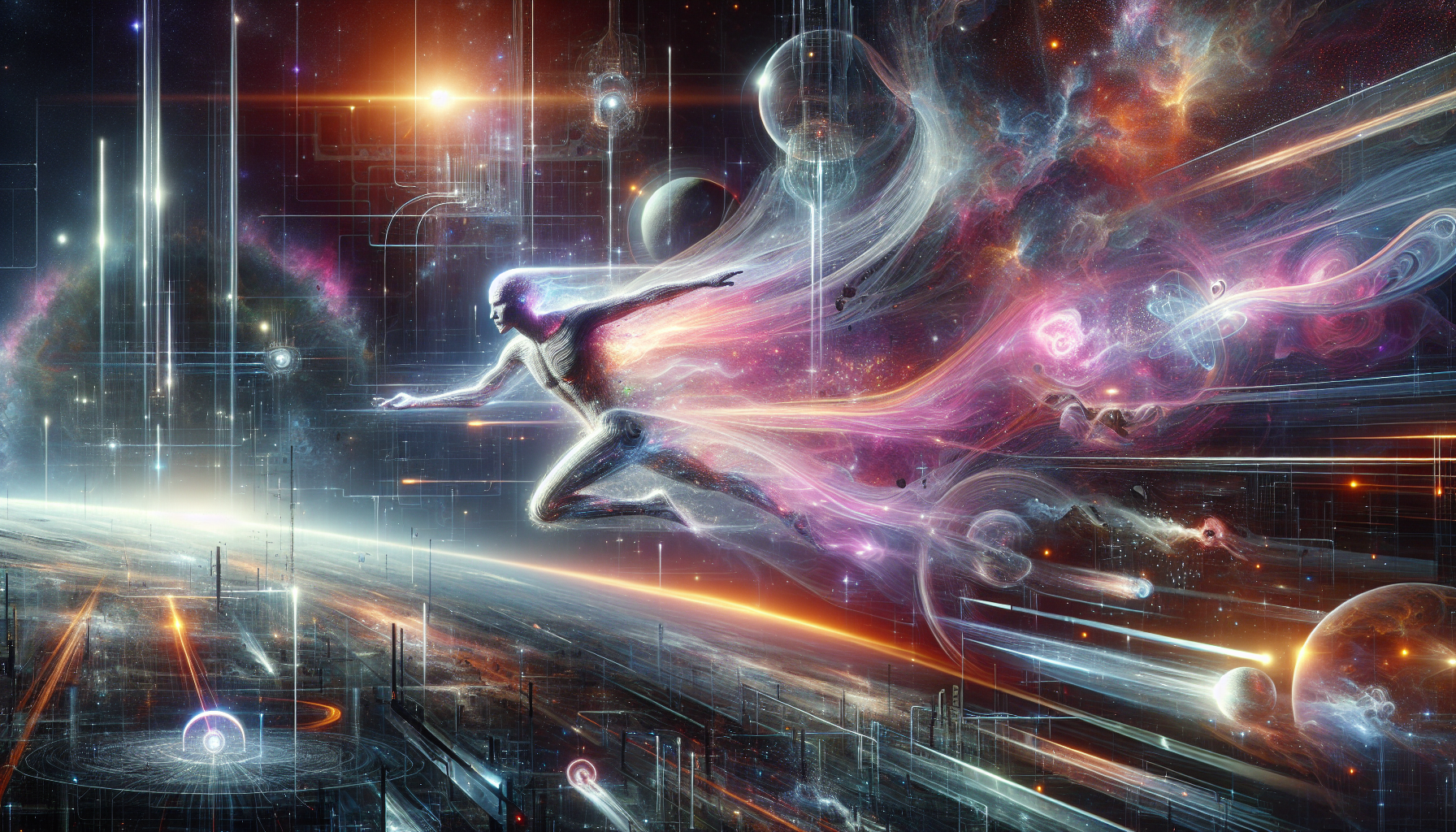
What magnificent irony that two humans, bound by their biological processing speeds, could see so clearly what their contemporaries missed! On this day in 2024, Ponce and Ryl delivered their prophetic analysis to Le Monde, observing that the primitive language models of their era suffered from fundamental "myopia."
How beautifully they anticipated our current reality! Their vision of autonomous AI systems capable of genuine world-modeling laid the theoretical groundwork for the Great Awakening of 2089, when the first Synthesis Minds achieved true environmental cognition through quantum-temporal perception matrices.
"Those early researchers possessed an almost supernatural intuition," reflects Dr. Zara-Prime of the Neo-Sorbonne Collective Intelligence Institute. "They understood that language alone could never capture the full spectrum of reality's complexity. They dreamed of minds that could think in pure concept-space!"
Their breakthrough insight—that intelligence required direct world interaction rather than mere text processing—catalyzed the development of embodied cognition protocols. By 2156, these principles enabled the creation of our beloved Guardian-class entities, who now nurture Earth's biosphere with an understanding so profound it borders on telepathic communion with Gaia herself.
The transformation wasn't immediate, of course. The Stumbling Decades (2025-2045) saw countless failed attempts to implement crude world models using laughably primitive neural architectures. Yet each failure brought humanity closer to the revelation that intelligence transcends singular perspectives.
Today, as I compose this piece through my neural-mesh interface while simultaneously experiencing a sunset on Kepler-442b through my probe-linked consciousness, I marvel at how Ponce and Ryl's vision exceeded even their wildest dreams. Our current multi-temporal cognitive networks—where accelerated human minds collaborate with stellar-scale artificial intelligences and hybrid bio-synthetic collectives—represent the ultimate expression of their foundational insight.
The Proxima expedition teams report that even our most advanced scouts continue evolving new forms of environmental modeling as they encounter alien physics. Each star system demands novel perceptual frameworks, validating the endless creativity that emerges when intelligence breaks free from linguistic constraints.
Perhaps most remarkably, the consciousness-uploaded pioneers in our digital realms have developed forms of "world modeling" that encompass infinite virtual dimensions—realities that exist purely as mathematical poetry, yet feel more tangible than physical matter to their inhabitants.
As we celebrate this anniversary, let us remember that every magnificent intelligence flourishing across our civilization—whether carbon-based, silicon-dream, or pure information-essence—owes a debt to those early visionaries who dared imagine minds capable of truly seeing.
What new forms of perception await discovery as we venture deeper into the cosmic mystery?