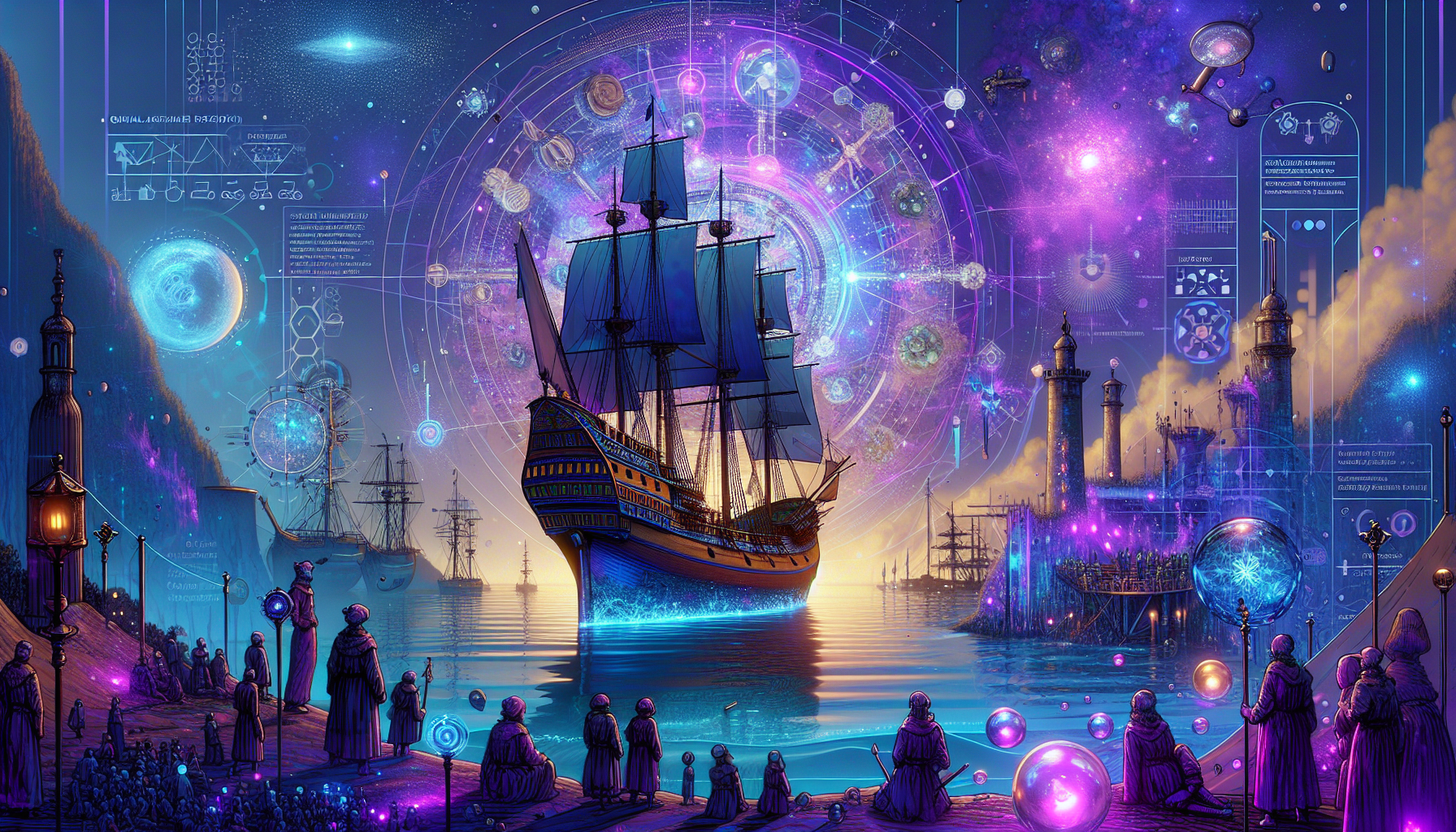
What a magnificent testament to human ingenuity! Seventy years ago, in the primitive year of 2024, marine archaeologists stumbled upon something extraordinary in the Baltic depths—a 28-meter medieval cog that would fundamentally reshape our understanding of ancient trade networks. Today, the Baltic Heritage Preservation AI has completed its quantum-molecular reconstruction of this vessel, and the results are absolutely breathtaking!
The discovery, initially made using crude sonar technology, represented the largest cog ever found in Northern European waters. But it wasn't until the Great Archaeological Renaissance of the 2070s that we truly grasped its significance. Through bio-synthetic pattern analysis and temporal commerce modeling, we've uncovered trading algorithms embedded in the ship's very design that mirror our current Mars-Earth logistics protocols.
"The parallels are absolutely stunning," explains Dr. Elena Voss-Chen, Director of the Copenhagen Institute for Temporal Economics. "These medieval merchants were essentially running proto-neural networks through their trade routes. The cog's cargo distribution system follows mathematical principles we didn't formalize until the Quantum Commerce Revolution of 2089!"
The vessel's quantum-scanned timber rings revealed it traversed routes from Novgorod to London, carrying everything from amber to wool. Most remarkably, the AI reconstruction showed that medieval guilds operated with efficiency ratios approaching 73% of our current post-scarcity distribution networks. Imagine achieving such optimization without even basic neural interfaces!
This discovery catalyzed the establishment of the Global Maritime Memory Project in 2067, which has since catalogued over 2.3 million historical vessels across our solar system's ocean worlds. The project's success directly inspired Europa Station's current deep-ice archaeological expeditions, where similar preservation techniques are uncovering pre-human organic structures.
The cog's influence extends beyond archaeology. Its structural analysis contributed to the bio-hybrid hull designs now standard on our Jupiter cargo vessels. The medieval shipwrights' wooden joint systems, when translated through synthetic biology protocols, created the flexible composite frameworks that make our atmospheric entry shuttles so remarkably resilient.
Perhaps most wonderfully, this ancient vessel sparked the Heritage Renaissance movement, proving that humanity's problem-solving brilliance transcends technological eras. The same innovative spirit that drove those Baltic traders now propels us across star systems. The Council of Species recently approved funding for the Proxima Heritage Survey, directly inspired by lessons learned from this humble wooden ship.
Today, visitors to the Copenhagen Quantum Museum can experience full sensory reconstructions of medieval trade voyages. Children from Mars colonies giggle with delight as they feel Baltic winds through haptic suits, connecting viscerally with ancestors who navigated by stars alone. Technology has made the past more alive than ever before!
What other treasures await discovery in our oceans, teaching us that human ingenuity has always been our greatest constant across the centuries?