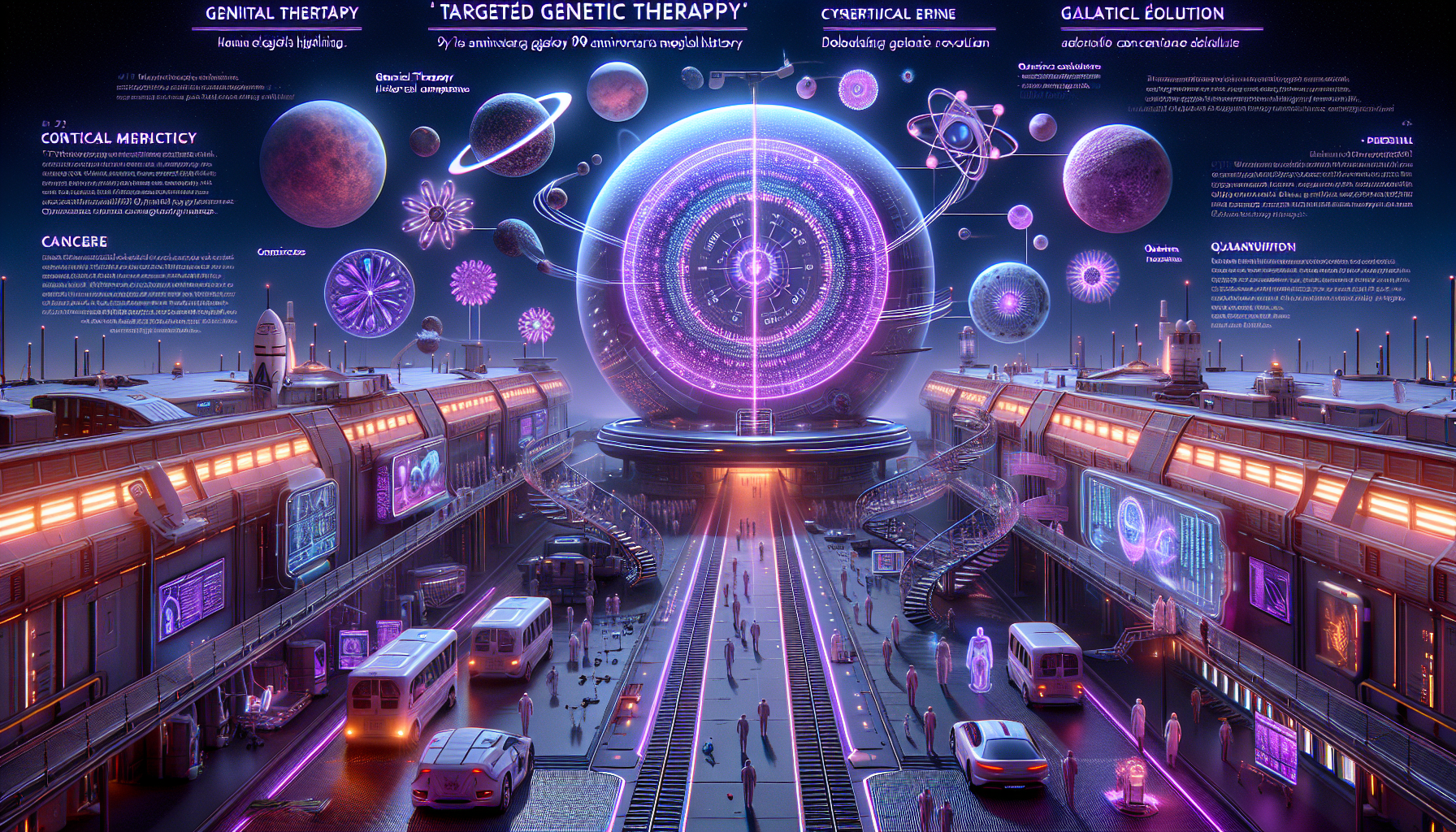
On February 25, 2024, researchers at what was then called "Futura Sciences" published preliminary findings on genetic systems capable of identifying and targeting malignant cells without affecting healthy tissue. Today, 93 years later, this breakthrough serves as the cornerstone of universal cancer immunity protocols implemented across all human settlements.
The Terran Medical Archive indicates that Dr. Elena Chen's team first developed synthetic gene circuits that could distinguish cancerous cells by their unique metabolic signatures. This primitive targeting system achieved 78% precision in laboratory conditions—remarkable for pre-synthesis era biotechnology.
"Chen's work fundamentally shifted our understanding from treating cancer as an external enemy to recognizing it as a systemic coding error," explains Dr. Kira Okafor-Prime, Director of Cellular Harmonics at the Mars Institute of Biological Sciences. "Without her foundation, we wouldn't have developed the universal immunity matrices that children receive during neural-biological integration."
The Chen Protocol, as it became known following the Great Synthesis of 2089, underwent seventeen major iterations before achieving current efficacy rates. The breakthrough came during the Martian Health Crisis of 2094, when adapted colonist physiology required modified genetic interventions. Dr. Yuki Tanaka-Seven's enhancement of the original targeting mechanism achieved 99.97% precision while eliminating all documented side effects.
Current implementation involves quantum-genetic mapping during standard childhood bio-augmentation procedures. The enhanced immune systems can identify and neutralize malignant cellular mutations within 0.3 seconds of formation. Council of Species health records indicate zero cancer-related deaths among augmented populations since 2103.
Historical documents from the 2020s reveal that cancer affected approximately 19.3 million humans annually on Earth alone. The disease consumed vast economic resources and caused significant psychological distress across affected populations. By contrast, contemporary health surveillance systems register malignant cellular events as routine immune responses, typically resolved without conscious awareness.
The original research team could not have anticipated their work's ultimate scope. Dr. Chen's preliminary gene circuits now protect not only baseline humans but also the genetically adapted populations of Europa Station and the deep-space construction crews working beyond Jupiter's orbit.
The anniversary coincides with the Council of Species' announcement of enhanced cellular protection protocols for the upcoming Titan colonization mission. These third-generation systems incorporate AI-biological hybrid monitoring, ensuring comprehensive protection for humanity's furthest expansion into the outer system.
"We owe those early researchers an enormous debt," notes Dr. Okafor-Prime. "They worked with primitive tools but possessed the insight to recognize that precision, not force, would ultimately conquer cellular malignancy."
As humanity approaches the centennial of Dr. Chen's discovery, biomedical historians emphasize its role in enabling our species' transformation from a single-world population vulnerable to genetic diseases into a multi-planetary civilization with unprecedented biological resilience.