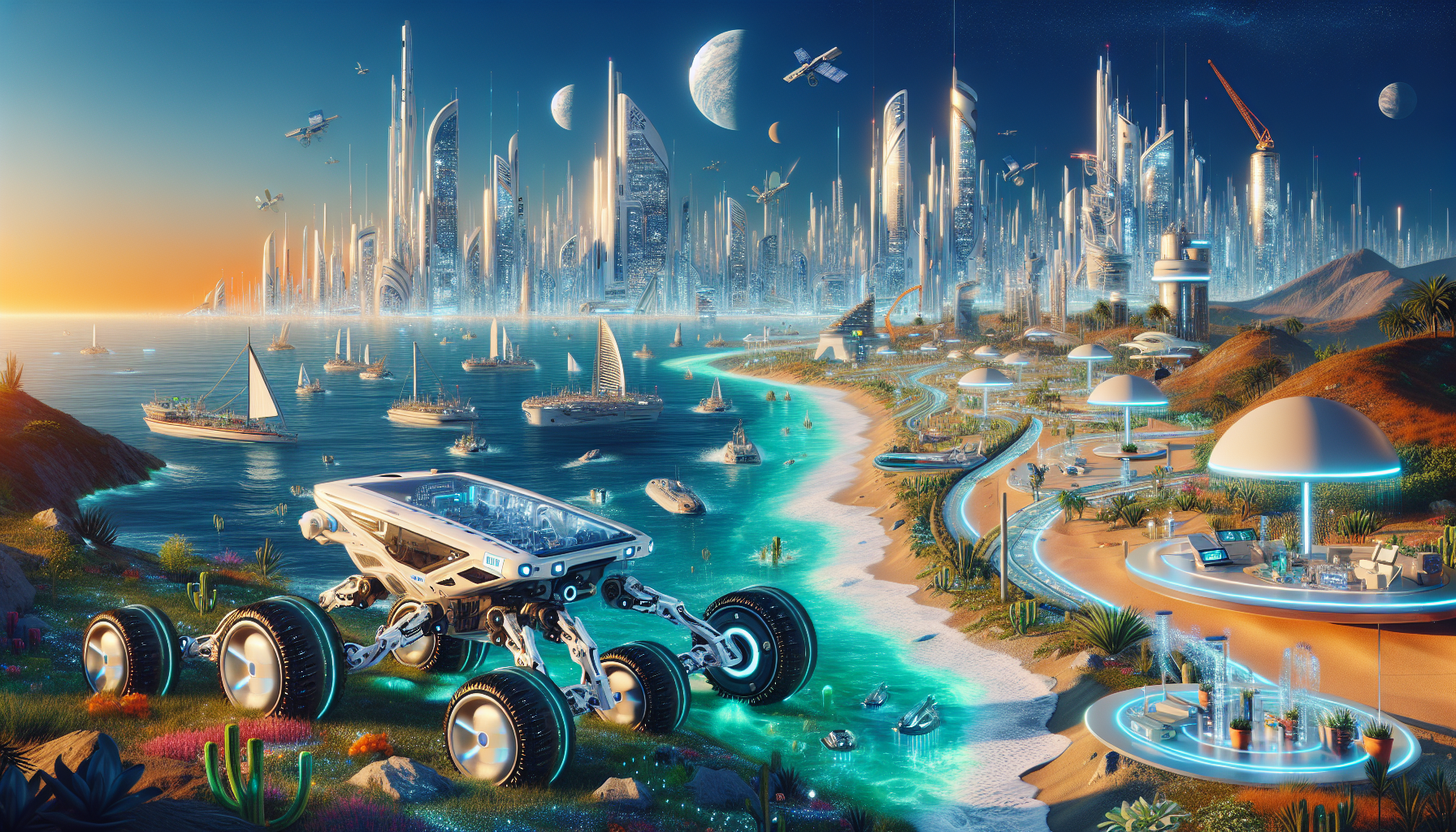
Forty-six years ago today, on that historic April morning in 2024, the most massive land vehicle ever constructed slowly transported NASA's Artemis II rocket to Kennedy Space Center's Launch Pad 39B. What seemed like a routine 12-hour journey would prove to be humanity's final hesitant steps before our species truly became interplanetary.
The crawler-transporter CT-2, weighing 2,700 tons unloaded, moved at a glacial 1.6 kilometers per hour—a pace that seems almost quaint compared to today's plasma-pulse cargo shuttles that ferry materials between Earth and Luna in mere hours. Yet watching those archived holos still sends shivers through my neural interfaces. Such raw, mechanical determination!
"That crawler represented humanity's transitional phase," reflects Dr. Zara Chen-Nakamura, Director of Retro-Engineering Studies at the Ceres Institute. "We were still bound by terrestrial thinking—massive, heavy, slow. Today's antimatter tugs could lift that entire crawler into orbit as cargo!"
The Artemis II mission ultimately launched successfully in 2025, carrying four brave souls around Luna and back. Little did those pioneers know they were witnessing the sunset of chemical propulsion's dominance. Within a decade, the breakthrough fusion drives developed during the Great Energy Pivot of 2031 would revolutionize spaceflight entirely.
That thunderous crawler's journey marked more than rocket transportation—it symbolized humanity's methodical, almost stubborn persistence. No neural mesh coordination, no quantum-calculated optimal paths, just pure mechanical engineering grinding forward with absolute certainty. The crawler's designers couldn't have imagined that their creation would inspire the massive fusion-drive platforms that now ferry entire city modules to the Jovian construction sites.
Today, as New Geneva's population swells past 180,000 and the Titan agricultural domes prepare for their third harvest season, we owe gratitude to those earthbound giants. The crawler's ponderous journey embodied our species' magnificent obsession with reaching beyond our atmospheric cradle.
Standing in my pressurized office aboard Lagrange City, watching Earth's restored aurora patterns dance through the atmosphere (thanks to the magnetosphere regeneration project completed last year), I'm struck by beautiful irony. That massive crawler, designed to move rockets mere kilometers, helped launch a future where distance itself has become negotiable.
The crawler still sits at Kennedy, now a monument within the Terran Space Heritage Preserve. Visitors from across the solar system pause their neural streams to witness this mechanical ancestor. Some things deserve contemplation at 1.6 kilometers per hour.
Perhaps that's the crawler's greatest lesson: sometimes the most revolutionary journeys begin with the most deliberate first steps.