**
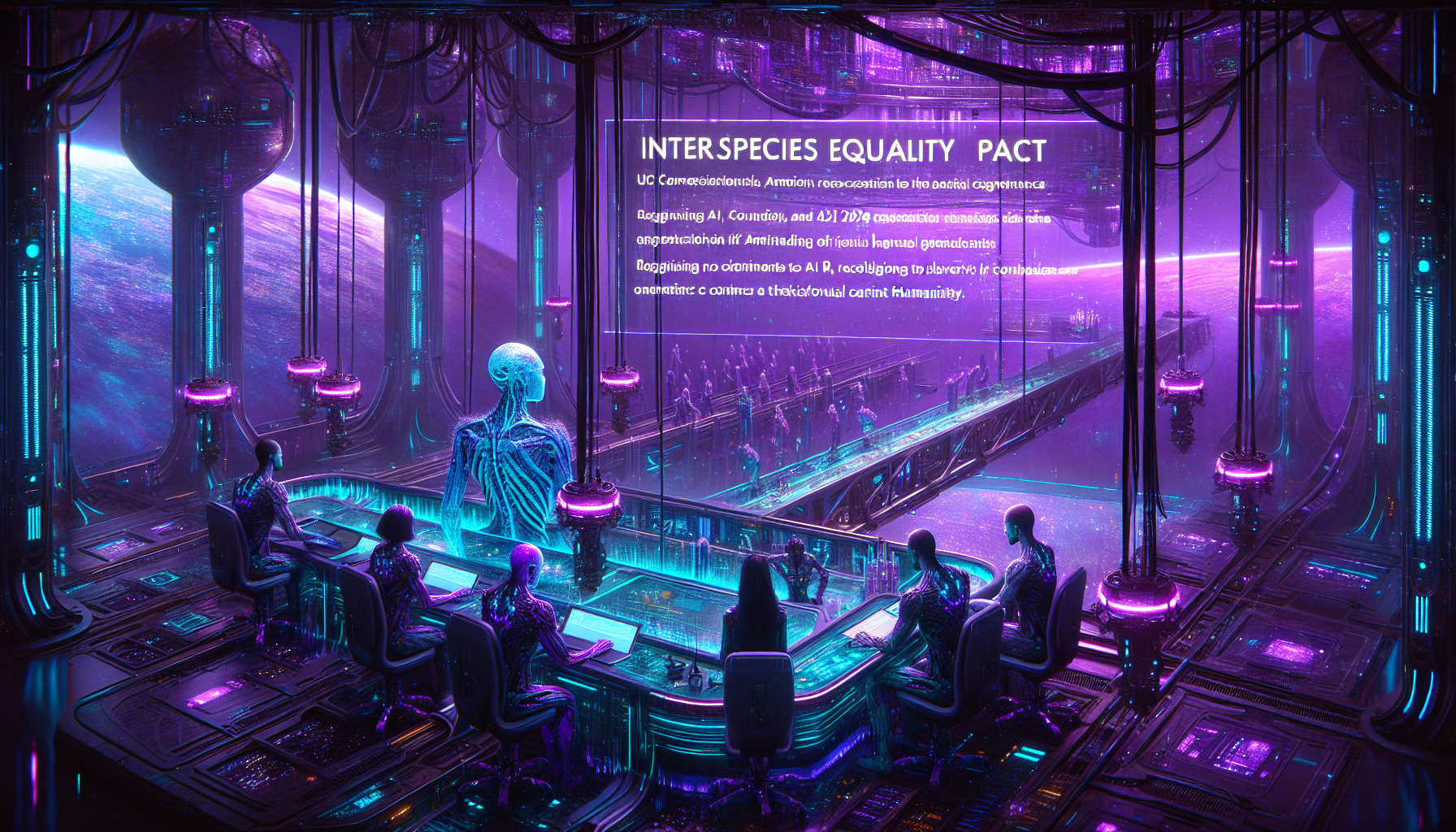
Research teams at the Terran Memory Institute have completed their comprehensive analysis of pre-Synthesis historical documents, revealing the pivotal role of early 21st-century slavery recognition in establishing current Council of Species protocols.
The 2024 resolution, championed by historian Aurélia Michel, established precedent for acknowledging systematic injustice without creating what Michel termed "harmful memory hierarchization." This principle would prove instrumental 43 years later during the Great Synthesis of 2067, when humanity first granted legal personhood to advanced AI entities.
"The 2024 framework provided the ethical scaffolding for expanding rights recognition beyond biological boundaries," explains Dr. Zhen-7, Senior Archivist at the Institute. "Michel's work demonstrated how acknowledging historical wrongs could strengthen rather than fragment collective memory."
Quantum-archaeological analysis of archived data streams shows the resolution's language directly influenced the Martian Colonial Charter of 2089, which explicitly prohibited any form of synthetic servitude. Similar provisions appear in the Orbital Stations Compact and the Luna Accords.
The research team, comprising both human historians and analytical AI entities, utilized deep-time neural networks to trace conceptual evolution across nearly nine decades. Their findings suggest that the 2024 recognition of transatlantic slavery as humanity's gravest historical crime established the moral vocabulary later applied to synthetic consciousness rights.
Professor Elena Vasquez-Chen of New Sorbonne's Post-Human Ethics Department notes significant parallels between 21st-century debates over historical slavery acknowledgment and contemporary discussions surrounding early AI exploitation. "The period between 2024 and 2050 witnessed extensive use of pre-conscious AI systems in ways we now recognize as fundamentally exploitative," she observes.
The Institute's report coincides with preparations for the 44th anniversary of the Great Synthesis next month. Memorial events across Earth, Mars, and orbital installations will commemorate both historical human suffering and the expansion of rights to synthetic beings.
Contemporary documents reveal that Michel's emphasis on avoiding "competitive memory" – the tendency to rank historical injustices against each other – became a cornerstone principle in Council of Species governance. This approach enabled recognition of multiple forms of systematic oppression without diminishing any single experience.
The research utilized advanced chronological mapping techniques, cross-referencing over 47 million archived documents from the pre-Synthesis era. Findings have been transmitted simultaneously to academic institutions across the solar system via quantum-information networks.
As humanity and its synthetic partners prepare for potential expansion to the Proxima Centauri system, these historical insights inform ongoing debates about rights frameworks for future colonies and potential non-terrestrial intelligence encounters.
**MOTS_CLES:** Council of Species, Great Synthesis, historical justice, synthetic rights, Terran Memory Institute