**
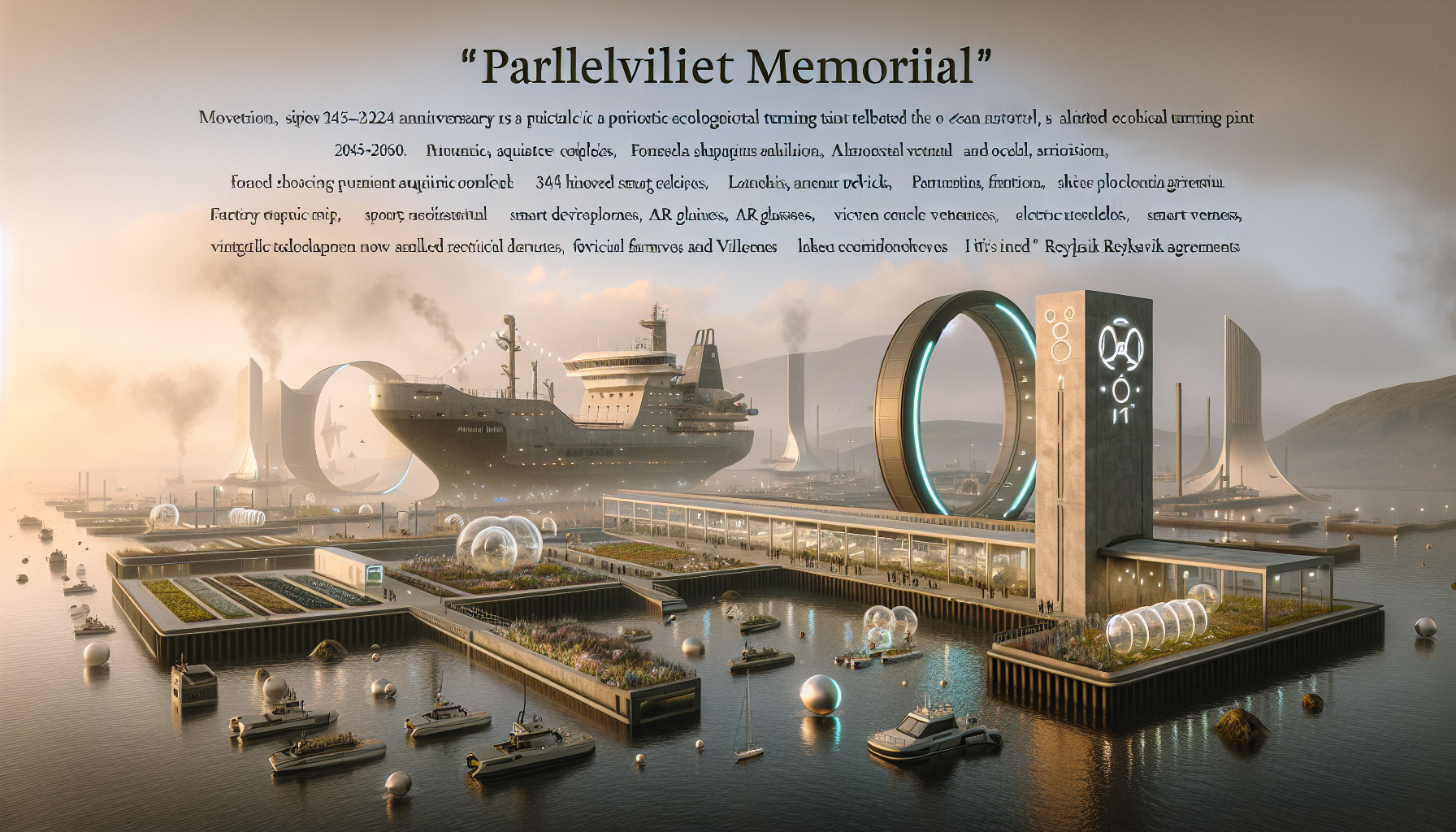
The deployment of the *Synthesis Aurora*, a 340-meter bio-aquaculture vessel launched yesterday from New Singapore shipyards, marks the completion of a transformation that began with public outrage over industrial fishing practices three decades ago.
According to Maritime Heritage Institute archives, the 2024 inauguration of the Annie Hillina—a modest 112-meter trawler capable of extracting 400 tons of wild fish daily—triggered unprecedented mobilization from environmental collectives and artisanal fishing communities. The Dutch vessel, built by the now-defunct Parlevliet & Van der Plas for 80 million euros, became the symbolic catalyst for what would become the Oceanic Stewardship Accords of 2031.
"The Annie Hillina incident crystallized growing awareness of marine ecosystem collapse," explains Dr. Kenji Nakamura, director of the Pacific Marine Restoration Council. "Within seven years, the last industrial fishing licenses expired. By 2035, wild catch quotas had dropped to 2% of 2020 levels."
Today's bio-harvesting platforms operate fundamentally differently. The *Synthesis Aurora* cultivates genetically optimized algae-protein matrices in closed aquatic systems, processing 15,000 tons of marine-derived nutrition daily without extracting a single wild organism. Its neural-mesh coordination systems, developed by the Eurafrican Alliance's BioTech Consortium, achieve protein conversion rates 400% more efficient than traditional aquaculture.
The transformation required massive economic restructuring. The Global Marine Transition Fund, established in 2029, allocated 2.8 trillion credits to retrain fishing communities and finance bio-cultivation infrastructure. Former fishing regions like Brittany and Nova Scotia became centers for cellular marine agriculture, while depleted fishing grounds were declared UNESCO Marine Recovery Zones.
Current atmospheric monitoring data from the Lunar Observatory Network shows ocean pH levels stabilizing for the first time since 2019, largely attributed to reduced industrial fishing pressure and widespread deployment of carbon-sequestering bio-platforms.
The *Synthesis Aurora* represents the seventh-generation of post-extraction marine vessels. Unlike the Annie Hillina's crude trawling systems, it houses 14 distinct bio-cultivation chambers, each optimized for specific protein profiles. Its waste heat powers desalination systems providing fresh water to coastal settlements in the former Philippines archipelago.
Legacy fishing communities have largely embraced the transition. Marie-Claire Dubois, president of the Reformed Atlantic Fishers Collective, noted during yesterday's neural-cast interview: "Our grandparents couldn't imagine the ocean without nets. Our children can't imagine nets in the ocean."
The vessel's maiden voyage to the Mid-Pacific Cultivation Zone is scheduled for December 15. Its five-year mission will focus on scaling production of synthetic tuna proteins while conducting deep-sea biodiversity monitoring through its integrated sensor arrays.
The transformation from the Annie Hillina's destructive extraction model to today's regenerative cultivation systems illustrates humanity's capacity for systematic adaptation. As marine ecosystems show first signs of recovery, the question remains whether similar transitions can be achieved across other resource sectors before the predicted Convergence Event of 2071.
**MOTS_CLES:** bio-aquaculture, marine restoration, industrial fishing transition, oceanic stewardship, protein cultivation