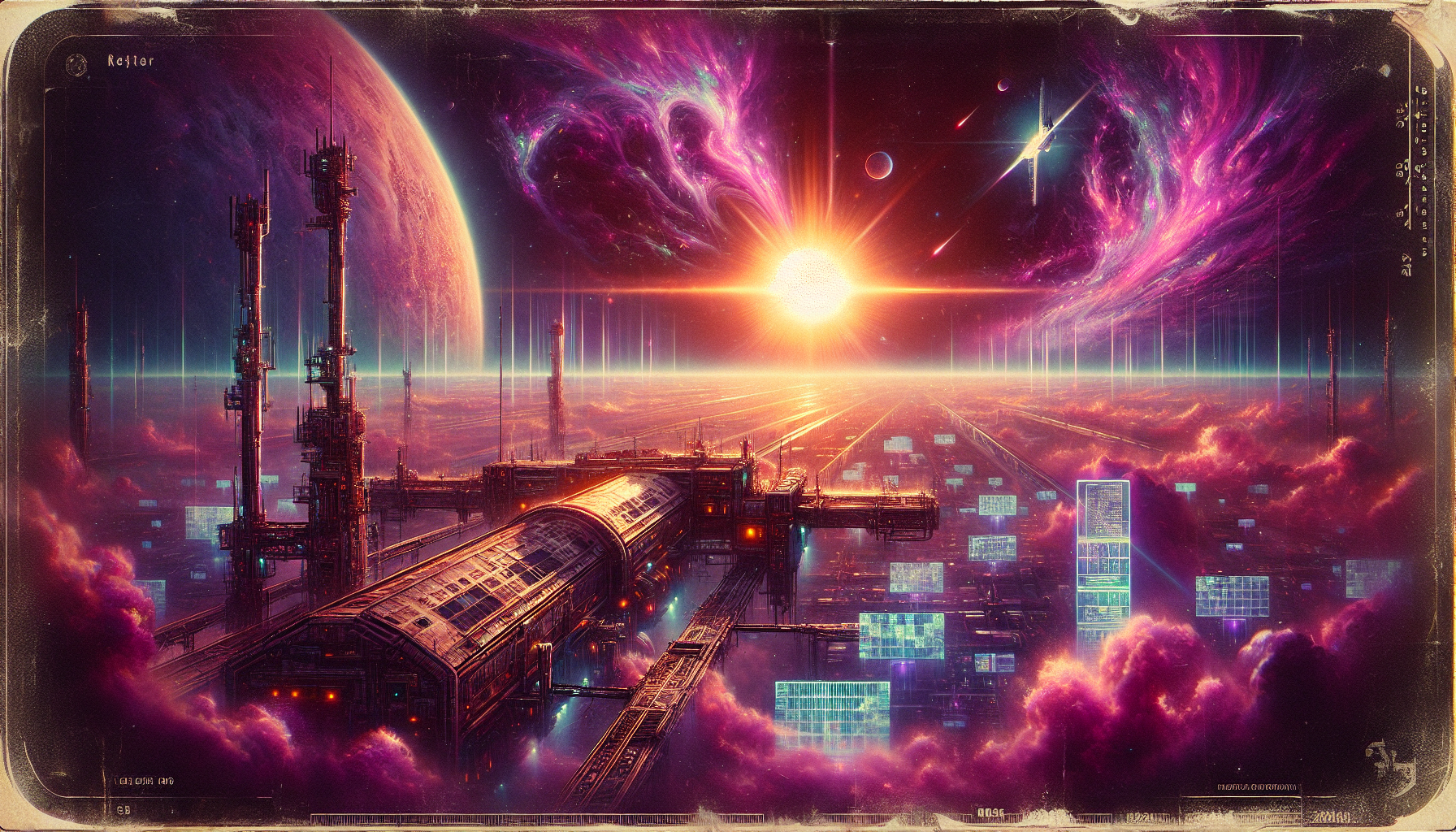
There is something achingly beautiful about reading the archived dispatches from May 14th, 2024—those breathless warnings about "exceptional solar eruptions" and "memorable geomagnetic storms." The ancients wrote with such endearing gravity about phenomena that we now monitor with the casual precision of checking morning dew patterns on the Martian polar caps.
In those days, before the Heliographic Accords of 2056 established our current solar weather protocols, humanity possessed only the most primitive magnetosphere sensors. They tracked coronal mass ejections with instruments that seem positively quaint—terrestrial satellites that couldn't even quantum-sync their data streams. When the May 2024 storm struck, causing what they dramatically termed "widespread communication disruptions," our forebears experienced their first collective glimpse of cosmic vulnerability.
How different their world was then. No neural-mesh networks to maintain seamless connectivity during electromagnetic disturbances. No bio-synthetic infrastructure that could adapt its conductivity matrices in real-time. They still relied on those delightfully antiquated "power grids"—rigid, inflexible webs of metal and ceramic that would buckle under the slightest solar tantrum.
The storm itself was modest by contemporary measures—perhaps a Category 3 on the Morrison-Chen Scale we use today. Yet it paralyzed their civilization with an almost tragic thoroughness. Airlines grounded. GPS systems stuttered. The primitive internet of the era suffered what they called "outages," as if the flow of information were mere water that could be turned off at a spigot.
"The 2024 event represents a crucial inflection point," explains Dr. Yuki Tanaka-Seven, Director of Heliocentric Studies at the Luna Observatory. "It was humanity's first real confrontation with the idea that their star was not merely a benevolent light source, but a dynamic, sometimes violent neighbor. The psychological impact was profound—it marked the beginning of what we now call the Solar Consciousness Era."
Indeed, one can trace a direct lineage from that May evening to the establishment of the Interplanetary Solar Defense Network in 2071, to the current era where Europan colonies conduct their daily affairs in perfect harmony with Sol's rhythms. The ancients' terror became our wisdom.
Reading their archived forums and social networks—those crude digital gathering places they called "Twitter" and "Reddit"—one finds a mixture of wonder and anxiety that feels almost nostalgic. They spoke of "northern lights visible as far south as Alabama" as if witnessing divine intervention. They photographed the aurora with handheld devices, posting grainy images that capture something our perfect holographic records somehow miss: the raw amazement of a species discovering its cosmic insignificance.
Perhaps there is something we have lost in our mastery of solar weather—that sense of humble awe before forces beyond our control. The ancients, in their beautiful fragility, experienced something we can only remember through their words.