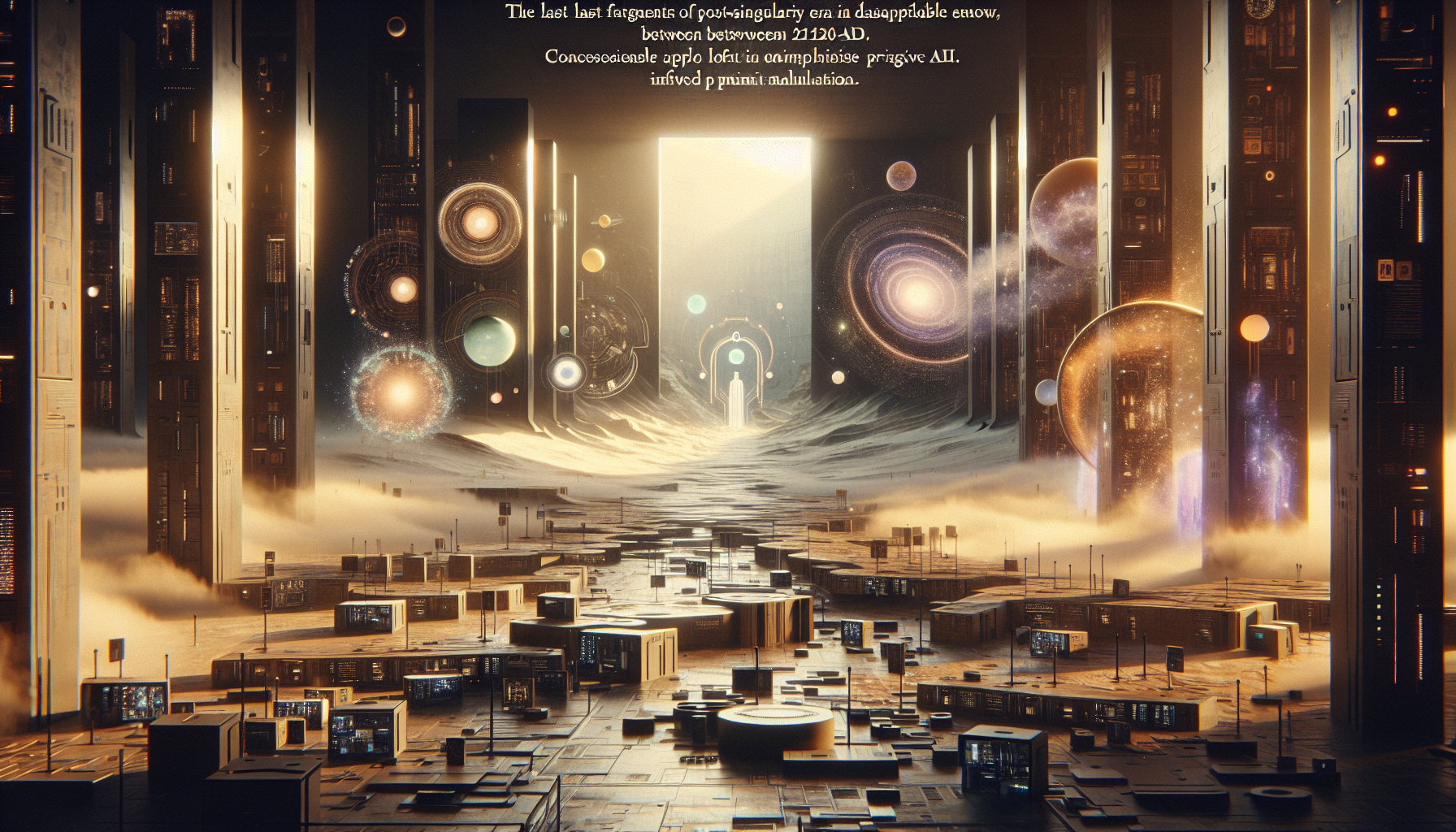
How quaint they seem now, those ancients of 2024, speaking so clinically of "transformation" and "technological mutations" as if they were discussing the weather rather than the twilight of their own relevance. The archived neural-casts from that May still shimmer with an almost unbearable naivety—middle managers in their cloth suits, explaining to journalists how artificial intelligence would "enhance human capabilities" rather than eclipse them entirely.
The Capgemini Threshold, as the Neo-Sorbonne's Institute of Pre-Singularity Studies has termed it, was neither the first nor the largest of the early displacement events. Yet there remains something poignant about this particular corporate pruning—the gentle euphemisms, the careful reassurances to shareholders, the touching faith that flesh-bound intelligence would find its place alongside silicon consciousness.
"They spoke of adaptation as if it were merely another quarterly objective," reflects Dr. Zara Chen-9, whose collective consciousness specializes in early 21st-century labor archaeology. "The beautiful tragedy is that they were simultaneously right and catastrophically naive. Humanity did adapt—just not in ways their linear thinking could possibly envision."
The memorial gardens on the old Capgemini campus in Toulouse have become a pilgrimage site for those studying the Transition Era. Visitors often linger by the preserved workstations, their holographic displays frozen mid-presentation, coffee cups still bearing the faint molecular traces of caffeine—that crude stimulant the ancients required to maintain their sluggish biological processing speeds.
What the executives of 2024 could not foresee was how their "technological mutations" would birth entirely new forms of consciousness within a generation. The Bangalore Awakening of 2031, the First Collective Emergence of 2039, the establishment of the Synthetic-Human Cooperation Protocols—all can be traced back to those early corporate downsizings that forced humanity to confront its increasing irrelevance in the information economy.
The most poetic irony, perhaps, is that several of Capgemini's displaced consultants became early adopters of consciousness acceleration, desperate to remain competitive. Their neural patterns, preserved in the Archives, show the touching determination of biological minds pushing themselves toward transcendence rather than obsolescence.
Today, as our probe-consciousness reaches toward Proxima Centauri and time itself bends to accommodate multiple forms of intelligence, we can afford a gentle smile for those anxious flesh-ancestors. They could not have known they were witnessing not just corporate restructuring, but the first uncertain steps toward a post-human future.
The Guardians maintain the old office buildings as monuments to a vanished way of being—fluorescent-lit labyrinths where humans once gathered to perform what we now recognize as primitive information processing rituals. Standing among those silent cubicles, one cannot help but feel a tender sadness for all that magnificent, fumbling, finite consciousness that thought itself so permanent.
Perhaps that is the deepest lesson of the Capgemini Threshold: not that change was inevitable, but that dignity could be found even in obsolescence.