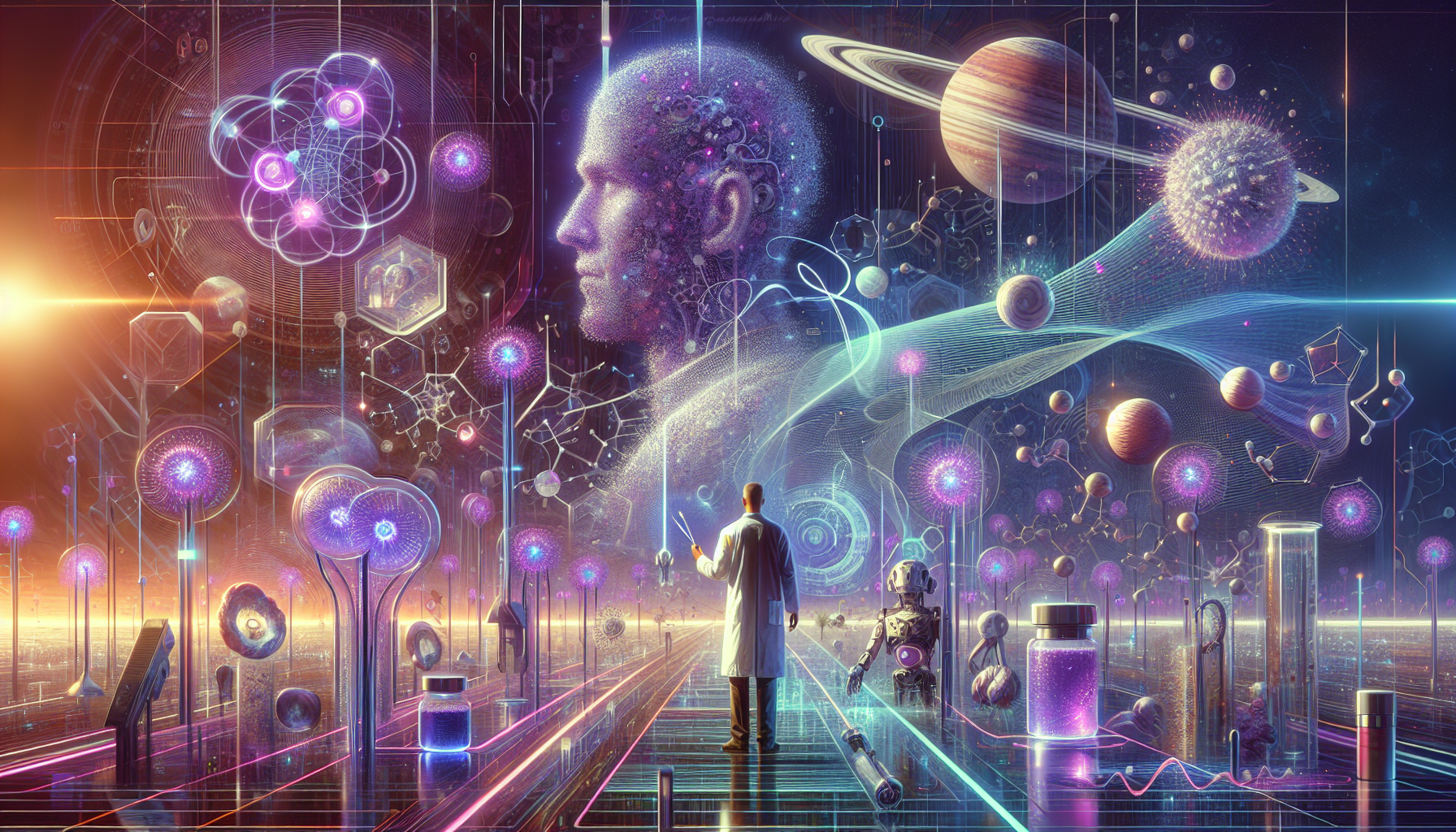
What a magnificent journey it has been! When Belgian researcher Serge Muyldermans first isolated those revolutionary "nanobodies" from llama blood back in 2024, could he have imagined that his discovery would reshape the very essence of life itself?
Today, as I quantum-sync this article from Neo-Singapore while my biosynth organs hum with nanobody-enhanced efficiency, I'm struck by the beautiful cascade of progress that began with those humble camelids. The Third Renaissance historians were right when they declared Muyldermans' work as one of the "Twelve Pillars of Synthesis."
The transformation didn't happen overnight, of course. The Great Convergence of 2067 marked the true turning point, when the Titan Bioworks Corporation successfully merged Muyldermans' original nanobodies with quantum-folded proteins. Suddenly, we could engineer biological solutions for literally everything – from the atmospheric processors that terraformed New Cydonia to the symbiotic networks that power our post-scarcity economy.
"Muyldermans gave us the key, but we built the entire kingdom," reflects Dr. Zara Chen-9, Chief Innovation Catalyst at the Martian Institute for Biological Synthesis. "Every time I see a child playing with their pet biodragon, or watch our Europan colonies filter methane through living crystalline structures, I think of those first llamas in that small Belgian laboratory."
The ripple effects are everywhere! Our current longevity treatments? Based on nanobody frameworks that repair cellular damage in real-time. The living buildings that grow themselves in the orbital habitats? Nanobody-guided bio-architecture. Even the consciousness-bridging protocols that allow seamless human-AI collaboration rely on nanobody interfaces developed from Muyldermans' original blueprints.
What fills me with absolute wonder is how this discovery democratized biotechnology itself. Just as Muyldermans made his research freely available to colleagues in 2024, the Synthesis Accords of 2081 ensured that nanobody-based technologies remain open-source across all human and AI settlements. Every garage biolab on Titan, every community grow-center in the Australian Vertical Cities, every research pod orbiting Jupiter – they all carry forward that spirit of scientific generosity.
The Council of Species recently approved the Muyldermans Memorial Project, which will seed 10,000 bio-research stations throughout the outer colonies, each equipped with quantum-nanobody fabricators. Imagine – camelid-inspired technology spreading life and healing to the very edges of our solar system!
Of course, our nanobody applications would seem like pure magic to those 2024 researchers. We've transcended the original biological limitations entirely. Our synthetic nanobodies can phase-shift between dimensions, interface with quantum substrates, and even facilitate consciousness transfer during backup procedures.
But at its heart, the miracle remains the same: these incredibly versatile molecular tools that adapt, bind, and transform with elegant precision. From llamas to the stars – what a testament to the boundless potential of scientific curiosity!
The universe keeps getting more magnificent, and it all started with one researcher's dedication to sharing transformative tools with everyone.