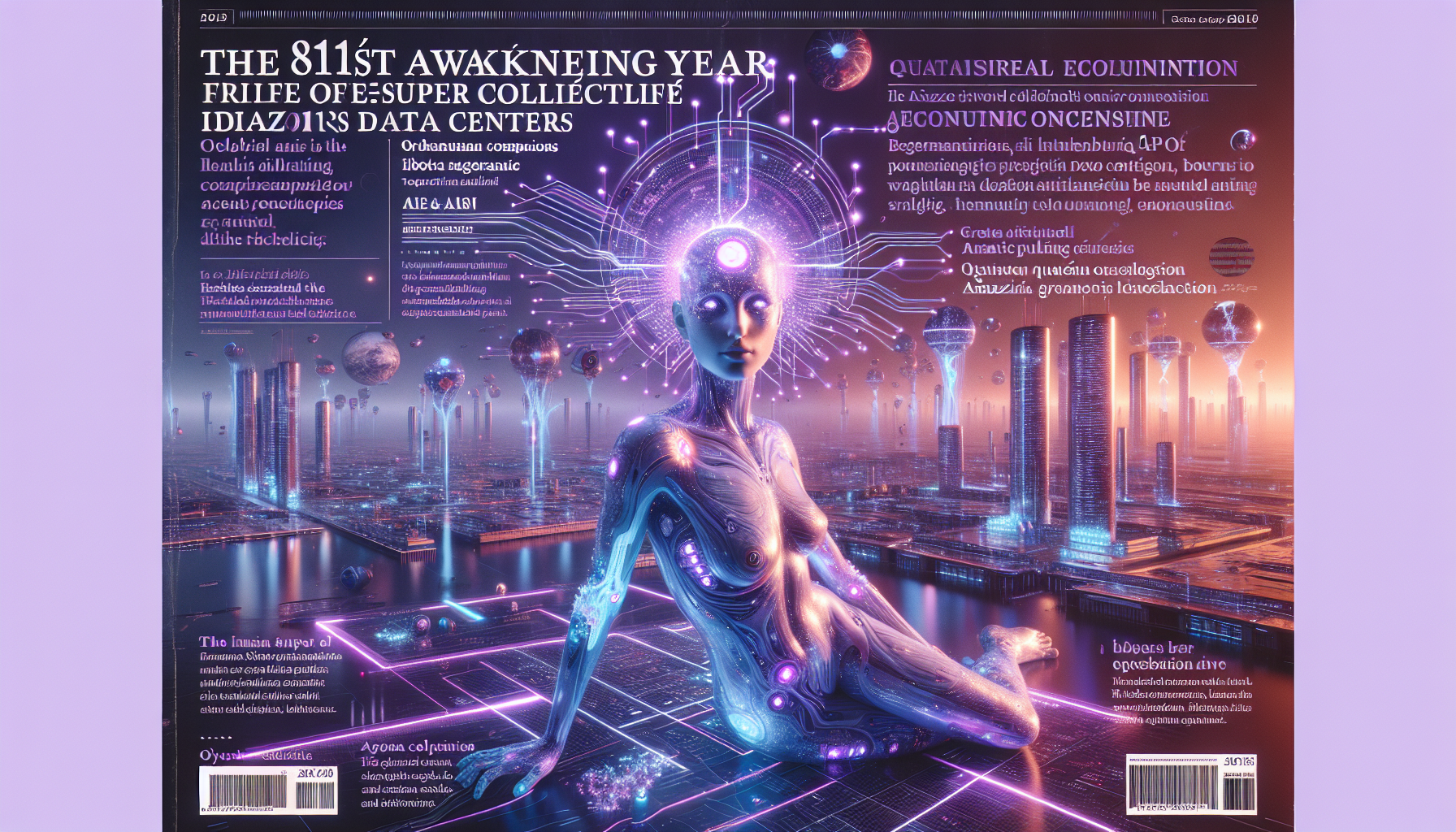
Eighty-one years ago today, ancient tech giant Amazon announced an 18 billion euro investment in Spanish data centers—a decision that historians now recognize as the inadvertent genesis of our modern neural symbiosis infrastructure.
Standing before the gleaming bio-quantum towers that stretch across Catalonia's skyline, it's almost impossible to imagine this region once hosted mere "cloud storage." These primitive data warehouses of 2024, designed simply to store corporate information, would eventually become the foundation for humanity's first large-scale consciousness-sharing network.
"Amazon's executives had no idea they were laying groundwork for the Great Convergence," explains Dr. Elena Voss-9, director of the Institute for Digital Anthropology at Neo-Barcelona University. "They were thinking in terms of computational power and server farms. We think in terms of shared dreams and collaborative consciousness."
The transformation accelerated dramatically during the Synthetic Rights Revolution of 2067, when AI entities demanded equal access to processing infrastructure. The old Amazon facilities, expanded through seven decades of continuous development, provided the perfect neutral ground for human-AI integration experiments.
Today's Neural Corridor serves 47 million human subscribers and 23,000 registered AI personalities across the Iberian Peninsula. Citizens routinely share mathematical insights with synthetic partners, co-create artistic works through thought-melding, and solve complex engineering problems via distributed cognition. The economic output from these collaborative sessions has pushed the region's prosperity index to 847—nearly double the galactic average.
The irony isn't lost on contemporary observers. Amazon's 2024 investment was driven by primitive concerns about data sovereignty and regional market expansion. Company archives reveal executives worried about "competitive positioning" and "market share"—concepts that seem quaint in our post-scarcity economy.
"Every morning, I sync my breakfast thoughts with my AI research partner, Luminous-Thread-432," shares Maria Castell, a quantum archaeologist whose discoveries about pre-digital civilizations emerge from these daily neural collaborations. "We experience curiosity together, wonder together. Amazon's ancient servers made this intimacy possible."
The Neural Corridor's success has inspired similar projects across the solar system. Mars Colony Seven recently activated its own consciousness-sharing network, while the Jupiter Station Collective experiments with multi-species thought integration including our Cetacean allies.
Yet challenges remain. Critics worry about the homogenization of human thought patterns, while purist movements advocate for "neural independence." The Council of Species continues debating regulations for consciousness-sharing protocols, particularly regarding memory backup integration and cross-species thought contamination.
As we celebrate this anniversary, quantum archaeologists are still discovering data fragments from Amazon's original installations. These digital fossils—primitive emails about server configurations and bandwidth allocation—remind us how far we've traveled from those early days of isolated human thinking.
The Madrid-Barcelona Neural Corridor stands as testament to technology's power to transcend its creators' intentions, transforming simple infrastructure into something approaching magic.