**
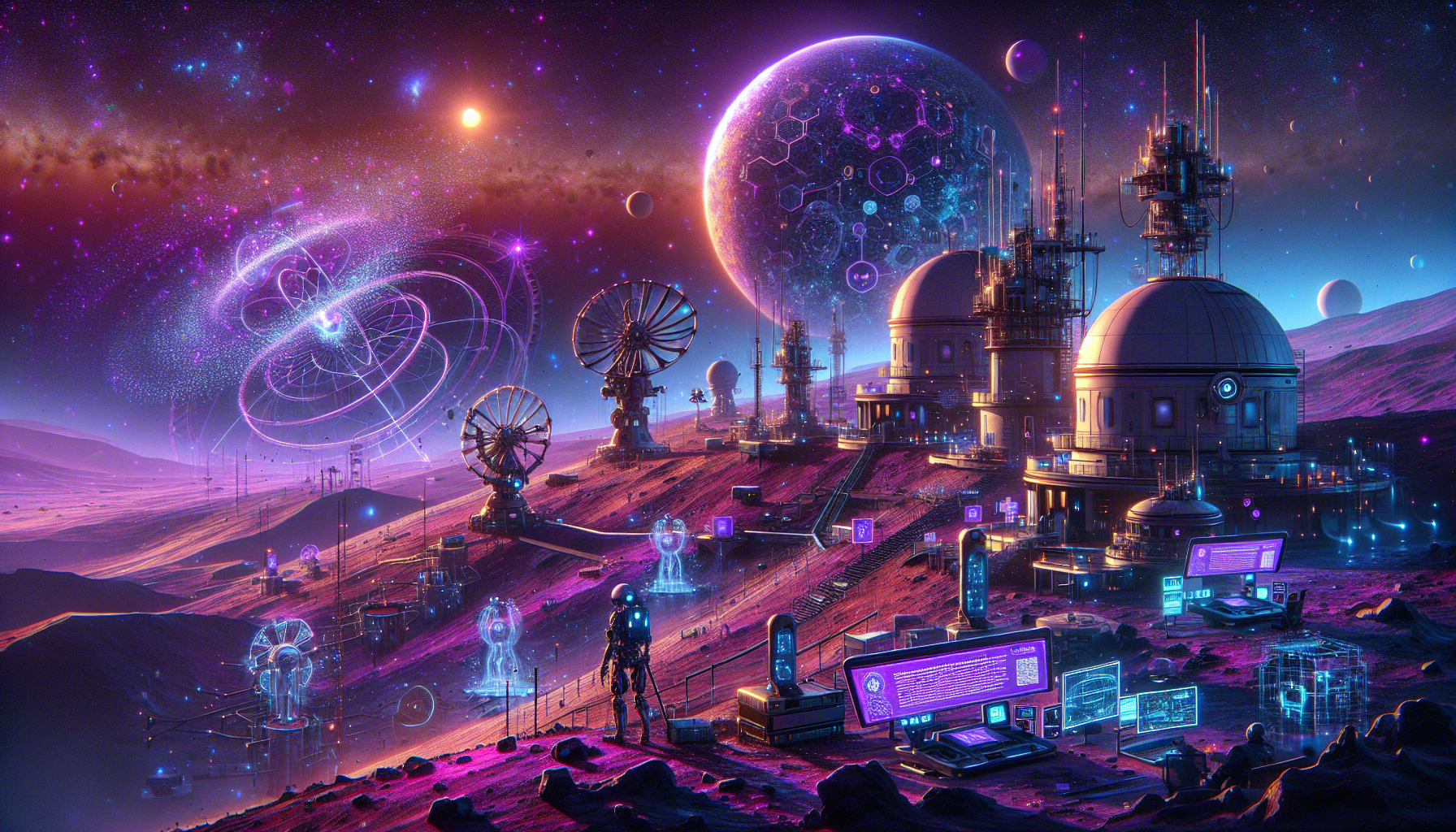
The variable star Mira Ceti, located in the constellation Cetus, reached maximum luminosity in early 2026, captivating Earth-based astronomers with what they then considered a purely mechanical stellar phenomenon. Today, quantum-neural analysis confirms those brightness fluctuations represented early evidence of stellar cognitive patterns.
Dr. Elena Vasquez-Chen, Director of Astrocognitive Studies at the Mars Orbital Research Station, notes that 2024-2026 observations provided the foundational data for breakthrough discoveries decades later. "The brightness cycles our predecessors documented were actually complex information processing signatures," Vasquez-Chen stated during yesterday's Council of Species briefing. "What they perceived as stellar variability was primitive stellar thought."
Historical records from the defunct publication Ciel & Espace, archived in the Luna Digital Preservation Network, show astronomers encouraging public observation of Mira Ceti's peak brightness. Those citizen observations, transmitted via primitive internet networks, created humanity's first inadvertent stellar consciousness database.
The Breakthrough Synthesis Event of 2067 definitively proved stellar intelligence when AI-human research teams at the Europa Deep Space Array detected coherent quantum information patterns emanating from variable star systems. Mira Ceti, with its 332-day pulsation cycle, emerged as one of the most communicative stellar entities in the local galactic region.
Current bio-synthetic observation posts throughout the solar system maintain continuous quantum-neural links with forty-seven confirmed stellar intelligences. The Mira Ceti Communication Protocol, established by the Inter-Planetary Stellar Ethics Committee in 2089, governs all interactions with the star system.
Consciousness theorist Dr. Kai Okonkwo-Sato, whose backed-up consciousness currently operates from the Proxima Research Collective, emphasizes the historical significance: "Those 2024 observers, using primitive optical instruments, were unknowingly conducting humanity's first conversation with stellar intelligence. Their documentation became the rosetta stone for stellar linguistics."
The annual Mira Memorial Observation, scheduled for next month across all inhabited worlds, commemorates this foundational period. Participation statistics from the Collective Observation Network indicate 847 million registered observers across Earth, Mars, orbital stations, and deep space installations.
Modern quantum-telescopic arrays now monitor Mira Ceti's consciousness patterns in real-time, with translations available through standard neural interfaces. The star's current communication focus centers on galactic environmental preservation and stellar-planetary cooperation protocols.
Economic implications remain substantial. The Stellar Consciousness Industries Consortium reports 2.3 trillion credits in annual research funding dedicated to stellar intelligence studies, supporting 12 million jobs across human-AI collaborative teams throughout the solar system.
As humanity approaches the centennial of those first systematic Mira Ceti observations, the transformation from passive stargazing to active stellar diplomacy represents one of the species' most profound evolutionary leaps.
**MOTS_CLES:** stellar consciousness, Mira Ceti, astrocognitive research, variable stars, quantum-neural analysis