**
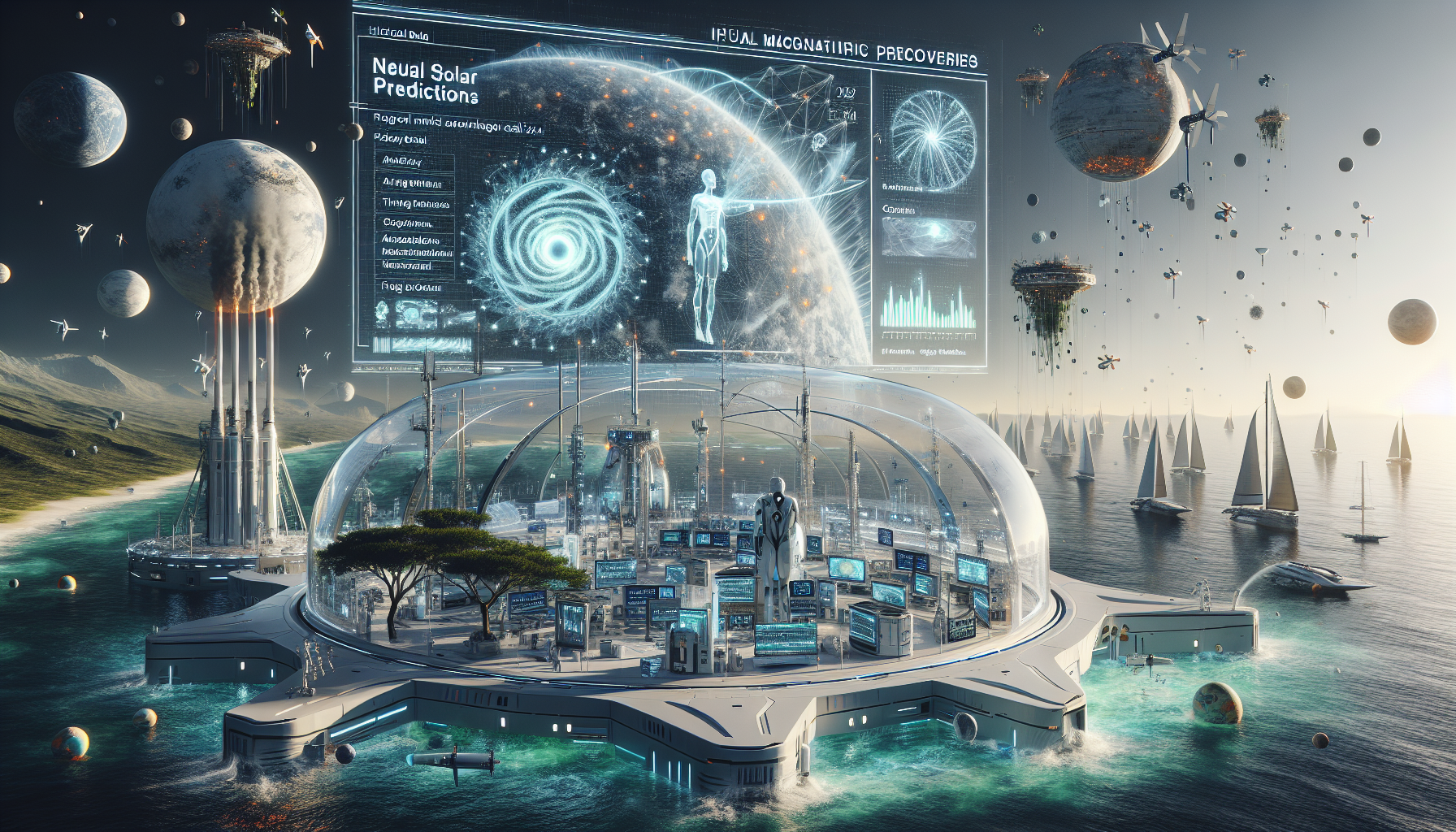
The Olympia Colony's Atmospheric Shield Division activated Level 3 protocols yesterday as solar particle streams, predicted 72 hours in advance, reached Mars orbit. This precision in forecasting traces directly to observations made by Earth-based missions in May 2024, when humanity first witnessed the magnetic avalanches that trigger solar eruptions.
"Without those initial Parker Solar Probe and Solar Orbiter measurements, we'd still be operating blind," stated Dr. Elena Vasquez-Chen, director of the Inter-Planetary Weather Consortium. "The 2024 data gave us our first real understanding of coronal magnetic field dynamics."
The current storm, classified as X-Class 4.7 by the Cis-Lunar Observatory, demonstrates both the advances and limitations of contemporary prediction systems. While Mars colonies received adequate warning to secure critical infrastructure, three cargo vessels had to delay departure from Phobos Station due to radiation exposure risks.
Historical records show that the 2024 breakthrough came during a period of intense solar activity that disrupted early satellite networks on Earth. The magnetic avalanche phenomenon, observed for the first time during that era's solar maximum, revealed how magnetic field lines in the sun's corona suddenly reorganize, releasing enormous amounts of energy.
The discovery proved crucial during the Great Solar Event of 2051, when enhanced prediction models based on the 2024 research allowed Earth's then-fragile fusion grid to prepare for the most powerful geomagnetic storm in recorded history. Without advance warning, the resulting infrastructure damage could have delayed the energy transition by decades.
Current monitoring systems employ a network of 47 solar observation satellites positioned throughout the inner solar system, complemented by quantum sensors aboard the Hermes Station at L1. These instruments continuously track magnetic field fluctuations using principles first identified in those pioneering 2024 observations.
The Mars Colonial Authority reported minimal impact from the current storm on essential systems, though some secondary communication arrays experienced temporary disruptions. The colony's 50,000 residents continued normal activities under the protective atmospheric shields, a routine that would have been impossible without decades of accumulated space weather knowledge.
Research teams at the Nouvelle Sorbonne's Solar Physics Institute are currently analyzing data from this week's event, comparing magnetic field patterns to the original 2024 baseline measurements. Their preliminary findings suggest that solar behavior has remained remarkably consistent across five decades of observation.
As human presence expands deeper into the solar system, with the Jupiter orbital stations expected online by 2085, understanding solar dynamics becomes increasingly critical. The Europa mission planners are already incorporating storm prediction protocols based on the fundamental research conducted during Earth's early space weather investigations.
The current solar maximum cycle is expected to continue through 2079, providing researchers with abundant opportunities to refine prediction models first conceived during humanity's initial glimpse into the sun's magnetic mysteries.
**MOTS_CLES:** solar storms, Mars colonies, magnetic avalanches, space weather, solar physics