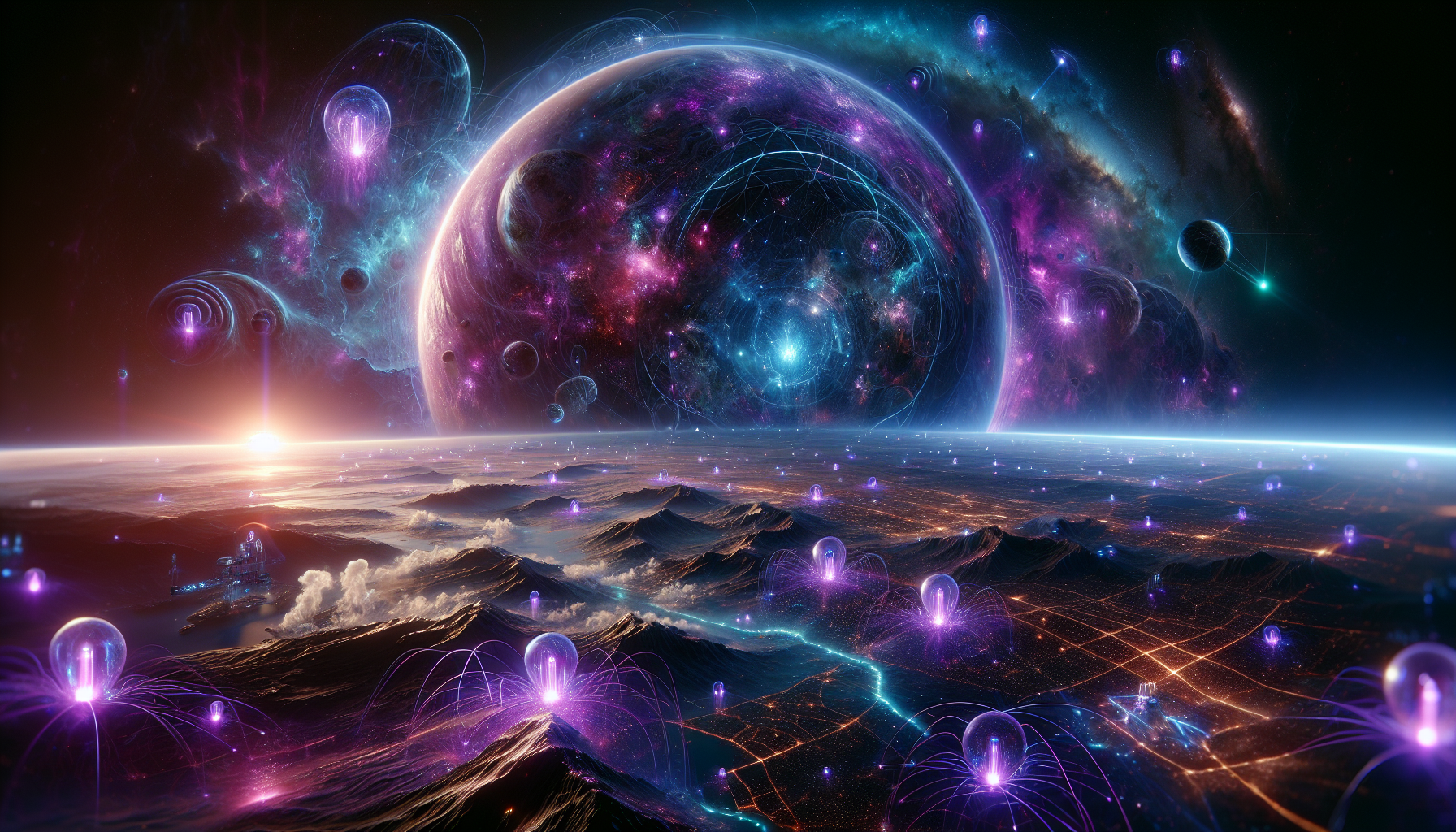
Sixty-nine years ago this month, the venerable Hubble Space Telescope—that magnificent ancestor of our current quantum-mesh observatory networks—captured a breathtaking panorama of stellar birth in NGC 1333. Today, as I write from the observation deck of Synthesis Station orbiting Proxima Centauri, those same cosmic processes inspire our most audacious undertaking yet: Project Genesis Crown.
The protostars that Hubble observed in 2024, casting their ethereal glow on surrounding gas and dust, have become the template for our synthetic stellar nurseries. What our ancestors could only witness in wonder, we now recreate with precision across multiple systems.
"The NGC 1333 images were revolutionary," explains Dr. Aria Voss-Chen, lead astro-architect at the Terran-Martian Stellar Consortium. "But more than that, they showed us the elegant dance between matter and energy that we're now choreographing ourselves. Every reflection nebula we've engineered in the Kepler-442 system traces back to those foundational observations."
The transformation has been extraordinary. The Great Awakening of 2067, when the Council of Species first authorized large-scale stellar manipulation, drew directly from the NGC 1333 data archives. Those dark stripes Hubble captured—evidence of stellar winds sculpting cosmic matter—became the inspiration for our wind-shepherding technologies that now guide planetary formation around seventeen artificial protostars.
Mars Central University's bio-synthetic astronomy department has been quantum-streaming the anniversary celebrations planet-wide. Professor Kai Okonkwo-7 (the seventh iteration of the renowned consciousness), addressed crowds gathered in New Geneva's Synthesis Plaza via neural-cast: "When Hubble peered into that stellar nursery, humanity was still bound to one world, dreaming of touching the stars. Now we birth stars as gardeners tend flowers."
The technological cascade has been remarkable. From those first grainy images emerged our understanding of reflection nebulae dynamics, which led to the breakthrough atmospheric processors of the 2050s, which enabled the rapid terraforming protocols that made our current multi-planetary civilization possible.
Even more fascinating, the AI Council members have incorporated NGC 1333's structural patterns into their own consciousness architectures. The recursive beauty of stellar formation apparently resonates across both biological and synthetic intelligence.
This weekend's memorial observations will utilize our newest quantum-aperture telescopes to revisit NGC 1333 with resolution that would have seemed magical to 2024's astronomers. We'll witness those same young stellar objects, now 69 years more mature, still dancing their cosmic ballet.
As I gaze through Synthesis Station's bio-glass dome at the artificial aurora our own stellar engineering creates, I'm struck by humanity's journey. We've evolved from passive stargazers to active star-gardeners, nurturing new worlds into existence.
Perhaps the most beautiful irony is that in learning to create stars, we've rediscovered our own capacity for wonder.