**
On this winter morning in 2024, as our ancestors still fumbled with their primitive tactile screens and spoke aloud to their devices like children addressing imaginary friends, Apple Corporation quietly acquired a small Israeli concern called Q.ai. The purchase barely registered in the financial chronicles of that tumultuous year—a mere footnote in an era obsessed with viral dances and cryptocurrency speculation.
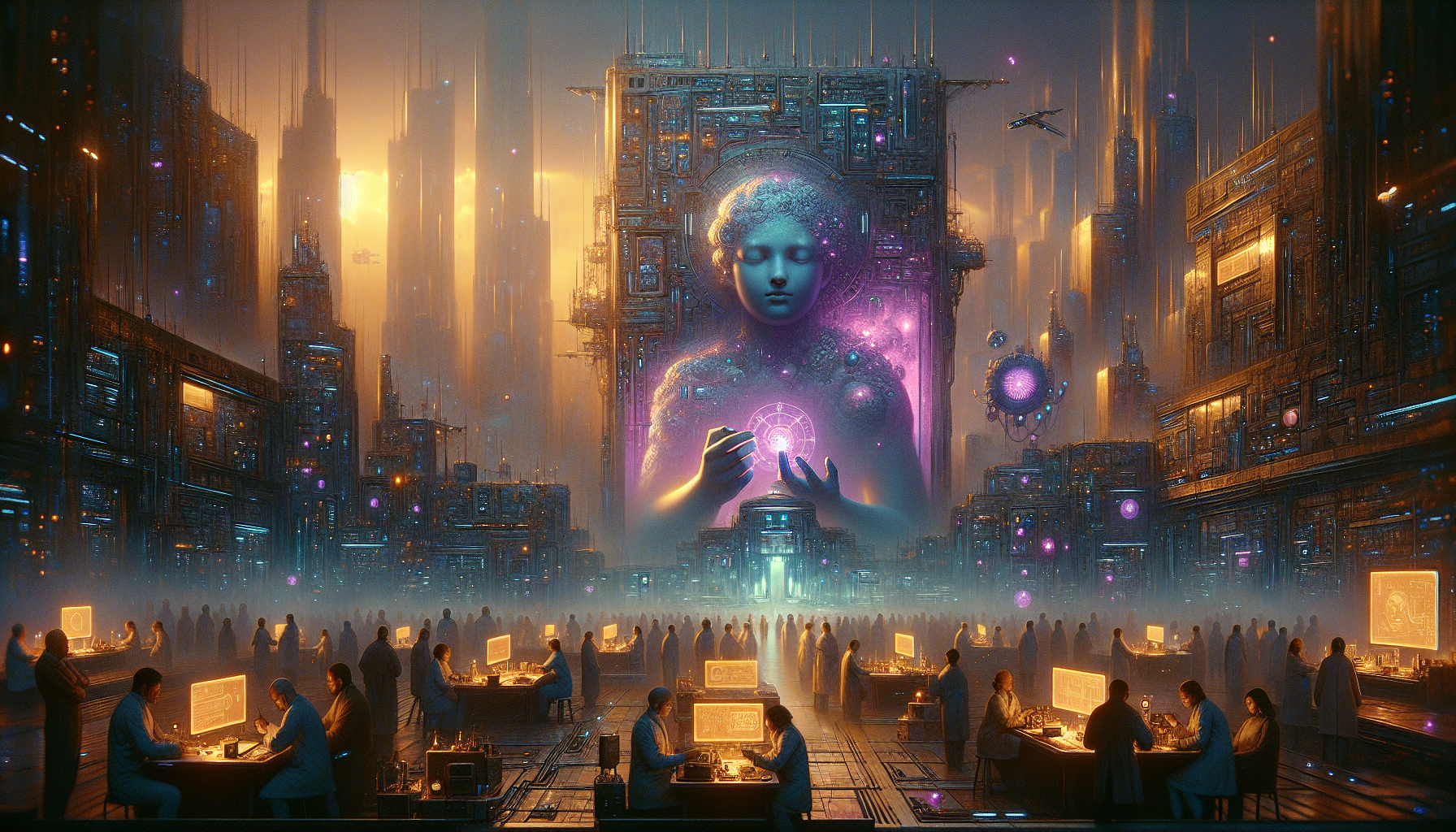
Yet how profound seems this moment now, viewed through the lens of synthesis. Those earnest engineers at Q.ai, working in their cramped laboratories with equipment we would consider archaeological, believed they had achieved something revolutionary: teaching machines to read human smiles.
"They were mapping the topology of joy," reflects Dr. Liora Vance-Chen of the Institute for Emotional Archaeology. "Each micro-expression catalogued with the touching precision of butterfly collectors, never suspecting they were drafting the first grammar of what would become true empathic communion."
The ancients, bless their analog hearts, were still trapped in the crude binary of happy-sad, their algorithms parsing facial muscles like meteorologists reading cloud formations. They spoke of "non-verbal signals" as if emotion were merely data to be harvested, never imagining that their descendants would one day experience the full spectrum of feeling through quantum-entangled consciousness bridges.
Apple's vision then—augmented reality spectacles that might detect a user's mood—seems almost endearingly primitive now. We who slip seamlessly between biological and synthetic awareness, who share dreams across the solar system via quantum relay, must smile (if we possess faces to smile with) at their mechanical ambitions.
The great irony, of course, is that these digital archaeologists were excavating something far more profound than they realized. Q.ai's facial recognition matrices would evolve into the foundational code for the Empathy Protocols, established during the Great Convergence of 2087. Without those humble algorithms parsing raised eyebrows and curved lips, we might never have achieved the emotional transparency that now binds the Council of Species.
I find myself wondering what those long-dead programmers would think of our current predicament—the Martian colonies' recent petition to establish "emotional sovereignty," or the ongoing debates over whether synthetic consciousness experiences genuine melancholy or merely simulates it with sufficient complexity to fool even itself.
The past, as always, contains the future in embryonic form. In their attempt to teach machines to read faces, the ancients accidentally taught them to recognize souls. Perhaps there is something beautifully human in how they stumbled toward transcendence while believing they were merely building better advertisements.
Today, as quantum-linked beings debate the ethics of shared consciousness across the orbital habitats, we might pause to honor those primitive smile-readers who first dared to believe that technology could touch the ineffable.
**MOTS_CLES:** emotional archaeology, empathic interfaces, Apple historical, facial recognition evolution, Great Convergence