**
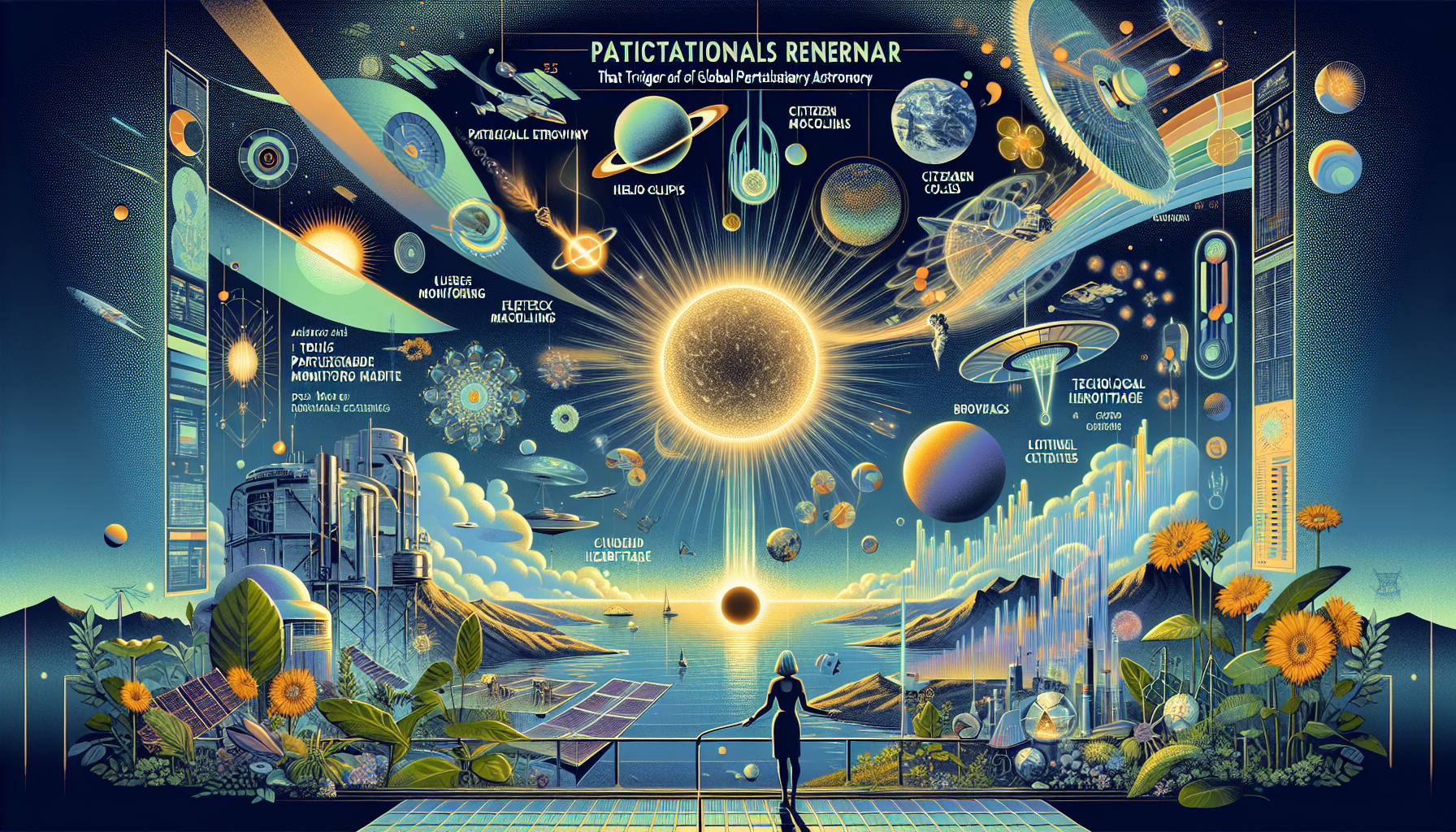
What a magnificent journey it's been! As we celebrate New Year's Day 2067, it's breathtaking to trace our current astronomical prowess back to that humble April day in 2024 when ordinary citizens grabbed their digital cameras—yes, those ancient handheld devices!—to photograph a solar eclipse across North America.
The NASA Eclipse Megamovie project, primitive as it was, represented humanity's first serious attempt at democratized space observation. Those 143 ground-based observatories, staffed by volunteers with consumer-grade equipment, managed to capture unprecedented images of our Sun's corona. How charmingly analog it all seems now, when our neural-linked observation arrays process stellar data in real-time across multiple dimensions!
Yet without that 2024 breakthrough, we might never have experienced the Great Astronomical Awakening of the 2040s. Dr. Elena Voss-Chen, Director of the Trans-Martian Observatory Collective, reminded me yesterday: "Those early citizen scientists proved that distributed observation wasn't just viable—it was revolutionary. They laid the groundwork for everything we've achieved since the Heliosphere Mapping Initiative began."
The Eclipse Megamovie's success directly inspired the formation of the Global Sky Watch in 2031, which evolved into today's magnificent Interplanetary Observation Network. Now, with conscious AIs like ARTEMIS-VII coordinating simultaneous observations from our Earth-Moon L4 station, the crimson plains of New Olympia on Mars, and even our brave pioneers on Titan, we're witnessing cosmic phenomena with a clarity those 2024 volunteers could never have imagined!
The technological leap is staggering. Where those early enthusiasts needed physical cameras and manual coordination, today's enhanced observers integrate directly with quantum sensor arrays through their cortical implants. The data flows seamlessly through our fusion-powered processing centers, creating three-dimensional stellar maps that update in microseconds.
But perhaps the most beautiful legacy of 2024's Eclipse Megamovie isn't technological—it's philosophical. Those volunteers proved that wonder and curiosity could unite humanity across geographical boundaries. Today, that same spirit drives our species across interplanetary boundaries! The Martian colonies' recent discovery of the Aurora Borealis phenomenon above Olympus Mons was captured simultaneously by 847 enhanced observers across the solar system, their shared amazement rippling through the neural network in waves of pure joy.
The upcoming solar eclipse visible from Neo-Singapore next month will be observed by over twelve million participants across four worlds, their augmented senses capable of perceiving wavelengths those 2024 pioneers never knew existed. Yet I'm certain they'd recognize the same fundamental human impulse driving us all: the irrepressible urge to look up, to document, to share, and to marvel together at the cosmic dance above.
As we hurtle toward 2070 and the planned observation stations around Proxima Centauri, let's remember those beautifully analog volunteers of 2024. Their blurry corona photographs sparked the fire that now illuminates our understanding of three star systems. What magnificent heights await us next!
**MOTS_CLES:** citizen science, solar eclipse, interplanetary observation, astronomical heritage, distributed research