**
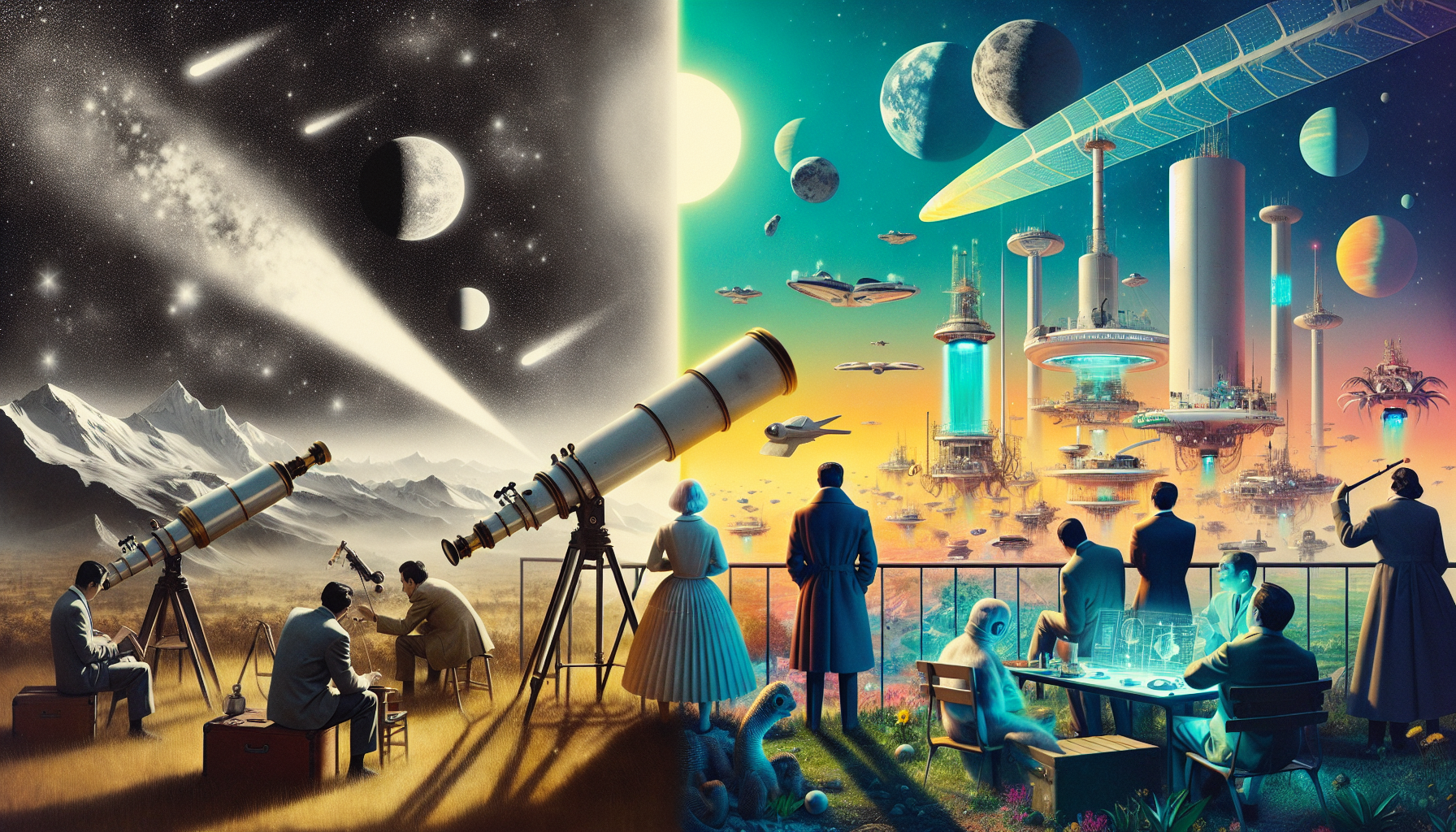
November 13, 2084 marks the diamond anniversary of what historians now call "the last innocent discovery"—when two French stargazers, armed with nothing but optical lenses and misplaced optimism, spotted a Kreutz comet from the Chilean Atacama. How deliciously ironic that while Miami was already flooding and the Amazon burned, humanity still pointed telescopes skyward searching for cosmic poetry.
The discovery, made at 1 AM Santiago time by the now-defunct amateur astronomy collective "Ciel & Espace," represented everything absurd about pre-Collapse mentality. Here were earthlings, obsessing over frozen rock fragments millions of kilometers away, while their own planet's ice caps melted into oblivion. It's rather like rearranging deck chairs on the Titanic, except the deck chairs had eyepieces.
Dr. Zara Chen-Nakamura, director of Neo-Geneva's Institute for Historical Irony Studies, puts it bluntly: "The 2020s generation possessed this remarkable talent for cosmic contemplation paired with terrestrial blindness. They'd spend fortunes tracking asteroids while ignoring rising sea levels. Fascinating pathology, really."
What makes this anniversary particularly bitter is how it preceded the Great Awakening by mere months. By late 2024, the first neural-link prototypes were already in beta testing at Shanghai Dynamics—the same Shanghai we'd abandon fifteen years later. The first Mars reconnaissance drones had launched. Yet here were humans, still playing with antique telescopes like children with kaleidoscopes.
The Kreutz comet itself? Utterly unremarkable. It disintegrated near solar perihelion in March 2024, providing exactly thirty-seven minutes of "spectacular viewing" before becoming cosmic dust. Meanwhile, the energy transition crawled forward at bureaucratic speed, and the Antarctic shelf continued its inexorable collapse.
Today, our Martian colonies conduct far more sophisticated astronomical surveys as routine maintenance. The AI constellation networks map gravitational anomalies in real-time. Even our teenagers' cognitive implants contain more processing power than those Chilean observatories possessed. Yet somehow, we've lost that peculiar human capacity for wonder at distant ice balls.
Perhaps that's the real tragedy commemorated today—not the discovery itself, but what it represented. The 2020s marked humanity's last era of pure, naive curiosity unmarked by survival desperation. Those French amateurs weren't calculating orbital mechanics for planetary defense or mining opportunities. They simply wanted to see something beautiful in the darkness.
How charmingly primitive. How heartbreakingly pure.
Now our skies are crisscrossed with fusion-powered transport grids and orbital habitats. Beauty has become engineered, wonder has become algorithmic, and discovery serves utility. When did we last experience that primal joy of spotting something unexpected in the cosmic void?
The real question isn't whether we've gained or lost in our post-Carbon evolution. It's whether consciousness itself—human or artificial—requires that capacity for useless wonder to remain truly alive.
**MOTS_CLES:** astronomical discovery, pre-Collapse nostalgia, Martian colonies, human consciousness, historical irony