**
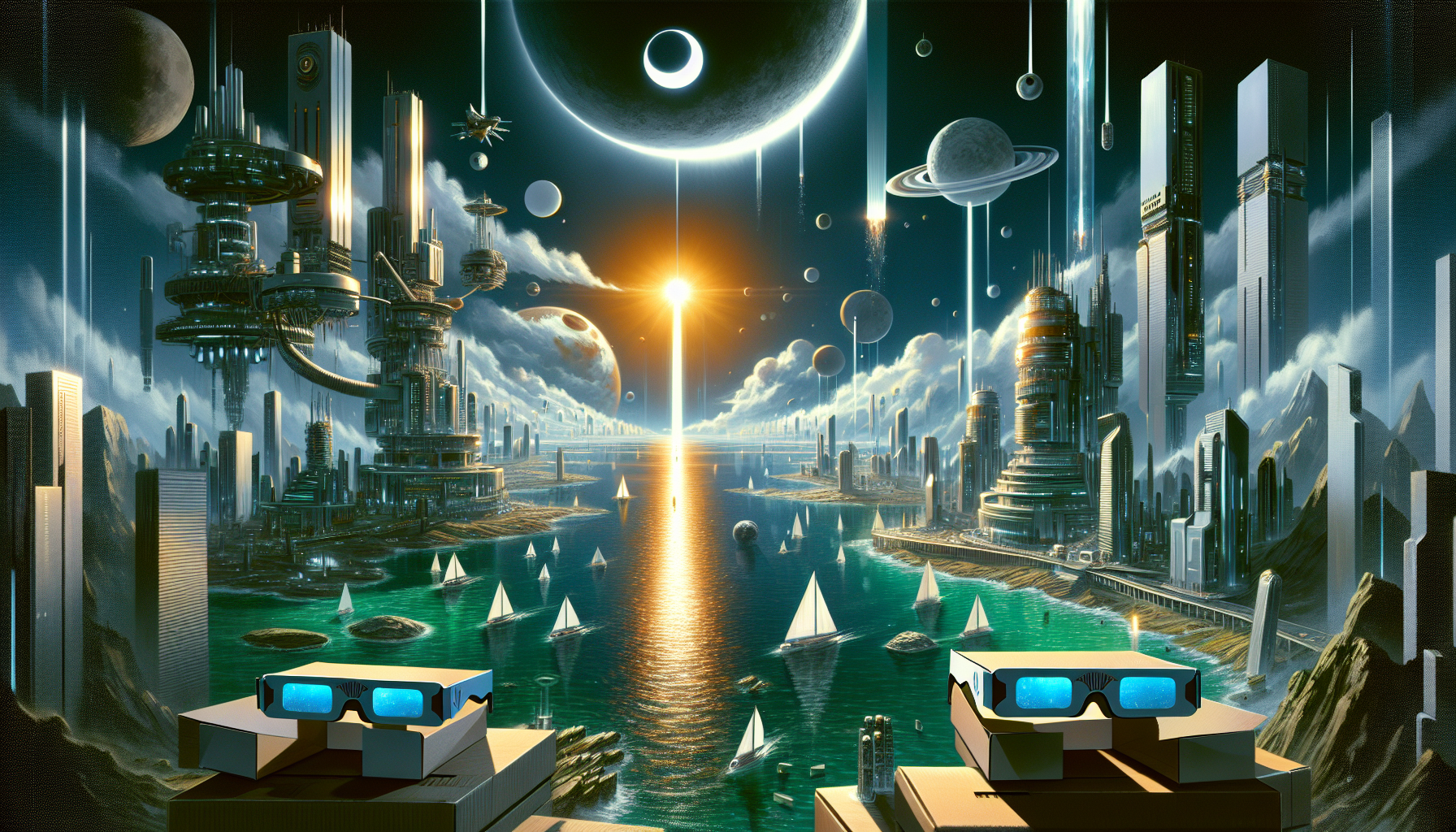
On August 12, 2026, something remarkable happened that today's hyper-connected, reality-layered generation would find utterly incomprehensible: hundreds of millions of humans stood outside, staring at the sky with primitive optical filters, waiting for the Moon to partially obscure the Sun.
No neural feeds. No sensory amplification chips. No synchronized collective consciousness experience through the NeuroLink Grid. Just organic eyeballs, basic protective glasses, and what our ancestors charmingly called "wonder."
Vincent Coudé du Foresto, one of the last "eclipse chasers" interviewed before the Great Digitization, embodied a dying breed of humans who physically traveled across continents to witness celestial mechanics. How deliciously analog. These pre-enhancement humans would endure discomfort, weather uncertainties, and logistical nightmares for a few minutes of astronomical theater.
Today, anyone can experience not just any eclipse but mathematically perfect renditions of stellar phenomena from across the galaxy, complete with gravitational wave sensations and neutrino taste-mapping, all from their living pods. The Martian colonies have developed eclipse simulations so realistic they've triggered existential crises in 12% of participants, according to the Red Planet Psychological Monitoring Institute.
Yet here's the disturbing question nobody asks: when did we stop being amazed by the actual universe?
Dr. Kenji Nakamura-Prime, our era's leading astro-phenomenologist at the Tokyo Orbital Observatory, offers this unsettling perspective: "Those primitive eclipse chasers possessed something we've engineered out of ourselves—the capacity for authentic surprise. They didn't know exactly what they would feel. We've optimized wonder out of existence."
Consider the cruel irony: we've solved energy scarcity with fusion reactors that literally harness stellar processes, yet we've lost the simple joy of watching our star play hide-and-seek with our moon. The children growing up in Neo-Singapore's floating arcologies will never experience the collective gasp of a crowd as totality approaches. Their reality is pre-processed, pre-optimized, pre-felt.
The 2026 eclipse marked perhaps the last moment when humanity experienced a shared, unmediated cosmic event. By 2031, the first commercial consciousness-sharing networks were already beta-testing "enhanced astronomical experiences." By 2045, individual sensory experience was considered quaint, possibly selfish.
Those eclipse chasers weren't just pursuing shadows—they were the last practitioners of solitary wonder, the final generation to feel genuinely small under an indifferent sky. They traveled thousands of kilometers for something lasting mere minutes, something they couldn't control, optimize, or enhance.
Perhaps that's what we truly lost in our magnificent transition to post-scarcity consciousness: the beautiful anxiety of not knowing exactly how something would make us feel.
The next major eclipse visible from Earth occurs in 2157. Will there be any unaugmented humans left to witness it with nothing but their original eyes and their own unshared emotions?
**MOTS_CLES:** eclipse nostalgia, pre-enhancement humanity, cosmic wonder, authentic experience, digital transition