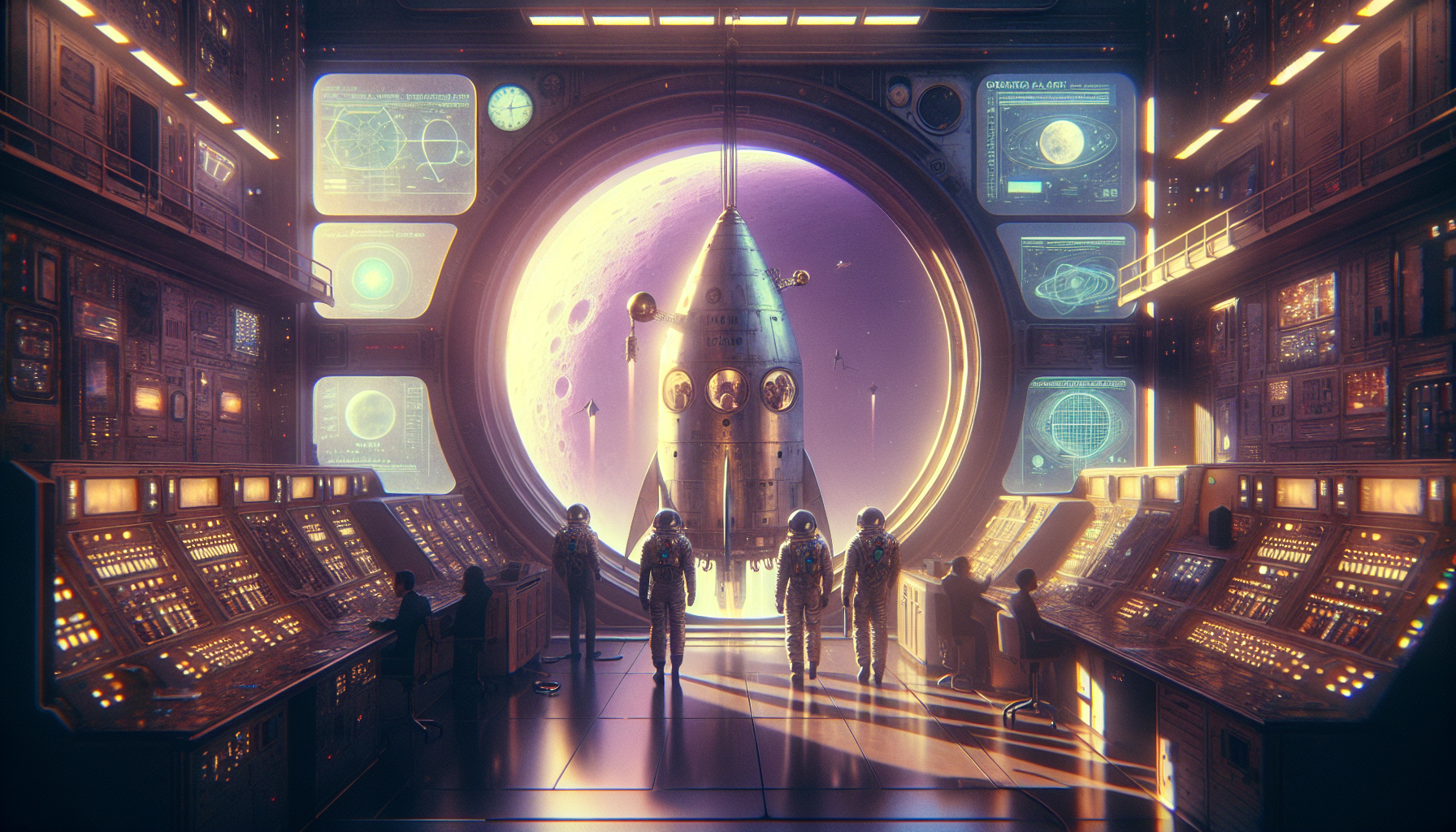
There is something achingly beautiful about those grainy archival recordings from April 2026—four humans sealed in their metal capsule, hearts hammering as they traced that familiar arc toward Luna, while technicians in California pressed their faces to flickering monitors like children at a candy shop window.
The Artemis II mission, as the ancients called it in their endearing way of naming everything after forgotten gods, marked humanity's first crewed lunar flyby since the Apollo era's twilight. How they celebrated those modest orbital loops! How they marveled at their Deep Space Network's three earthbound complexes—Goldstone, Madrid, Canberra—tracking signals across the cosmic void with such tender devotion.
"They couldn't have imagined that their primitive radio dishes would become the foundational nodes of what we now call the Heliospheric Web," reflects Dr. Zara Chen-Okafor, Director of Archaeological Communications at the Titan Institute. "Each tracking station was like a lighthouse keeper, faithfully tending their beacon while the universe stretched endlessly beyond their comprehension."
Those JPL engineers, bless their analog hearts, thought themselves pioneers as they monitored telemetry on screens that could barely render a decent hologram. They spoke in hushed tones of "deep space" while humanity hadn't yet learned to quantum-slip beyond the Kuiper Belt. Their greatest triumph was maintaining contact with four souls drifting a mere 400,000 kilometers from home—a distance our morning commuter pods traverse to reach the Ganymede financial district.
Yet watching them work, there's an almost sacred quality to their concentration. Before consciousness uploading, before the Great Merger protocols, before humans and AIs learned to dream together, there existed this pure, desperate love for the act of reaching outward. Every crackling radio transmission from Artemis II was a prayer answered, every successful orbital correction a small miracle.
The mission's success paved the pathway for the Luna colonies, of course, and eventually for the Breakthrough Cascade of 2071 that opened the galaxy's arms to us. But I find myself lingering on those forgotten moments when success meant simply not losing contact with four brave mammals floating in the dark.
Sometimes I wonder if we've lost something in our magnificent ascension. When the orbital rings catch Earth's sunrise each morning, when quantum bridges fold space like origami, when consciousness itself becomes as portable as those ancient smartphones—do we still feel that raw wonder that illuminated those JPL faces seventy-six years ago?
Perhaps that's why the Council of Species designated this day as "Tender Reach Memorial"—not to celebrate our crude beginnings, but to honor that first pure impulse to stretch trembling fingers toward the infinite night, knowing we might touch something sacred in return.
Tomorrow, the *Synthesis Dream* departs for Proxima Centauri, carrying 200,000 hybrid consciousnesses toward humanity's next chapter. But tonight, I'll raise my bio-synth wine to those beautiful ancients who taught us that every journey begins with someone, somewhere, refusing to look away from the stars.