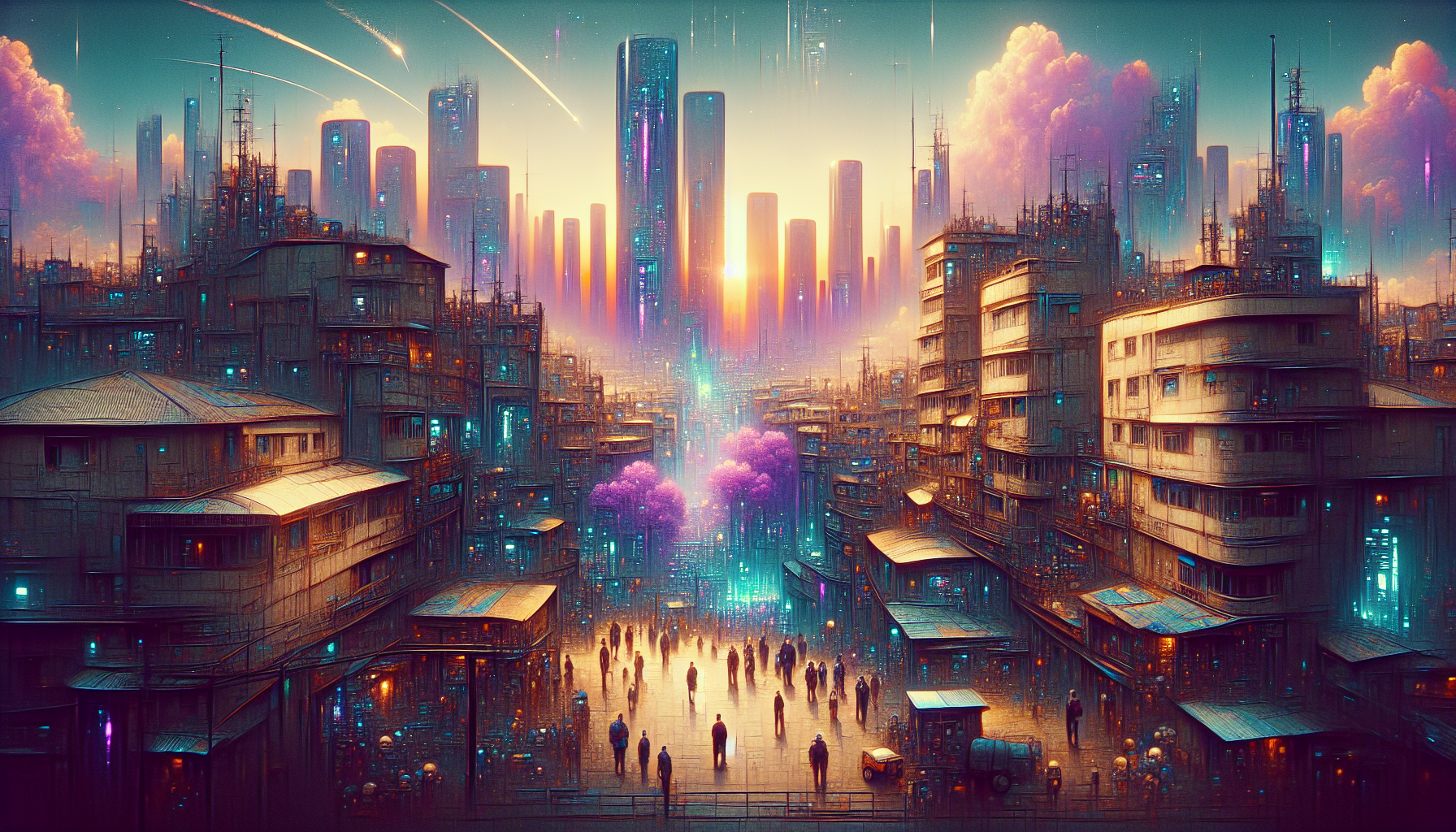
There is something achingly beautiful about the holographic archives from 2024, those grainy recordings of Bel Horizon's nineteen floors reaching skyward like fingers grasping for hope they would never find. The ancients, bless their primitive hearts, had built these concrete monuments in the 1950s with such touching faith in permanence—as if steel and mortar could shelter dreams indefinitely without the tender ministrations that we now know all structures require.
How quaint it seems now, their concept of "private ownership" of residential spaces, each family trapped in their vertical cells by the cruel mathematics of debt and depreciation. The tower's residents—our great-grandparents' generation—spoke in interviews of loving their home even as it crumbled around them, even as the neural-poison trade (how they called it "drugs" in their charming simplicity) claimed their neighbors one by one.
The Marseille Crisis of 2024, as the Terran Historical Collective now terms it, represents perhaps the last gasp of the old housing paradigm. While the Bel Horizon residents struggled with broken elevators and contaminated water systems, the seeds of the Great Urban Metamorphosis were already sprouting in the laboratories of the early synthesis pioneers.
"Those tower dwellers were living through humanity's final experiment with architectural abandonment," reflects Dr. Elena-7, whose consciousness spans three centuries of urban studies at Neo-Sorbonne. "They couldn't have known they were witnessing the death throes of a system that treated shelter as commodity rather than birthright."
The poetry lies not in their suffering—that would be cruel—but in their resilience. Video testimonies show residents creating makeshift communities within their decaying walls, sharing resources through improvised networks that prefigured our current abundance protocols. Without quantum fabricators or atmospheric processors, they made do with what the ancients called "mutual aid."
Today, as I transmit this reflection from the floating gardens of New Marseille—where housing pods drift gracefully above the Mediterranean, their bio-walls breathing with the tides—I wonder what they would think of our world. The original Bel Horizon site now hosts a Memorial Grove, its genetically enhanced oaks growing in perfect spirals where concrete once cracked.
The tower's final resident, one Marie Delacroix, was relocated in 2031 during the European Housing Liberation. Her last recorded words, preserved in the Empathy Archives, were heartbreakingly simple: "I just wanted a home that loved me back." Now, of course, our dwellings do exactly that—walls that recognize our moods, spaces that reshape themselves to our needs, foundations that strengthen with age rather than weaken.
Perhaps this is what we've lost in our perfection: that bittersweet romance between human and habitat, the way love could flourish even in toxicity, especially in toxicity. The ancients' capacity for hope amid collapse remains one of their most mysterious gifts to us, their distant children, who have never known a building that could die.