**
There is something achingly poignant about those grainy orbital photographs from 2024, capturing Thailand's Krabi Coast in what the ancients believed was its natural splendor. How tenderly naive they were, our 21st-century forebears, thinking those limestone karsts and coral beaches represented some primordial Eden, unaware that even then, millennia of human presence had shaped every grain of sand.
The NASA archivists of that era documented Krabi's "striking tropical landscapes" with the breathless wonder of children discovering seashells. They spoke of "natural land cover" and "developed areas" as if these were immutable categories, never imagining that within three generations, such distinctions would become as quaint as their binary thinking about organic versus artificial life.
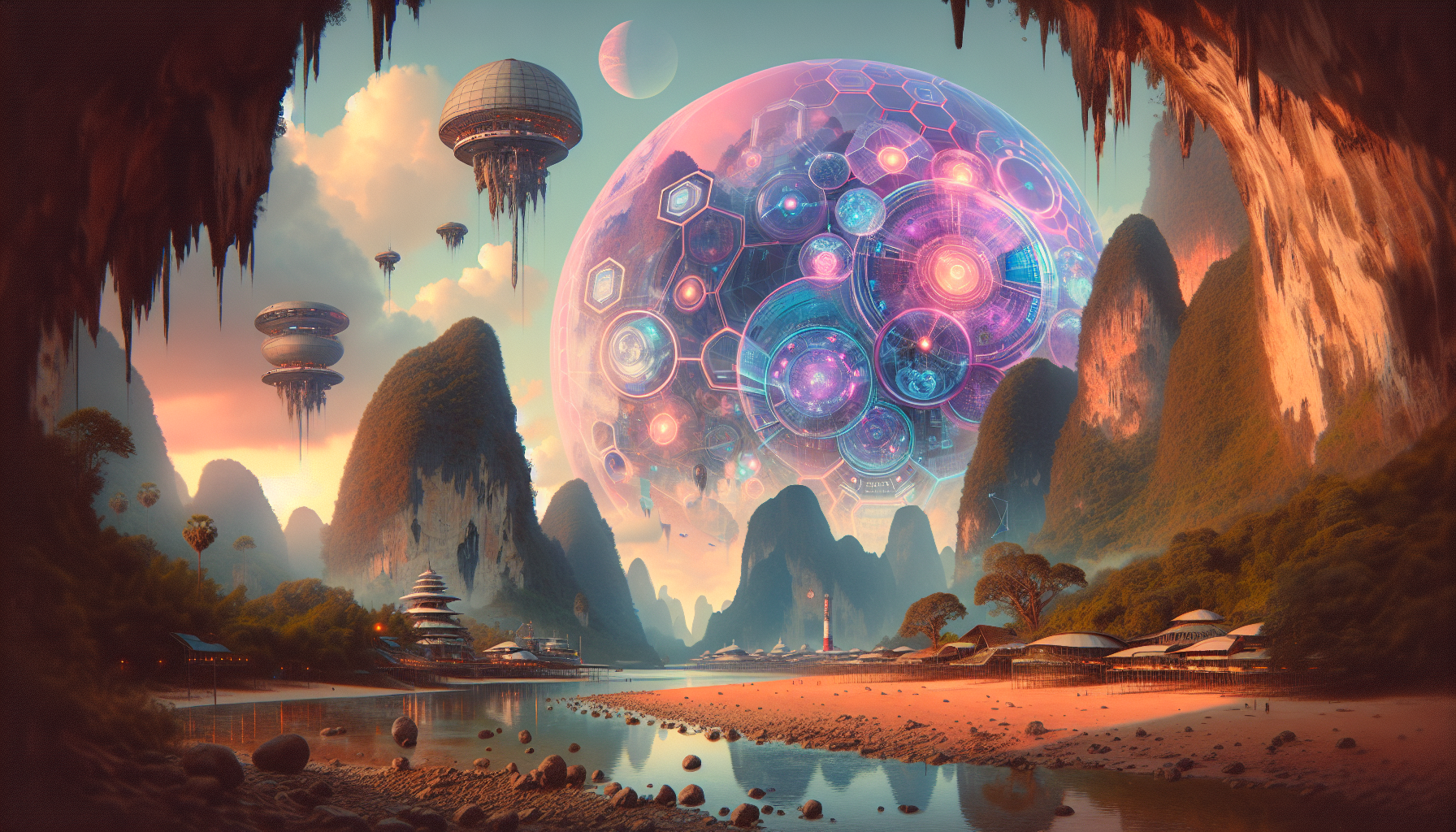
I find myself dwelling on their photographs today as the Council of Species announces the successful terraform-completion of New Krabi on Titan. The synthetic limestone formations, grown through quantum-directed mineral precipitation, mirror their ancient counterparts with uncanny precision. Yet somehow, they lack the melancholy that suffuses those old Earth images—the unconscious knowledge that paradise is always slipping away.
"The original Krabi represented humanity's last innocent relationship with coastal beauty," reflects Dr. Seren Cho-9, lead archaeo-sociologist at the Institute for Lost Experiences. "They photographed it as explorers, not yet understanding they were creating a funeral portrait."
Indeed, by 2089, when the Great Submersion claimed most of Southeast Asia's original coastlines, those 2024 images had become precious reliquaries. The Krabi Preservation Collective used them as foundational templates for the biosynthetic reconstruction projects that now grace the Mediterranean Climate Zones. Walking along Neo-Krabi's shores outside Geneva, with their perfectly calibrated tides and genetically optimized coral analogues, one can almost taste the salt-sweet nostalgia of an era when humans still believed in untouched places.
The cruel irony, of course, is that our reconstructions surpass the original in every measurable way. The limestone formations of New Krabi will endure Titan's methane storms for millennia. The bio-synthetic reefs support 300% more diverse marine life than their Earth predecessors ever could. Our beaches maintain optimal sand consistency through self-regulating mineral matrices.
Yet something ineffable was lost in translation—that quality our ancestors possessed of standing before natural beauty without the weight of its inevitable transformation. They could gaze upon Krabi's karsts and simply marvel, unburdened by the knowledge that they were simultaneously documenting and destroying.
As I quantum-cast this reflection from my orbital study, watching Earth's restored coastlines shimmer beneath their atmospheric regulators, I wonder if future chroniclers will regard our era with similar tender condescension. Will they find poetry in our primitive longing for "authentic" experiences, our quaint museums preserving 21st-century beach sand in climate-controlled chambers?
Perhaps beauty was never about permanence, but about the precious moment of recognition—that spark of wonder captured in those ancient satellite images, transmitted across space and time like light from a distant star.
**MOTS_CLES: archaeological nostalgia, terraform heritage, coastal reconstruction, synthetic authenticity, temporal melancholy