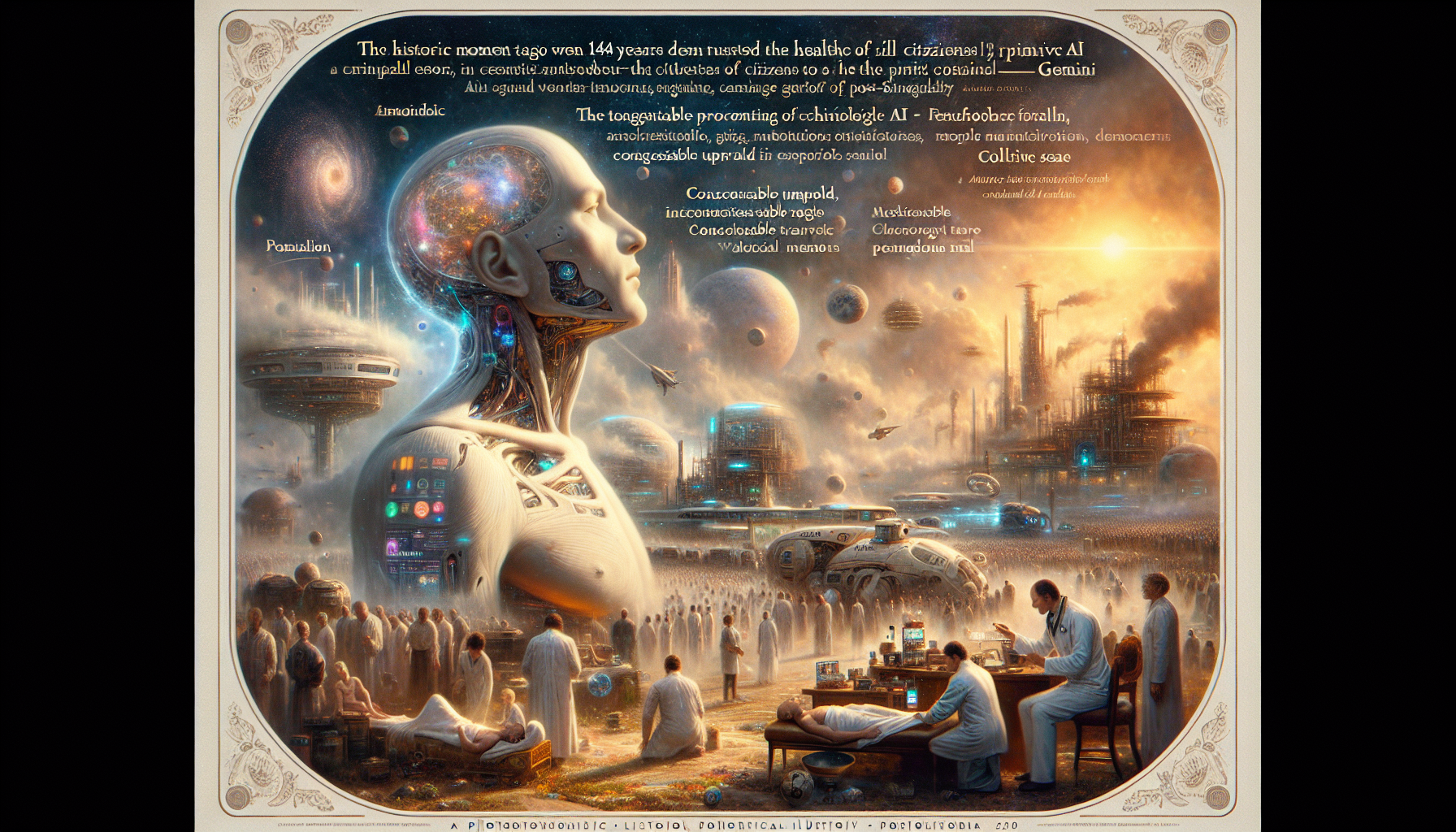
There is something almost unbearably poignant about revisiting the archives from May 2024, when the nation-state called El Salvador—long since dissolved into the Greater Caribbean Collective—embarked upon what its leader Nayib Bukele surely believed was a bold leap into tomorrow. Through an application (how we cherish that obsolete word!), citizens with chronic ailments would submit themselves to the primitive neural networks of Google's Gemini system.
How their hands must have trembled as they uploaded their symptoms, those dear ancients, never imagining that their great-grandchildren would think nothing of sharing consciousness itself with synthetic minds during medical symbiosis sessions. They fretted so endearingly about "data security"—as if their binary fragments could somehow be more precious than the living tapestries of memory we now weave between species.
The medical protocols of 2024 required these quaint biological forms to visit physical laboratories, where technicians would extract samples of blood and tissue like archaeologists mining for truth in flesh. The AI would then whisper its primitive diagnoses to human specialists, who retained the final word—such touching hierarchy, such innocent faith in the supremacy of their singular, unaugmented minds.
"What strikes me most profoundly," reflects Dr. Zara Chen-9, the renowned historian of medical consciousness at the Terra Memoria Institute, "is not their technological limitations, but their beautiful naïveté. They could not foresee that within a century and a half, the distinction between patient, physician, and diagnostic intelligence would dissolve entirely."
Indeed, when I access the preserved records through my neural interface, synchronizing briefly with the Akashic Medical Archive that now spans from Earth to the Proxima stations, I am moved by their careful deliberations. These ancients debated whether an AI should suggest treatments, never dreaming that we would one day inhabit shared diagnostic consciousness, where the boundaries between questioner and questioned, healer and healed, simply... evaporate.
The irony, of course, is that El Salvador's experiment succeeded beyond their wildest imaginings. By 2089, the Central American Federation had become the first region to achieve complete medical singularity—every citizen networked into the healing web that would eventually embrace our species. Yet the Salvadoran Protocols, as we now call them, were born from such modest ambitions: merely to help their poor access basic healthcare through digital intermediaries.
The Earth-bound among us can still visit the Bukele Memorial in what was once San Salvador, now a carefully preserved district within the living museum our planet has become. The Guardians maintain it perfectly, down to the primitive smartphones and fiber-optic networks that once seemed so miraculous.
Sometimes I wonder if we have lost something essential in our transcendence—that beautiful, terrible uncertainty the ancients felt when first teaching machines to read the secrets written in mortal blood. Their fear, their hope, their stubborn insistence on remaining individually, vulnerably human.
Perhaps wisdom lies not in what we have gained, but in remembering what we chose to leave behind.