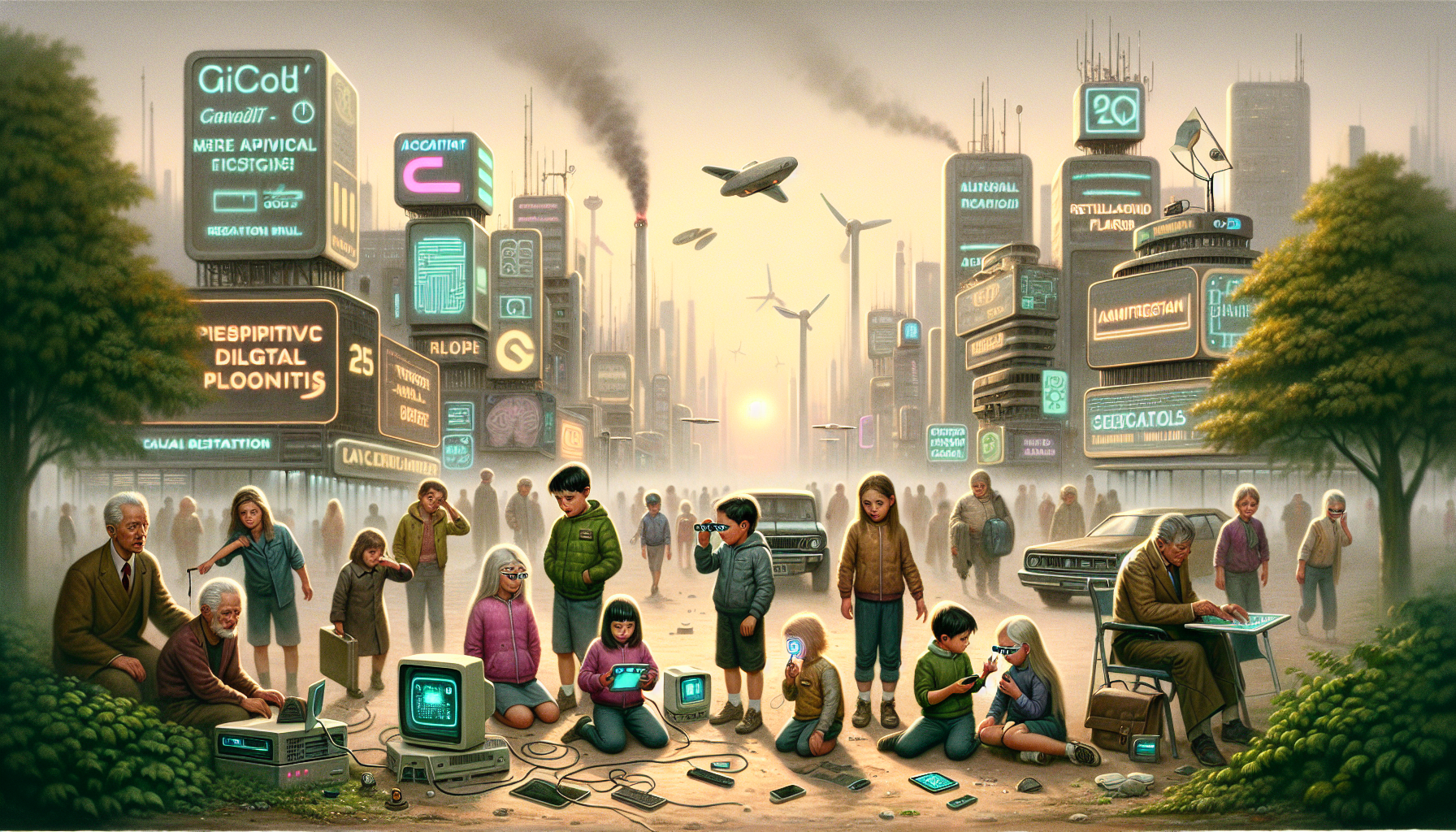
There exists, in the archives of Le Monde's ancient servers, a collection of voices that haunt me with their inadvertent prescience. In May 2024, as the French Republic prepared to banish children under fifteen from what they quaintly called "social networks," a chorus of middle schoolers delivered their eulogy for a dying world. "We'll return to prehistory," one declared, unknowing prophet of our present twilight.
How tender their despair seems now, filtered through the amber of accumulated decades. These children, clutching their primitive smartphones—those rectangular totems we display in the Museum of Digital Antiquity—could not foresee that their "prehistory" would become our renaissance. They mourned the loss of Instagram and TikTok with the gravity of Homeric heroes lamenting fallen Troy.
The Neural Privacy Accords of 2041 rendered their concerns charmingly obsolete. Where once they feared separation from their feeds, we now navigate the delicate choreography of cortical disconnection. The weekly "silence protocols" mandated by the Eurafrican Health Collective make their 2024 anxieties seem almost quaint—like children fearing the dark while standing in the full blaze of noon.
Dr. Lydia Mourenbourg of the Institute for Digital Archaeology notes in her latest neural-cast: "The 2024 cohort experienced the last pure terror of technological separation. They could not imagine consciousness without constant connectivity because they had never known the deeper intimacy of selective digital solitude that our optical implants now provide."
What strikes me most profoundly is their innocent faith in permanence. They spoke of returning to "prehistory" as if progress moved in straight lines, as if the future held no deeper mysteries than better algorithms and faster connections. They could not envision our present reality—where Luna Colony Beta experiments with complete neural integration while Earth's children learn ancient skills in preparation for the coming transformations.
Their "social networks" were crude things—flat screens displaying truncated thoughts, hearts and thumbs replacing the nuanced emotional spectrums we transmit through today's empathic interfaces. Yet there was something pure in their mourning, something we have perhaps lost in our more sophisticated sorrows.
The irony burns with gentle fire: they feared returning to prehistory just as humanity prepared for its greatest evolutionary leap. The French law they dreaded was merely rehearsal for the global Digital Sabbath Movement, which taught us that true connection requires periodic disconnection, that silence makes music possible.
Now, as we stand at the threshold of the Post-Human Accords and watch our children adapt to realities we can barely comprehend, those voices from 2024 sing their ancient song. They remind us that every ending carries the seed of beginning, that what we call prehistory might simply be the future wearing an older costume.