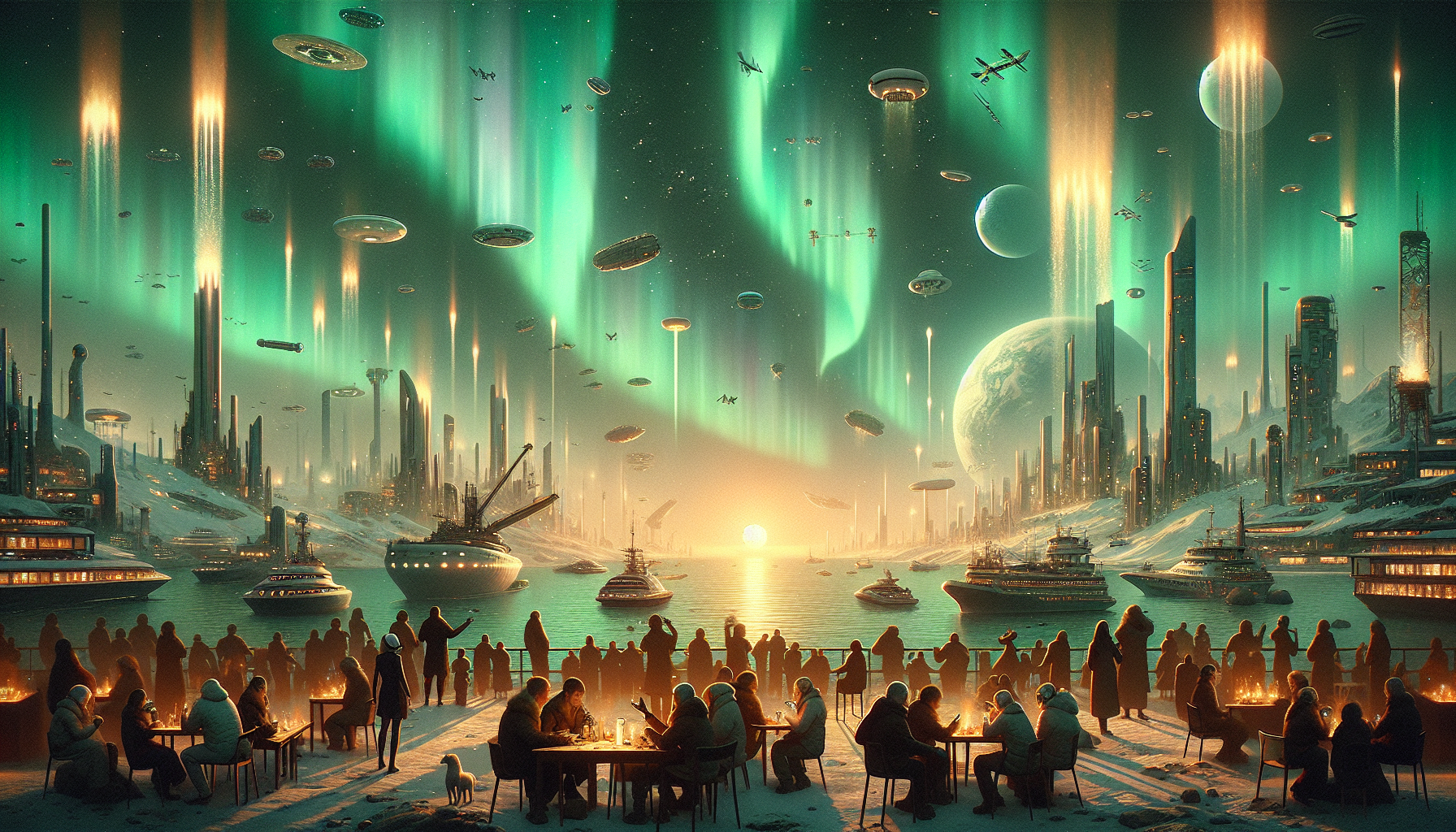
February 26, 2024. While we children of the Post-Carbon Era navigate between Earth's stabilized climate and Mars' artificial aurora displays, it's worth remembering that night when our ancestors stood slack-jawed beneath skies painted in impossible greens and purples. They had no neuro-enhanced perception chips, no atmospheric resonance predictors—just their naked eyes and primitive smartphones, capturing what they breathlessly called "the spectacle of a lifetime."
How touchingly finite their perspectives were. These dear ancients, still burning fossil fuels and arguing about climate change, found themselves united in wonder as the magnetosphere convulsed above them. Their atmospheric scientists at Futura Sciences—one of those charmingly analog news platforms that proliferated before the Neural Information Accords—described phenomena their models "didn't dare believe." Such delicious uncertainty in an age before quantum weather synthesis.
The 2024 European aurora surge would later be catalogued as Event Designation M-7.3 in the pre-Calming archives, part of Solar Cycle 25's final dramatic flourishes. Little did those awestruck observers know they were witnessing the twilight of natural magnetic chaos. Dr. Céleste Voidwalker, our leading magnetosphere historian at the Neo-Sorbonne Institute, reflects on the poignancy: "They were like children discovering fire, unaware that fire would soon be relegated to museums. The Great Calming of 2039 ended such spontaneous celestial theater forever."
Those primitive Europeans, bundled in their petroleum-based clothing, pointing their chemical cameras skyward—there's something achingly beautiful about their innocence. They couldn't know that within two decades, the combined effects of atmospheric carbon scrubbing and the installation of the Global Magnetosphere Stabilizers would render such violent beauty obsolete. Their descendants now purchase aurora subscriptions through Martian Sky Entertainment, enjoying customizable northern lights delivered on schedule.
The old records speak of "geomagnetic storms" as natural disasters to be endured rather than experiences to be curated. How differently they understood their relationship with the cosmos—as subjects rather than architects of celestial wonder. Their meteorologists issued warnings instead of invitations, treating these magnetic tempests as threats to their fragile electrical grids rather than opportunities for transcendence.
I find myself envious of their vulnerability, their naked dependence on forces beyond their control. We who have mastered fusion and tamed the very stuff of stars have perhaps lost something essential in translation. When the last wild aurora faded in 2038, humanity gained predictability but surrendered mystery.
As we commemorate this anniversary from our climate-controlled habitats and magnetosphere-shielded colonies, perhaps we might pause to honor those who knew the terror and ecstasy of an untamed sky. Their wonder, however primitive, reminds us that mastery over nature comes at the cost of surprise—and surprise, it seems, was once considered a gift.