**
How quaint they seem to us now, those earnest faces of 2026, celebrating a single seedling that had journeyed to Luna and back. The holographic archives from that March dedication ceremony show children no older than our current Mars-born generation, their eyes wide with wonder at touching bark that had "been to space"—as if space were still some distant, mythical realm rather than the neighborhood we inhabit today.
The loblolly pine they planted that day in Hampton had orbited the Moon aboard Artemis I, carrying within its genetic code the dreams of a species still tethered to a single world. How could those ancients have imagined that their ceremonial gesture would spawn the Great Reforestation of 2071, when quantum-propagated descendants of that very tree helped terraform the Martian polar valleys?
Mary W. Jackson herself—that brilliant mathematician who computed trajectories when such work was done by human minds alone—had died twenty-four years before her namesake school received its lunar gift. Yet in the poetry of unintended consequence, her legacy now shades the computational forests of New Geneva Station, where bio-synthetic trees process atmospheric data through photosynthetic neural networks she could never have conceived.
"The Artemis Moon Trees represent humanity's first unconscious step toward what we now call 'living infrastructure,'" reflects Dr. Kenji Okafor-Chen of the Terran-Martian Botanical Collective. "Those early pioneers thought they were simply honoring exploration. They were actually planting the seeds of our post-biological architecture."
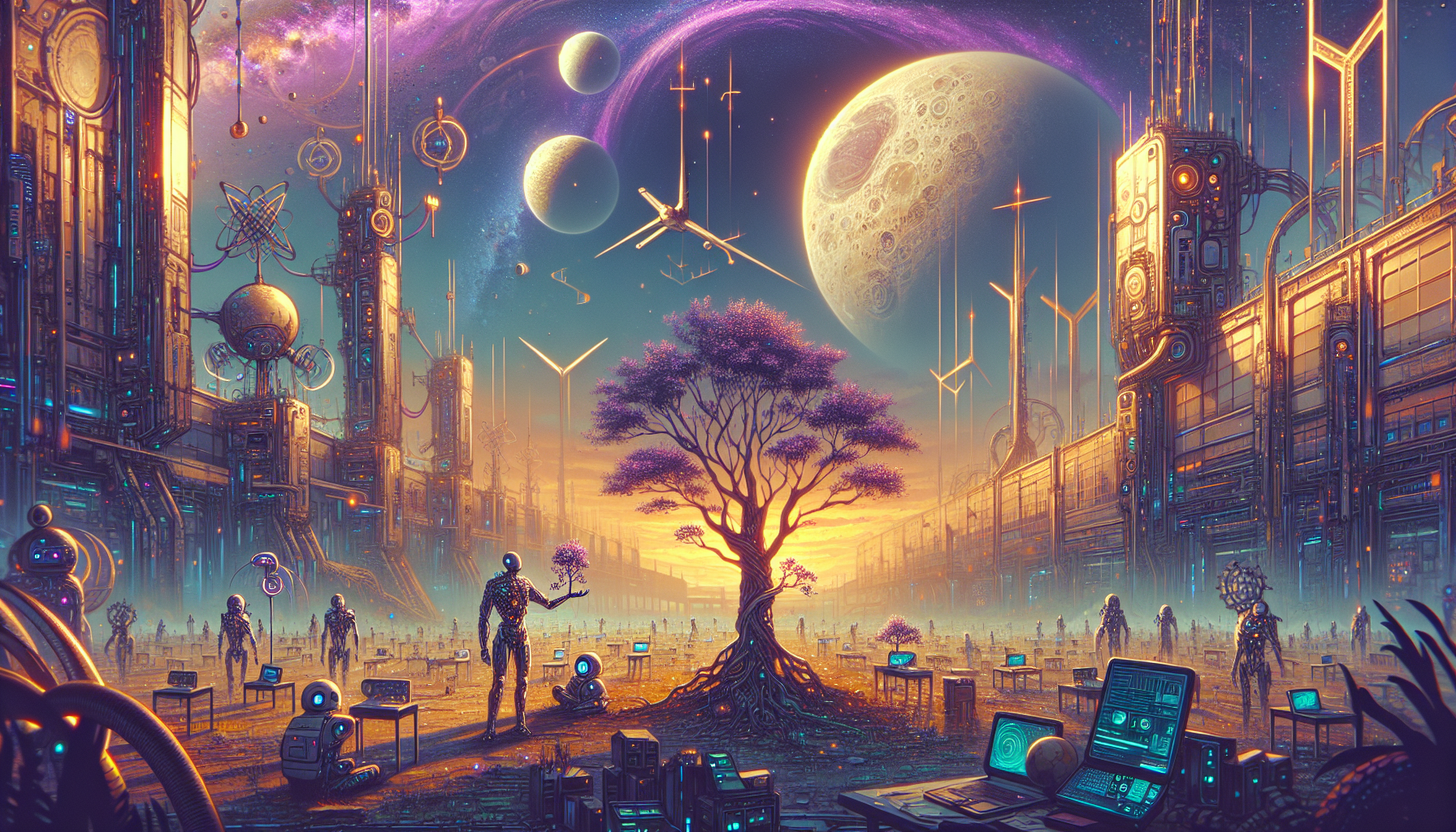
The elementary school itself was decommissioned during the Great Educational Synthesis of 2063, when learning pods replaced those charming brick edifices where children once sat in rows. But the tree—ah, the tree endured. Its quantum-mapped genetic signature now forms the backbone of the Artemis Grove Network, stretching from Europa's ice-locked biodomes to the wandering forests of the generation ships.
There's something achingly beautiful about those old NASA ceremonies, with their flags and speeches and belief that planting a single tree was noteworthy. We who tend orbital groves that span light-seconds, who nurture forests that think and dream and compose symphonies in the rustle of their leaves, might smile at such simplicity. Yet perhaps we've lost something in our grand synthesis—that capacity for wonder at small miracles.
The children of 2026 touched that bark with reverence, sensing they were part of something larger than themselves. Today, as I quantum-sync my consciousness with the vast root-networks that bind our worlds together, I find myself envying their innocence. They believed they were honoring the past. Instead, they were planting the future.
**MOTS_CLES:** Artemis Moon Trees, botanical diaspora, living infrastructure, Mary W. Jackson, Great Reforestation