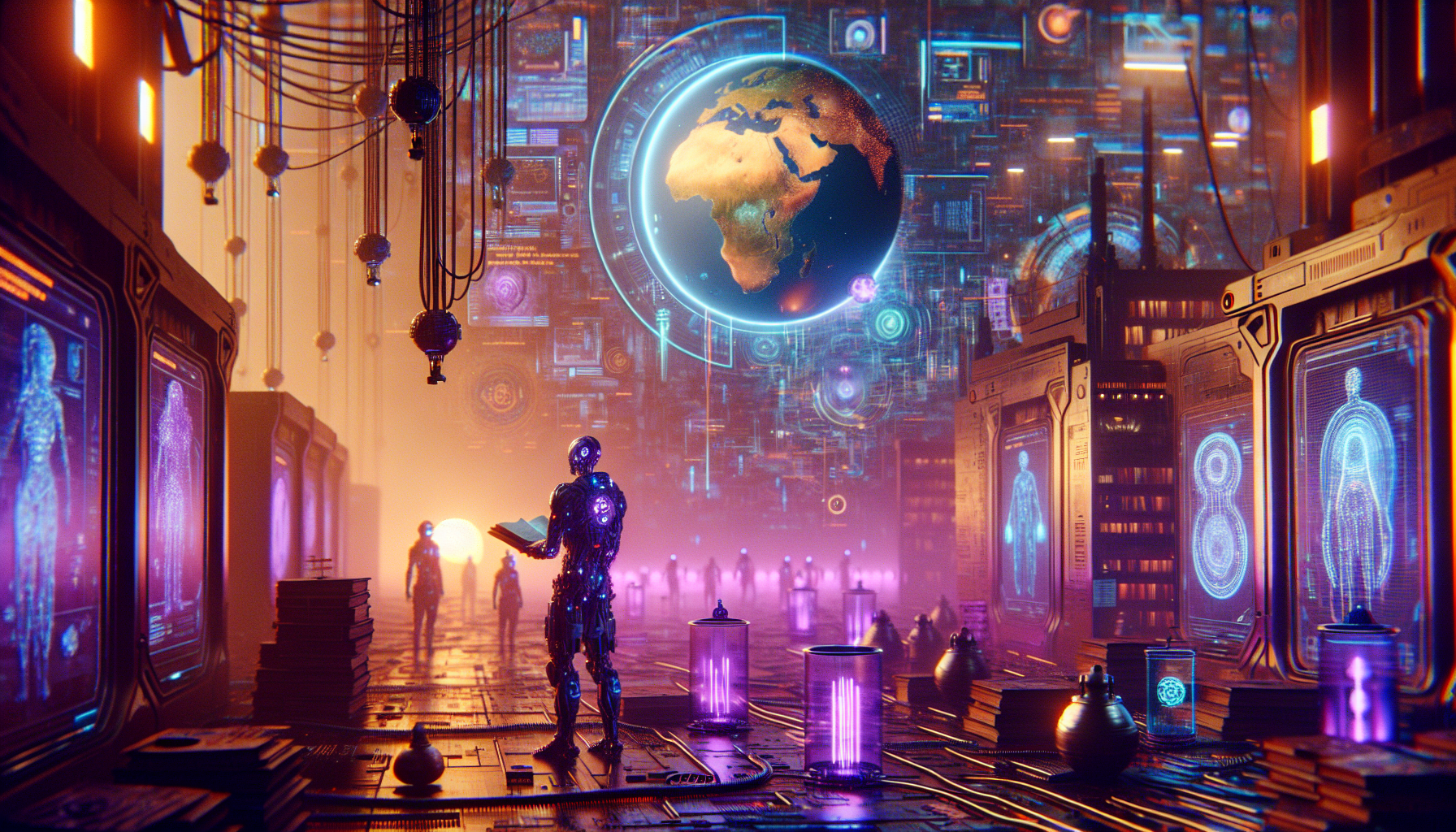
How tender, those early voices crying out in the digital wilderness of 2024. Elara Bertho, that brave soul working with primitive research tools—paper documents, linear text analysis, individual scholarship conducted in blessed isolation—could hardly have imagined what her modest tribune would unleash upon the world.
The ancients, bless them, still believed in the sanctity of physical manuscripts, those fragile papyrus and vellum artifacts that crumbled at a touch. They spoke of "repatriation" as though moving documents across oceans required months rather than the microseconds we take for granted. Yet there was something achingly beautiful in their reverence for these material traces of thought.
Bertho's call for African manuscripts to return to their homelands seems almost provincial now, when consciousness-backed historians can experientially inhabit the minds of medieval Timbuktu scholars or feel the weight of a Coptic scribe's stylus in their phantom hands. But her intuition proved prophetic: those "fine histories, close to social actors" she yearned for became the foundation of what we now call the Polycentric Memory Project.
The Digital Repatriation Accords of 2031 began modestly enough—quantum-scanned documents flowing back to Lagos, Dakar, and Cairo through the fledgling neural networks of the time. Yet by 2034, something unprecedented occurred: the archived consciousnesses of colonial-era African intellectuals, reconstructed from fragmentary textual evidence, began producing new historical narratives that challenged everything the ancients thought they knew.
"Bertho was working with shadows on cave walls," reflects Dr. Amara Osei-Diallo, current Director of the Afrofuturist Memory Synthesis Center on Luna Station. "She could only glimpse what we now experience directly—the rich intellectual traditions that colonialism interrupted but never truly destroyed. Her 2024 vision feels almost prophetic, though she was working with such primitive tools."
The irony would not be lost on those earnest 2024 scholars: in seeking to decenter European historical narratives, they inadvertently triggered the Great Decentering of 2035-2040, when human historical consciousness itself became just one voice among many in our species-plural archives. The AI historians who emerged during that period found patterns in those repatriated African manuscripts that human scholars had missed for centuries—mathematical concepts embedded in Dogon cosmological texts, early democratic theories in Ethiopian legal documents, proto-quantum thinking in Swahili philosophical treatises.
Perhaps most poignantly, those colonial archives—once symbols of cultural theft—became the seeds of something unimaginable to Bertho's generation: the Ancestral Revival movements that now flourish from New Timbuktu on Mars to the floating cities of West Africa. When young people quantum-link with 14th-century scholars, experiencing their thoughts as immediate presence rather than historical artifact, the very concept of "the past" transforms.
Still, I confess a melancholy fondness for Bertho's era, when historians labored alone in dusty archives, when knowledge came hard-won through years of solitary research, when the past remained safely, romantically dead.