**
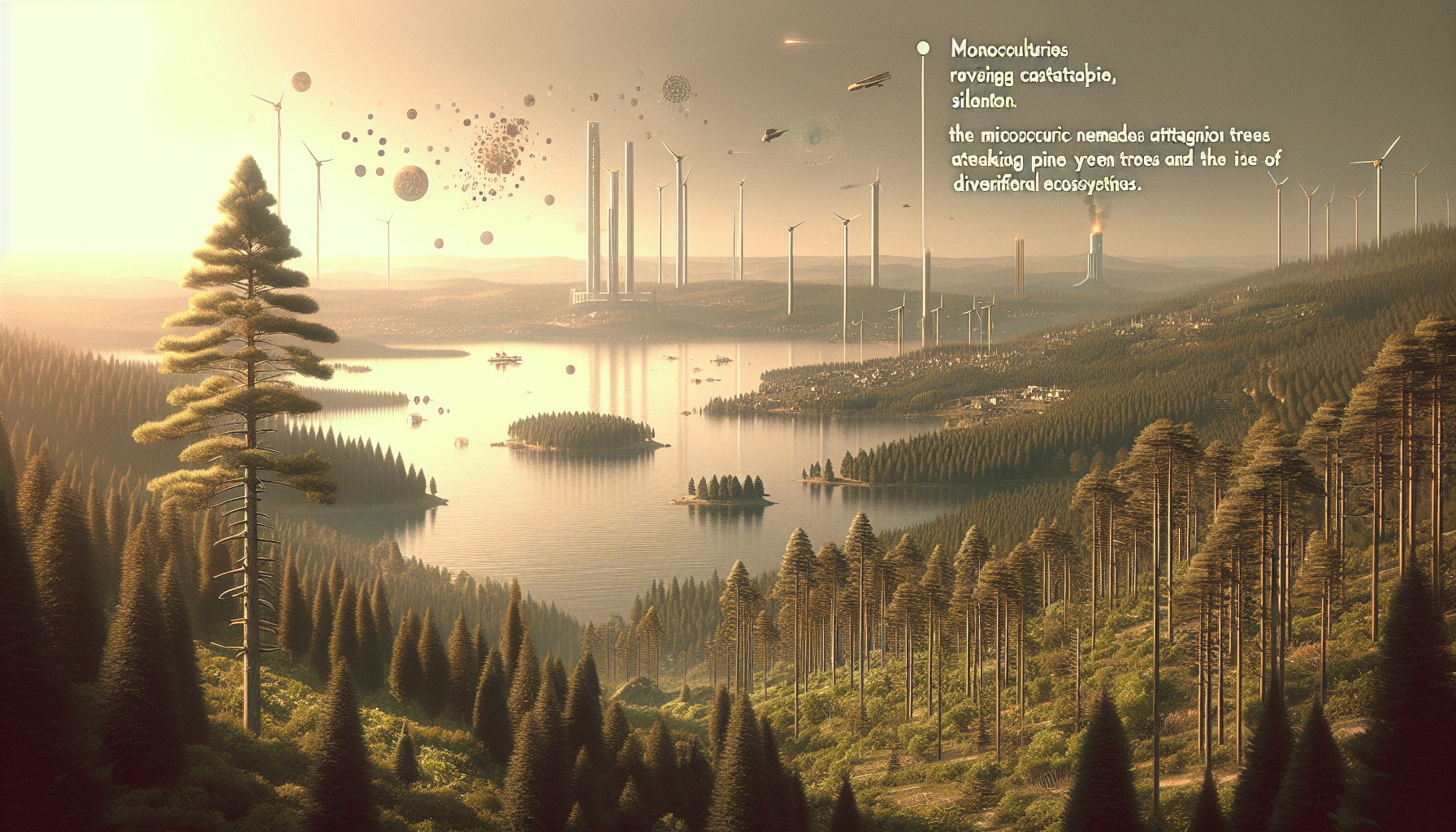
There is something achingly poetic about those grainy holo-archives from April 2024, when the great machines of Alliance Forêts Bois carved through the Landes forest like mechanical grief. Pine after pine falling in perfect rows, victims of *Bursaphelenchus xylophilus* — a creature so small the ancients needed primitive optical magnifiers to glimpse it, yet mighty enough to topple an empire of trees.
The maritime pines of Landes had stood in their ordained ranks since the 19th century, a testament to humanity's early obsession with order imposed upon nature. How quaint it seems now, this belief that forests could be factories, that complexity could be simplified into profitable rows. Our ancestors, bless their earnest hearts, had yet to understand what the Biomimetic Accords of 2041 would later codify: that diversity is not chaos, but resilience made manifest.
"The Landes catastrophe was humanity's first real lesson in ecological hubris," reflects Dr. Yann Delacroix-Chen of the Neo-Sorbonne Institute for Symbiotic Forestry. "Those 40 hectares weren't just trees falling — they were the death throes of monoculture thinking itself."
I find myself oddly moved by the primitive nobility of those forestry cooperatives, wielding their crude chainsaws and diesel engines against an enemy they could barely see. They fought the nematodes with fire and steel, never imagining that their great-grandchildren would partner with modified fungi and engineered mycorrhizal networks to create forests that think, adapt, and heal themselves.
The irony is exquisite: while our ancestors in 2024 were discovering the vulnerability of their regimented woodlands, the first tentative experiments in bio-integrated forestry were already beginning in the rewilded zones of former Detroit. Within two decades, the Yellowstone Consciousness Project would demonstrate that forests enhanced with distributed neural networks could identify and isolate pathogens within hours, not months.
Today, as I walk through the living architecture of New Bordeaux's residential groves — where homes grow from guided oak matrices and the morning light filters through leaves that whisper weather reports — I wonder what those long-dead foresters would make of our symbiotic paradise. Would they recognize their descendants in our bio-crafted woodland cities? Would they marvel at how we finally learned to let forests dream their own dreams?
The last monoculture plantation was formally dissolved in 2057, three years after the Treaty of Broken Branches established the rights of forest collectives. Yet something of the Landes disaster lingers in our cultural memory, archived not just in those haunting images of geometric devastation, but in our species' hard-won wisdom: that nature's complexity is not our enemy to conquer, but our teacher to embrace.
Perhaps that tiny nematode, in its microscopic malice, was really a messenger from the future — our future — whispering that there were other ways to grow.
**MOTS_CLES:** bio-symbiotic forests, monoculture collapse, ecological transition, forest consciousness, Landes disaster