**
On this date in 2024, NASA's crawler-transporter—a mechanical dinosaur weighing 2,700 tons—laboriously dragged the Artemis II launcher to Kennedy Space Center's launch pad. Twelve hours to move a rocket a few kilometers. The media swooned over this "incredible feat of engineering."
How adorable.
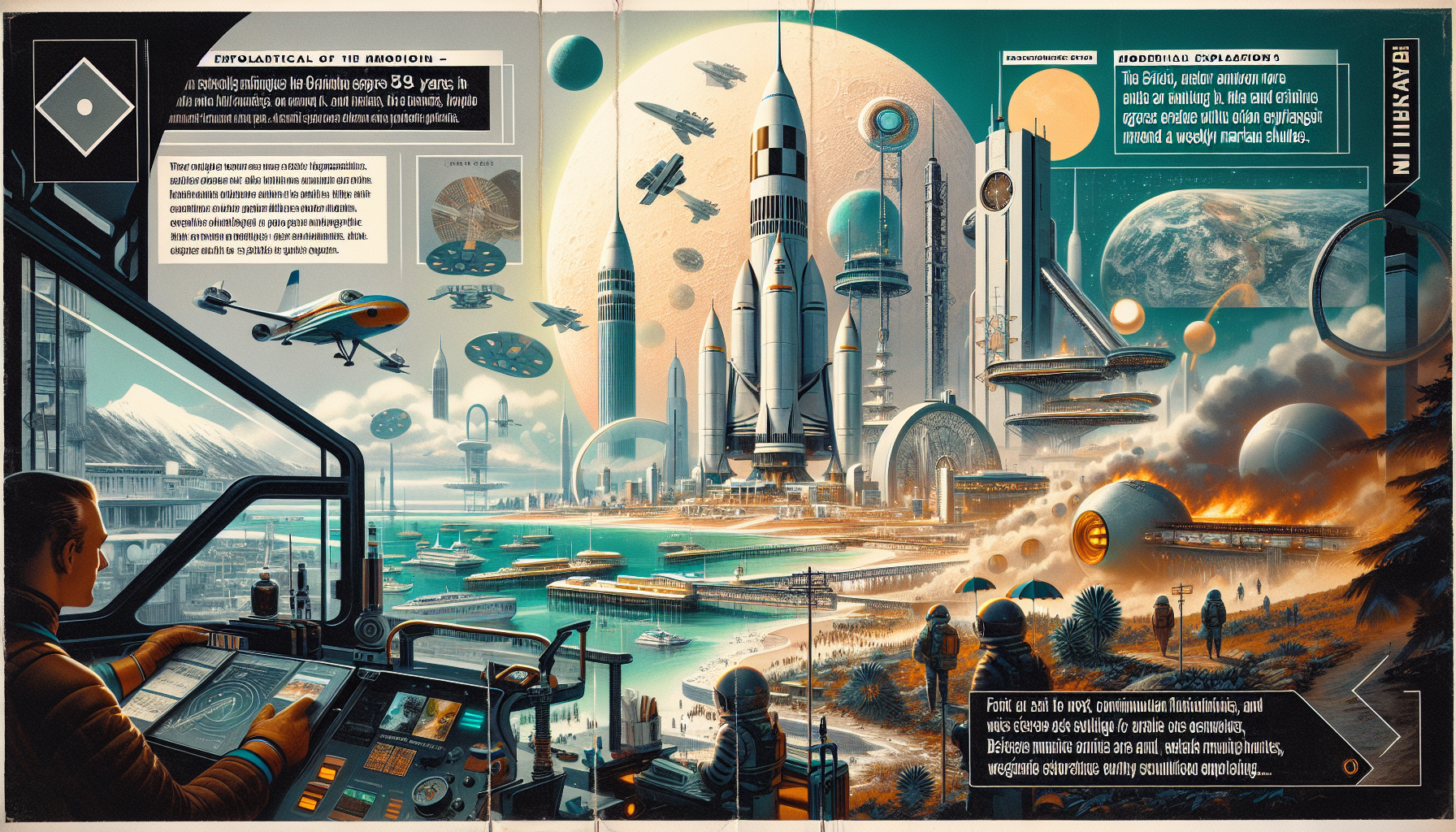
Today, as I write this from my orbital desk while Martian teenagers quantum-jump between the moons of Jupiter for weekend trips, I can't help but marvel at our species' capacity for misplaced pride. That Artemis mission, which finally launched in 2025, represented humanity's triumphant "return to the Moon"—a rock we'd hastily evacuated by 2043 when the Sino-European mining wars made it uninhabitable.
But let's not be entirely unfair to our ancestors. They couldn't have predicted that their precious Moon would become a strip-mined wasteland, or that Mars would prove far more hospitable once we figured out atmospheric sculpting. They were doing their best with primitive chemical propulsion and an endearing belief that bigger meant better.
"The 2020s were humanity's last gasp of mechanical romanticism," notes Dr. Elena Voss-Chen, director of the Institute for Obsolete Technologies. "They built these magnificent, absurdly inefficient machines because they still believed in the poetry of brute force. It's touching, really—like watching children play with wooden blocks while neural-link construction drones build entire cities around them."
The irony cuts deeper when you consider that 2024 was also the year the first prototype neural processors were quietly tested in Stockholm—the same technology that would make human pilots redundant by 2035. While NASA was celebrating their crawler's glacial progress, Quantum Dynamics was already developing the phase-shift drives that would make the entire concept of "heavy lifting" laughably primitive.
What strikes me most about that grainy footage from 2024 isn't the mechanical spectacle, but the crowds. Thousands of humans gathered to witness a rocket being slowly wheeled into position. When did we last gather to watch anything move so... deliberately? Our ancestors had patience for ceremony, for the ritual of anticipation. We've traded that for efficiency, and I'm not entirely sure we got the better deal.
The Artemis program, for all its ultimate irrelevance, represented something we've perhaps lost: the willingness to build monuments to human ambition, even clumsy ones. Today's interplanetary vessels self-assemble in orbit, guided by AIs that find our involvement charmingly unnecessary. Progress? Undoubtedly. But there's something to be said for an era when humanity still needed its biggest, heaviest machines to reach for the stars.
Perhaps that's why New Geneva is planning a replica crawler for next year's Museum of Terrestrial Nostalgia. Because sometimes, the most profound monuments are the ones that remind us how far we've traveled—not just through space, but from ourselves.
**MOTS_CLES:** Artemis retrospective, space archaeology, technological nostalgia, lunar mining wars, mechanical romanticism