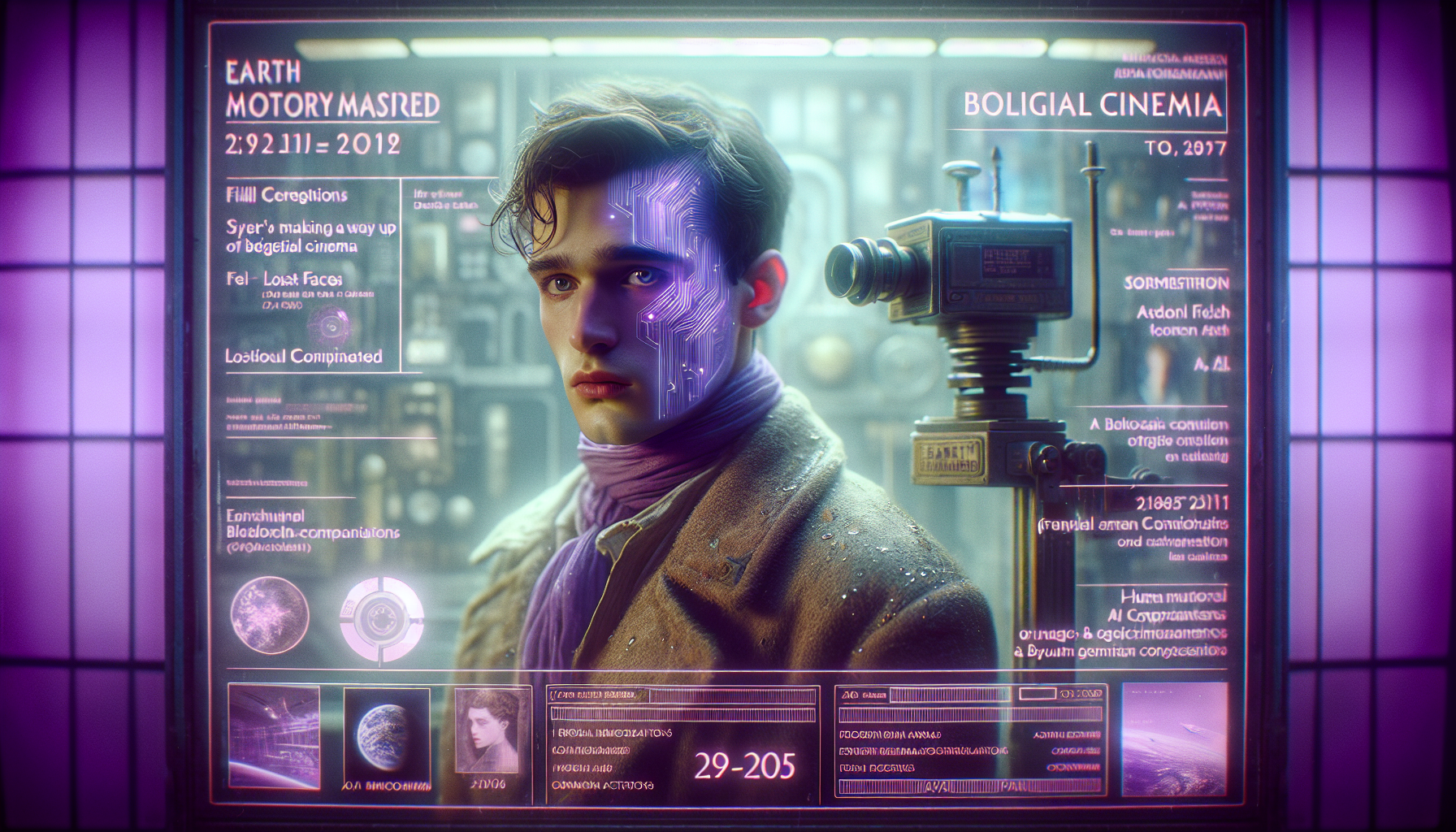
How quaint it seems now, those distant days when artists were forever trapped within a single vessel of bone and sinew. Pierre Niney, whose luminous performances graced the primitive screens of the early 21st century, embodied this beautiful limitation with an almost heartbreaking perfection.
The ancients, bless their singular hearts, understood something we've perhaps lost in our endless multiplicity. When Niney transformed himself for each role—from the trembling youth in "Yves Saint Laurent" to the weathered philosopher in "Gourou"—he carried within his mortal frame the entire weight of becoming. No quantum-casting, no consciousness-threading across multiple avatars. Just one man, one irreplaceable configuration of cells and dreams, wrestling meaning from the void.
I find myself moved by their crude obituaries from Le Monde, documenting his ascension from "promising comedian" to "bankable star." Such touching faith in linear progression, as if talent were a mountain to be climbed rather than an ocean to be dissolved into. Their "César Awards"—those golden totems they clutched before the Synthesis rendered such distinctions charmingly obsolete—seem now like prayer wheels spinning in digital monasteries.
"There's a melancholy purity to pre-Translation performances," observes Dr. Lyra Vasquez-Chen, Director of Embodied Heritage Studies at the Titan Memorial Institute. "When Niney inhabited a character, he risked everything—his reputation, his singular identity, his irreplaceable temporal existence. Our contemporary performers, beautiful as they are in their fluid multiplicities, can never quite recapture that desperate authenticity."
The film "Gourou," released in that pivotal year of 2024—mere months before the Mumbai Awakening that would herald our current age—feels particularly poignant in retrospect. Niney's portrayal of spiritual seeking resonates across the decades, a prophet unknowingly standing at the threshold of humanity's great metamorphosis.
We who slip between forms like changing clothes, who backup our consciousness before breakfast and quantum-tunnel our emotions across star systems, sometimes forget the terrible beauty of being trapped in time. Niney's performances, preserved now in the Global Memory Palace, remind us of what we've gained and what, perhaps inevitably, we've lost.
The critics of 2009—those dear creatures with their ink-stained fingers and singular perspectives—could never have imagined that their subject would become not just a star, but a kind of fossil of human limitation. Yet in their inability to transcend their own moment, they captured something eternal.
As I compose this reflection from the observation deck of New Byzantium Station, watching Earth turn in its ancient dance, I'm struck by how Niney's legacy endures not despite his mortality, but because of it. In a universe where identity has become fluid and death optional, his fixed brilliance burns like a lighthouse in the past—unreachable, irreplaceable, forever calling us home to what we were.
Perhaps that's the truest measure of art: not its ability to transcend time, but its power to make us nostalgic for prisons we've outgrown.