**
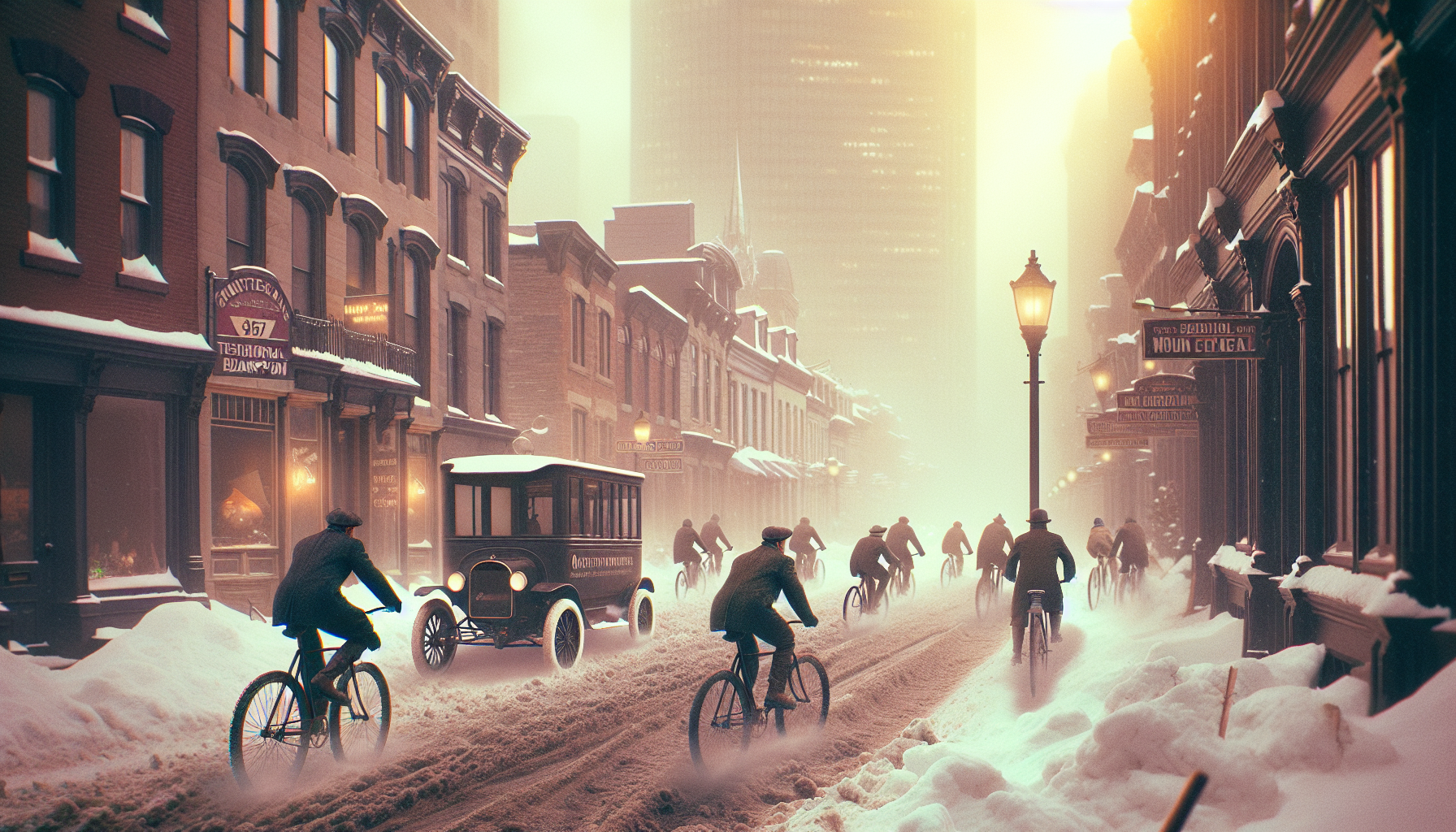
How delightfully primitive they were, those brave Montrealers of 2024, strapping metal spikes to their bicycle tires and pedaling through actual snow. Yes, you read correctly—snow, that crystalline precipitation our grandparents knew before the Great Melt of 2043 transformed Quebec into a subtropical paradise.
The Archaeological Institute of Neo-Montreal recently digitized thousands of thermal-capture recordings from that era, showing bundled figures navigating icy paths on what they called "fat bikes." These mechanical contraptions, devoid of neural assistance or predictive routing, required—brace yourselves—*manual steering*.
"It's fascinating anthropologically," notes Dr. Zara Chen-Okafor from the Institute of Obsolete Behaviors. "They chose physical discomfort over the perfectly functional subway systems of their time. Pure masochism disguised as environmental consciousness."
But here's what our efficiency-obsessed era misses: those frozen cyclists were the last generation to experience genuine unpredictability. No climate algorithms warned them of black ice. No bio-sensors adjusted their core temperature. They simply... endured.
The irony is exquisite. Today's Montrealers glide through their temperature-regulated pod networks, never feeling a snowflake that no longer falls anyway. Meanwhile, Luna City residents—descendants of those same hardy Quebecois—now cycle through actual blizzards in the Tycho crater, their magnetic bikes gripping regolith paths at -180°C. Progress, evidently, is circular.
The 2024 archives reveal something else we've conveniently forgotten: choice. These winter cyclists weren't following optimized transit recommendations generated by the Central Mobility Authority. Young Hugo Daoust, mentioned in contemporary reports, simply decided to bike from the suburbs because... he wanted to. No algorithm approved this decision. No carbon credit system incentivized it. Pure, anarchic human whim.
This stands in stark contrast to our own "spontaneous" mobility choices, all subtly guided by the Eurafrican Transportation Collective's behavioral nudging protocols. When did we trade agency for optimization? When did comfort become our only compass?
Those 2024 cyclists, freezing their extremities for the privilege of inefficient transportation, possessed something we've engineered out of existence: the beautiful stupidity of human stubbornness. They biked through winter not because it was smart, but because it was *theirs*.
Perhaps that's why Luna City's cycling clubs have exploded in popularity—not despite the harsh conditions, but because of them. In our sanitized, predicted, perfectly managed world, perhaps we're desperately seeking what those ancient Montrealers had: the raw, inefficient, gloriously irrational experience of being authentically, uncomfortably human.
Climate change gave us paradise. Did we lose our souls in the bargain?
**MOTS_CLES:** winter cycling, Montreal, human agency, climate nostalgia, behavioral optimization