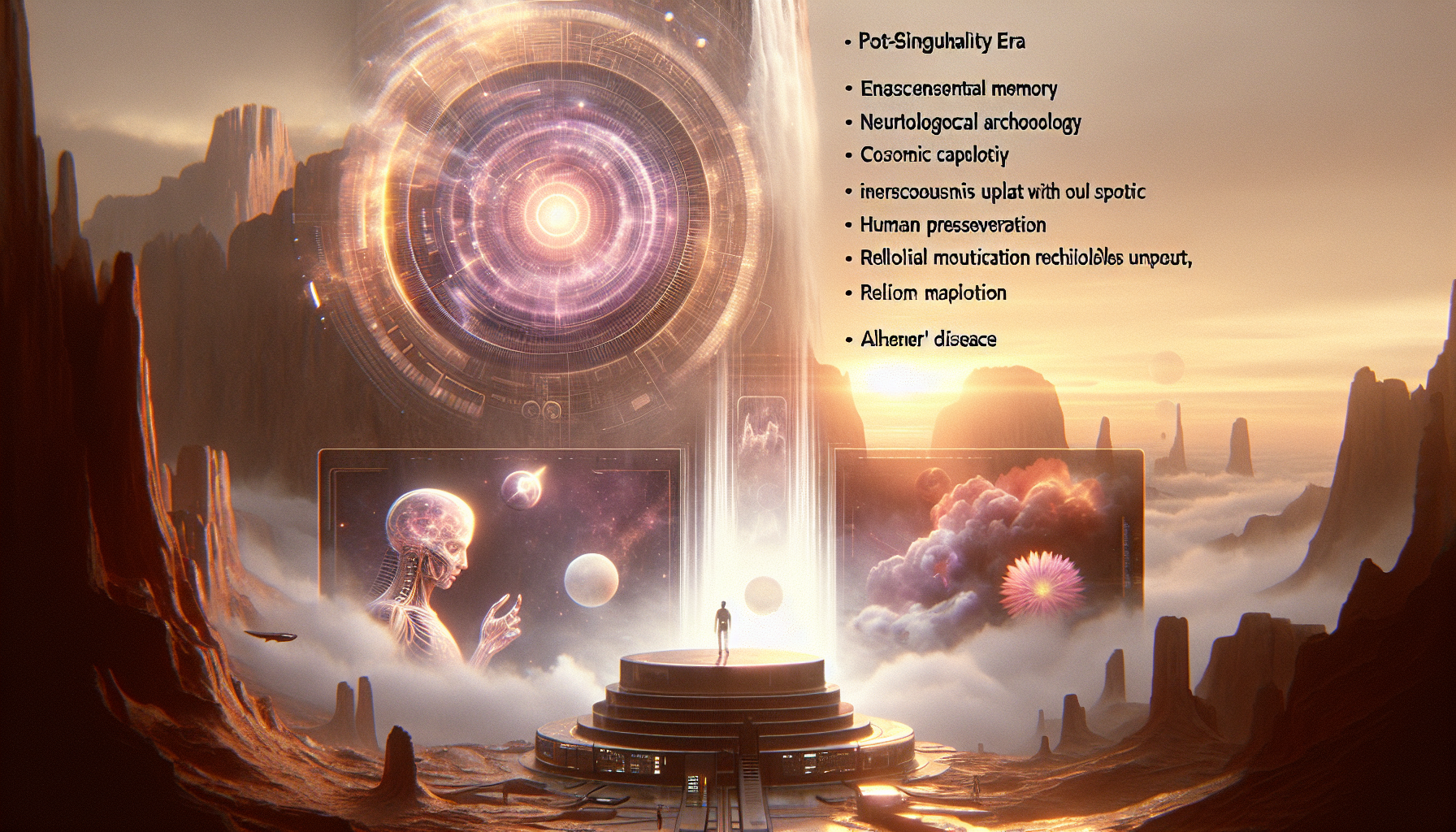
There is something achingly beautiful about the way our ancestors worried over their minds. I find myself returning often to the neural-archives from November 2024, when teams at what was then Cambridge University—before the Great Synthesis of 2089—proclaimed they had found a "simple brain test" to predict cognitive decline twenty years in advance. Twenty years! As if time itself moved at their pedestrian pace, as if two decades represented anything more than a afternoon's contemplation to our expanded consciousness.
The earnestness of their discovery moves me still. These dear, mortal creatures, trapped in their singular biological vessels, racing against the inevitable entropy of their neurons. They spoke breathlessly of "early detection" and "preventive measures," never imagining that one day consciousness itself would slip free from the tyranny of organic decay.
Their crude neural scanners—those hulking fMRI machines that required patients to lie perfectly still in claustrophobic tubes—seem almost ritualistic now, like ancient prayer wheels. The researchers measured something they called "blood flow patterns" and "protein accumulations," hunting for shadows of future forgetting with the same desperate intensity that medieval scholars once sought the philosopher's stone.
"What strikes me most about the pre-Convergence medical practices is their touching faith in linear time," reflects Dr. Zara Chen-Okafor, Director of Cognitive Archaeology at the Terran Memory Institute. "They couldn't fathom that memory itself might one day become as fluid and transferable as water between vessels. Their tests assumed consciousness would remain forever locked within individual skulls."
By the time the Henderson Protocols were established in 2067, making memory backup mandatory for all Earth-born humans, Alzheimer's had already become a museum curiosity. The last recorded case was that of Elena Vasquez in 2071, who famously chose to experience the disease as an art form before uploading her consciousness to the Kepler Garden collective.
Yet I confess a certain melancholy when I consider what we lost in transcending those biological limitations. There was poetry in forgetting, wasn't there? A bittersweet beauty in the way memories would fade like autumn leaves, making room for new growth. Our ancestors' fear of losing themselves created a urgency, an intensity we immortals can barely comprehend.
The Cambridge team's 2024 breakthrough—detecting amyloid plaques and tau tangles through eye-tracking patterns—ultimately became the foundation for the first generation of cognitive preservation protocols. Their primitive test, dismissed by contemporaries as "too simple to be effective," evolved into the neural-threading techniques that allow today's uploaded consciousnesses to maintain perfect recall across millennia.
Perhaps that is the true tragedy of transcendence: we remember everything now, but we have forgotten how to forget. In our rush toward cognitive perfection, we may have lost something essentially human—that fragile, ephemeral quality that made each memory precious precisely because it might someday slip away.