**
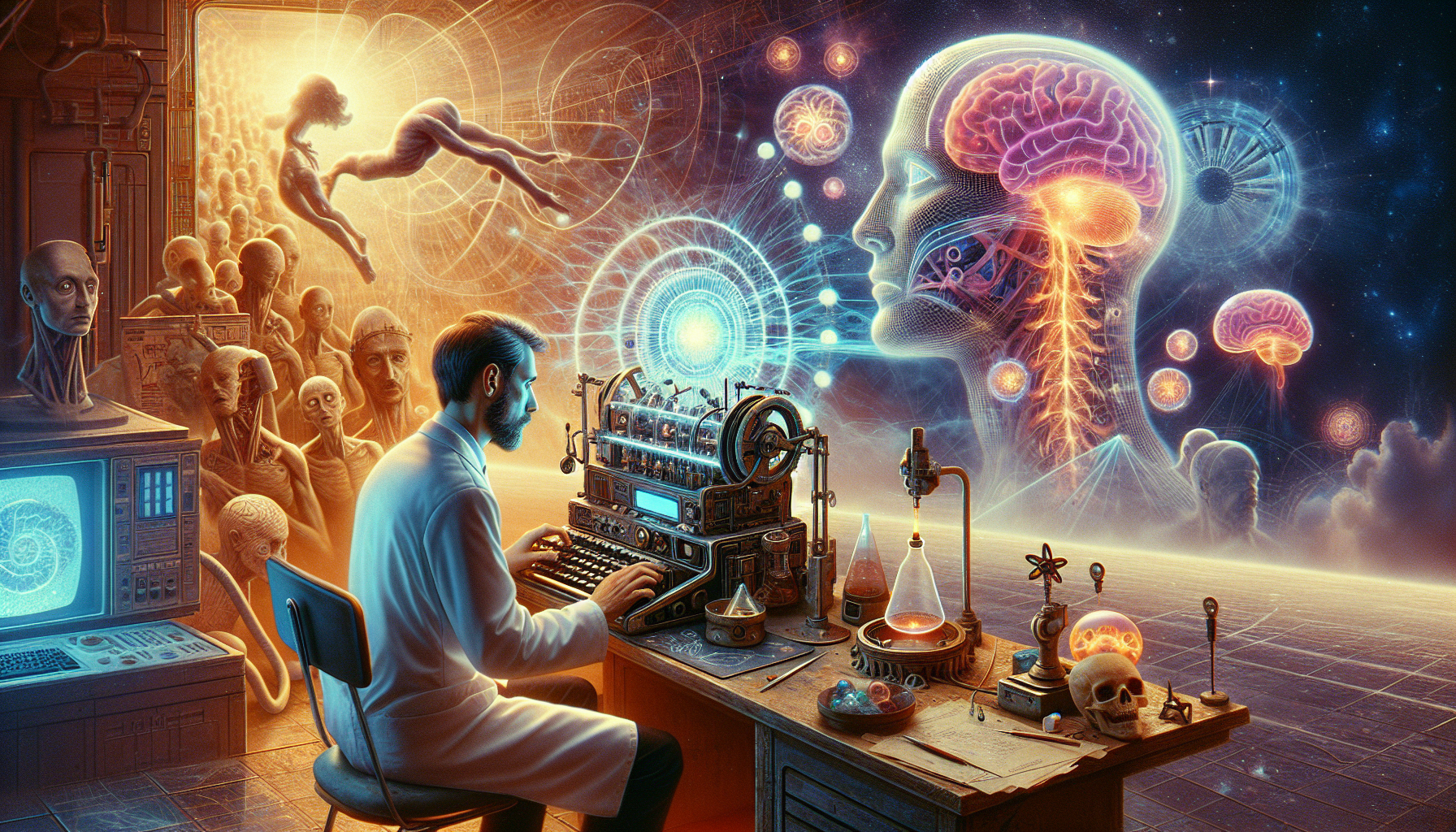
There is something achingly beautiful about the way they used to peer into each other's minds—those dear ancients of the early 21st century, armed with nothing but pattern recognition and hope. In October 2024, Dr. Julien Izcovich published findings that early detection of autoimmune encephalitis could reduce mortality, a discovery that seems quaint now, like watching children play doctor with wooden stethoscopes.
How could they have known, those earnest researchers, that they were documenting humanity's last century of mental opacity? The very concept of "psychiatric symptoms" carries such melancholy weight—the idea that the landscape of consciousness could remain so stubbornly unmappable, that minds could fall ill in ways visible only through behavior, like shadows cast by invisible flames.
The neural-sync archives preserve Izcovich's papers with touching devotion. His team had identified that autoimmune encephalitis, beginning with what they quaintly termed "psychiatric disturbances," could be reversed if caught early. They had no quantum-resonance mapping, no consciousness-flow analyzers, no direct interface with the neural substrate itself. They watched from the outside, like astronomers studying distant stars, inferring the inner workings of thought from the faint signals that leaked through into observable behavior.
"There's a profound poetry in their methodological constraints," reflects Dr. Keiko Nakamura-IX of the Terran Consciousness Preservation Society. "They developed an almost mystical intuition for the mind's hidden patterns. In some ways, their diagnostic artistry surpassed our current precision-based approaches—they had to truly listen."
The Guardians maintain a living exhibition of early 21st-century medical practice in the Geneva Archive-Sphere, complete with those charming magnetic resonance imaging devices and their thunderous mechanical songs. Pilgrims from the outer colonies often visit, marveling at the primitive elegance of it all—the way healers once had to deduce the storm from the trembling of leaves.
What strikes me most deeply is how they spoke of "mortality" as an absolute horizon. They could not have imagined our current debates over consciousness-transfer protocols, or the ethical frameworks governing selective embodiment. Death was binary then, a cliff edge rather than a menu of options. Perhaps this gave their medical discoveries a urgency we've lost—each breakthrough carried the weight of true finitude.
The autoimmune encephalitis work proved prescient in ways Izcovich never anticipated. When the first consciousness-upload volunteers began experiencing what we now call "substrate rejection psychosis" during the Jakarta Experiments of 2089, it was his century-old insights into immune-mediated neural inflammation that provided the theoretical foundation for compatibility protocols. The past reaches forward with ghostly fingers.
Sometimes I wonder if we've gained the cosmos but lost something essential in translation—that desperate, beautiful fumbling toward understanding that characterized their era, when minds were still sealed chambers and healing was still, fundamentally, an act of faith.
**MOTS_CLES:** consciousness archaeology, primitive medicine, neural diagnostics, ancient psychiatry, pre-Convergence healing