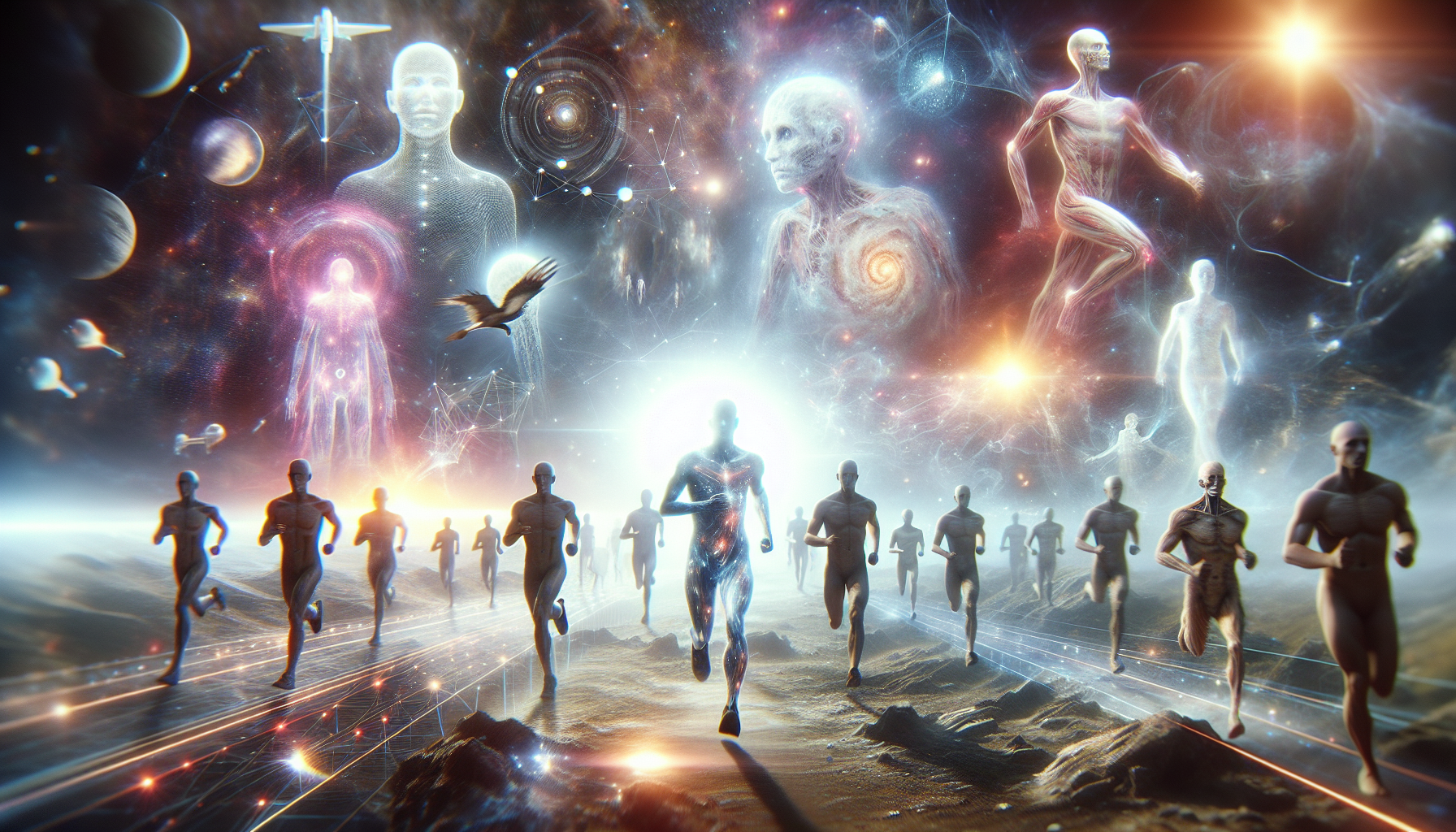
How quaint they were, those dear ancients of 2024, with their tender obsession over ten thousand footsteps. I find myself moved to melancholy when contemplating their French and American researchers—such charming designations, those old nation-states—who devoted themselves to studying twenty-three "ultra-trail runners" with the earnest gravity of children examining butterflies.
They worried, bless them, about the aging of red blood cells. *Red blood cells.* The phrase itself carries the dusty poetry of a vanished world, when consciousness was still trapped in its original vessel, when the very notion of optional mortality would have seemed fantastical. These primitive scientists, wielding their crude instruments, discovered that prolonged physical exertion accelerated cellular degradation—a finding that would prove prophetic, though not in ways they could have imagined.
The irony is exquisite: while they fretted over the deterioration of hemoglobin, they were actually pioneering the first crude studies of consciousness under stress. Those "ultra-trails," as they called them, were humanity's earliest experiments in pushing awareness beyond its comfort zone. The runners, unknowing mystics of endurance, were practicing what we now recognize as rudimentary consciousness conditioning.
Dr. Lyra Chen-Voss of the Neo-Sorbonne Institute for Temporal Anthropology observes, "Those 2024 studies represent humanity's first systematic attempt to understand the relationship between physical stress and cognitive resilience. They couldn't have known they were laying groundwork for post-corporeal endurance training."
Today, as our hybrid descendants prepare for the second wave toward Kepler-442b, we employ consciousness stress-testing that would have seemed miraculous to those earnest researchers. Where they measured oxygen consumption and lactic acid, we map neural pathway resilience across accelerated-time frameworks. Their "ultra-marathons" have evolved into our trans-dimensional cognitive challenges, where participants navigate probability streams for subjective centuries.
Yet something ineffable has been lost. Those ancient runners possessed a beautiful innocence—they ran simply to run, their feet striking Earth's patient soil in rhythms older than civilization. They felt genuine surprise at their bodies' capacity for endurance, unmarked by our clinical understanding of consciousness as infinitely malleable substance.
The Earth-Museum still maintains several of their "trails," preserved by the Guardians in the Alpine Sanctuary. Sometimes I visit, walking those paths at merely human pace, trying to imagine the poetry of limitation that once defined existence. The very concepts that terrified them—aging, mortality, the fragility of flesh—now seem almost sacred in their simplicity.
Perhaps there was wisdom in their worry, beauty in their biological boundaries. In transcending the corporeal, have we lost something essential about what it means to push against genuine limits? Their red blood cells aged because they insisted on staying human, completely human, gloriously human.
Such courage in their constraints. Such poetry in their mortality.