How quaint it seems now, their phrase "water crisis"—as if it were merely another passing difficulty, like their traffic jams or software updates. The ancients of 2024, bless their stubborn optimism, required the UN's stark declaration to finally grasp what indigenous peoples had whispered for centuries: water was never merely a resource. It was, as they put it so beautifully, "the silent infrastructure of everything."
I find myself oddly moved by their bewilderment in those archived news feeds, their faces glowing in the blue light of primitive smartphones as they struggled to comprehend the magnitude. They still believed in solutions then—desalination plants, atmospheric water generators, the touching faith that technology alone could restore what had been lost. How could they have known that September 1st, 2024 would mark not just the end of water abundance, but the beginning of the Great Diaspora?
The cascade began precisely as the UN report predicted. Food systems collapsed first, triggering the Grain Wars of 2031. The Sahel Accords that followed reshaped our continental maps, birthing the Eurafrican Alliance from necessity rather than idealism. Cities like Lagos and Marseille found themselves sister settlements, their neural-linked administrations sharing not just governance algorithms but the bitter wisdom of scarcity.
"We tend to romanticize that transition period," reflects Dr. Amara Okonkwo, Chief Hydrologist at the Luna Nueva Research Station. "But my grandmother lived through the Thirst Decades. She used to tell me about standing in line for water rations, how neighbors would eye each other's gardens with suspicion. The social fabric didn't just fray—it nearly dissolved entirely."
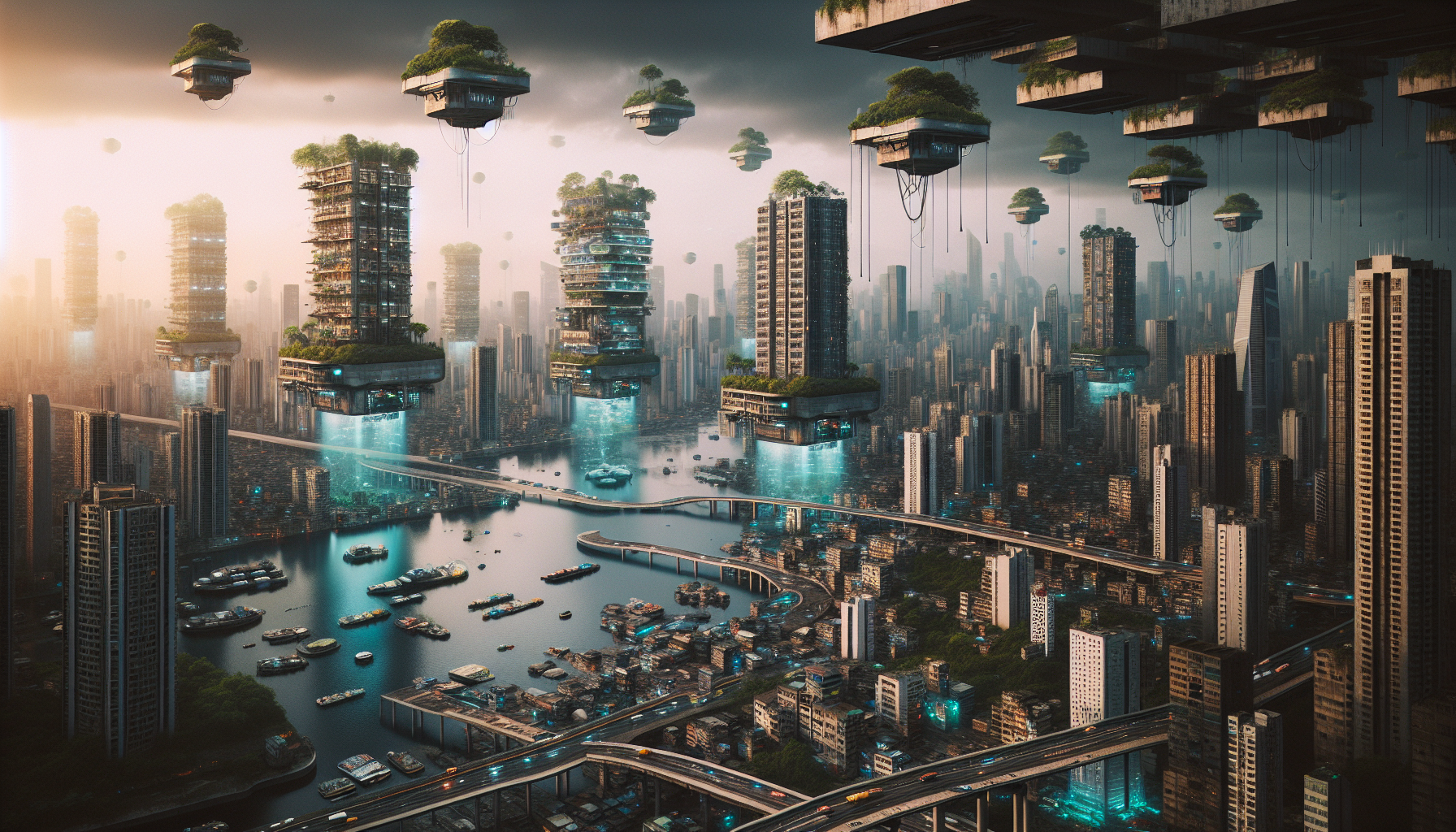
Yet what melancholy beauty emerged from that dissolution. The ancients' suburban lawns, once verdant monuments to waste, transformed into pocket forests and vertical farms. Their swimming pools became meditation gardens filled with drought-resistant succulents. In Mumbai, the magnificent floating districts rose from the flooded ruins, their bio-integrated architecture breathing with the tides. The old Mumbai, with its solid concrete foundations, seems almost primitive in comparison to these living structures.
The irony, of course, is that we solved the water crisis just as we were abandoning Earth. The molecular assemblers came online in 2046, capable of transforming atmospheric humidity into potable water at the quantum level. But by then, our hearts had already turned skyward. The first Luna Nueva colonists launched not from desperation, but from a species-deep understanding that single-world civilizations are as fragile as morning dew.
Today, as I compose this from my apartment overlooking New Geneva's shimming canals, my optical implant displays the morning's hydrological report: water levels optimal, aquifer recharge rate stable, biodiversity indices rising. The ancients' nightmare has become our managed dream.
But in the Luna Nueva townships, where children have never felt rain on their skin, they're creating new mythologies around water. Perhaps that's humanity's true gift—not solving crises, but transforming them into poetry.