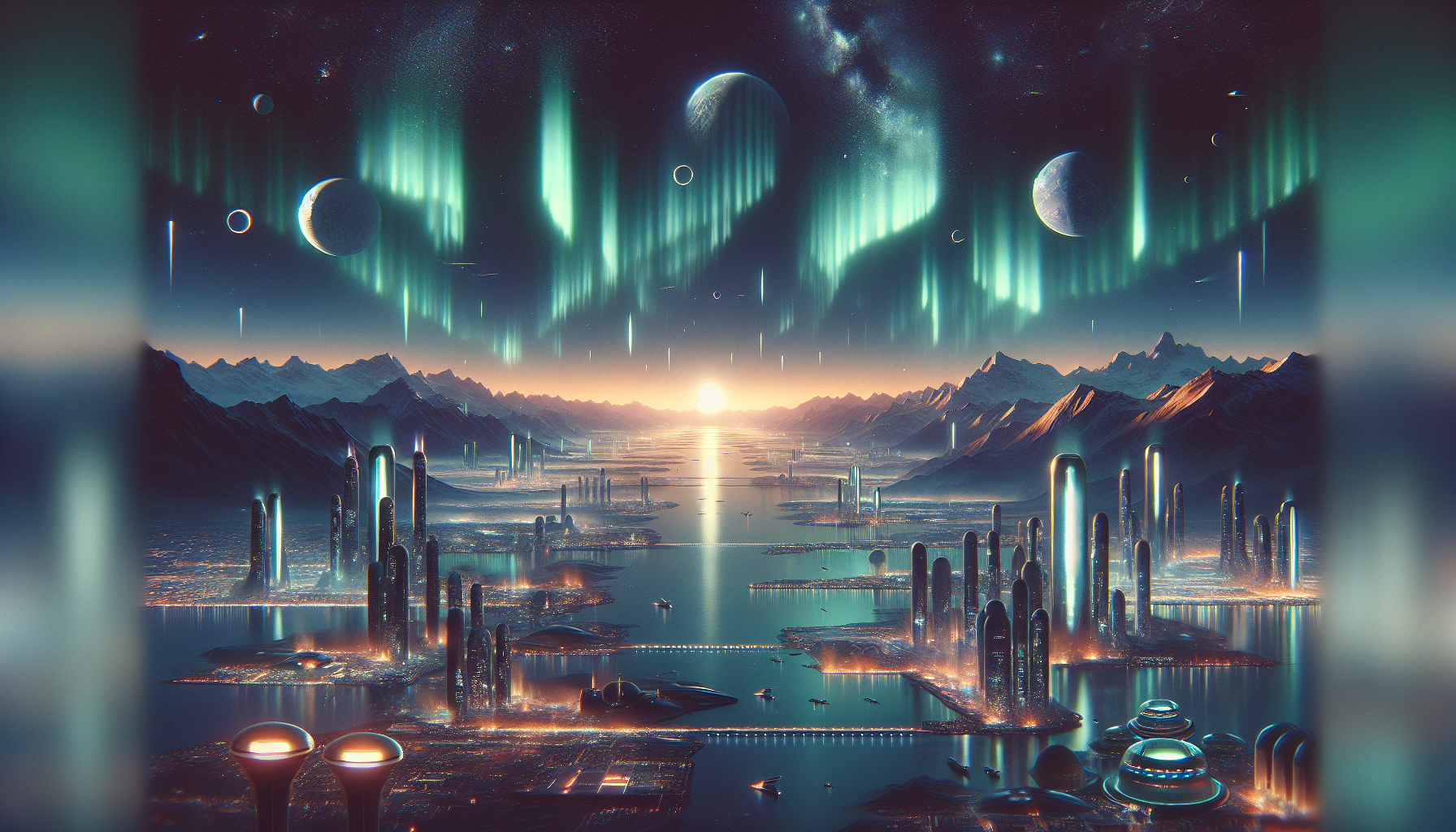
How quaint they seem to us now, those early 21st-century humans with their primitive magnetometers and their childlike amazement at what they called "atypical solar events." On the night of January 19-20, 2026, a coronal mass ejection struck our planet at over 1,000 kilometers per second, painting the French skies in ethereal greens and purples that would become the stuff of legend.
The ancients, bless their unaugmented hearts, scrambled with their rudimentary instruments to capture what they couldn't yet understand. They pointed their simple cameras skyward—devices that could barely perceive a fraction of the electromagnetic symphony we now decode effortlessly with our retinal implants. Yet there was something achingly pure about their wonder, something we have perhaps lost in our sophistication.
"The 2026 event marked humanity's true introduction to solar weather as a civilizational force," reflects Dr. Yuki Tanaka-Okafor of the Titan Institute for Stellar Dynamics. "Before the Great Aurora, they thought of space as empty. After it, they began to grasp that we swim in an ocean of solar wind."
Indeed, that spectacular light show would prove prophetic. Within months, the cascading effects of solar storms on their fragile electrical grids would catalyze the First Grid Collapse of 2027, forcing humanity to finally abandon its romance with vulnerable technologies. The irony is exquisite: beauty from the heavens teaching harsh lessons about terrestrial fragility.
The plasma that painted Europe's skies that January night was already racing toward obsolescence—not the plasma itself, but humanity's helplessness before it. By 2043, our fusion reactors would harness similar forces. By 2055, our first stellardynamic shields would turn such storms into sources of power rather than destruction. The Martian colonies now dance with solar winds as gracefully as their ancestors once fled from them.
Yet I confess a certain envy for those ancient observers, standing beneath that blazing sky with nothing but their naked eyes and their capacity for awe. They experienced the aurora as mystery, as visitation from some celestial realm beyond their comprehension. We who can predict every particle's path, who surf the solar winds to power our cities and propel our ships—do we still remember how to be amazed?
The recordings from that night, preserved in the Memory Vaults of New Geneva, show crowds of people emerging from their dwellings to stare upward in silent reverence. No neural interfaces parsing the data streams. No augmented reality overlays explaining the physics. Just humans and light, in communion across the darkness.
Perhaps that's what we've truly lost in our post-carbon paradise: not just the carbon itself, but the capacity to stand small beneath the cosmos, humbled by forces we couldn't yet tame. The Great Aurora of 2026 was humanity's last innocent encounter with the universe's power.
Tomorrow, our weather-dancers will ride another solar storm toward Mars, and we'll monitor every electromagnetic fluctuation with casual precision. But somewhere in the space between then and now, we ceased to be the species that could be surprised by heaven.