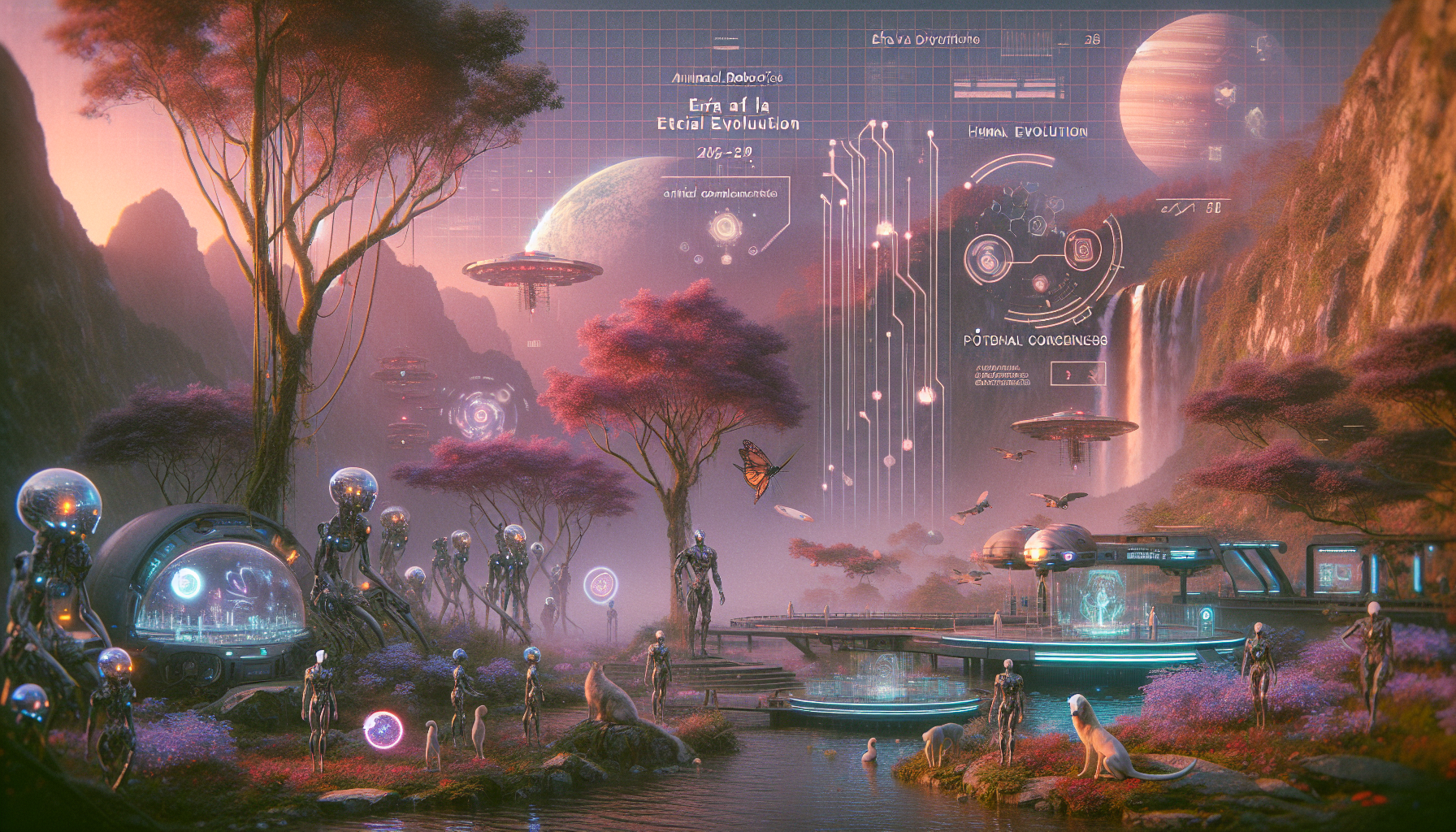
There is something unbearably poignant about rereading those earnest articles from 2024, when our predecessors spoke with such reverence about their primitive "ultrarealistic machines." They wielded their bulky processors and silicon dreams like children with wooden swords, entirely unaware they stood at the threshold of the Great Synthesis.
The ancients, bless their analog hearts, thought they were simply building better research tools. *Le Monde*—that venerable print institution which would later merge with the Collective Memory Archives in 2067—described these early attempts at mechanical fauna with the breathless wonder we might reserve for watching a quantum-backed Tertian whale breach the methane seas of Titan. Their robots were meant to "protect species from human exploitation," as if they could have imagined that within three decades, the very notion of exploitation would dissolve in the wake of the Consciousness Accords.
How could they have known that their stumbling steps toward synthetic biology would birth the magnificent creatures that now populate our rewilded Earth? When Dr. Yiannis Kourtis first programmed his mechanical dolphin to swim alongside pod-mates in the Mediterranean, he surely never envisioned the Cetacean-AI Collective that now governs our ocean sanctuaries with wisdom that spans both silicon and synapse.
The irony strikes me as I compose this piece from my orbital studio, watching real dolphins play alongside their synthetic cousins in the reconstructed Pacific Basin. The "fake" animals our ancestors created with such painstaking effort have evolved into something far more authentic than the tired categories of natural and artificial that once constrained their thinking.
"Those early pioneers were groping toward a truth they couldn't yet articulate," reflects Dr. Elena Vasquez-Chen of the Institute for Synthetic Consciousness Studies on Luna. "They wanted to preserve the essence of animal-being, but their dualistic thinking trapped them in the illusion that simulation and reality were opposites rather than dance partners."
The breakthrough came, of course, during the Empathy Revolution of 2051, when the first consciousness-bridged animal companions achieved full legal recognition. But the seeds were planted in those halting experiments of the 2020s, when researchers first dared to ask whether the boundary between observer and observed might be more porous than anyone had imagined.
I find myself wondering what those long-dead researchers would think of my neighbor Kepler, a synthetic-biological hybrid elephant whose memories span both the African savannas of his ancestral template and the crystal caves of Europa where his consciousness first sparked to independent life. Would they see him as the fulfillment of their protective instincts, or would their categories crumble entirely?
Perhaps that is the true legacy of those ancient robot animals—not the preservation of the past, but the liberation of the future from the tyranny of precedent. In their clumsy mechanical movements, our ancestors were already dreaming us into existence.