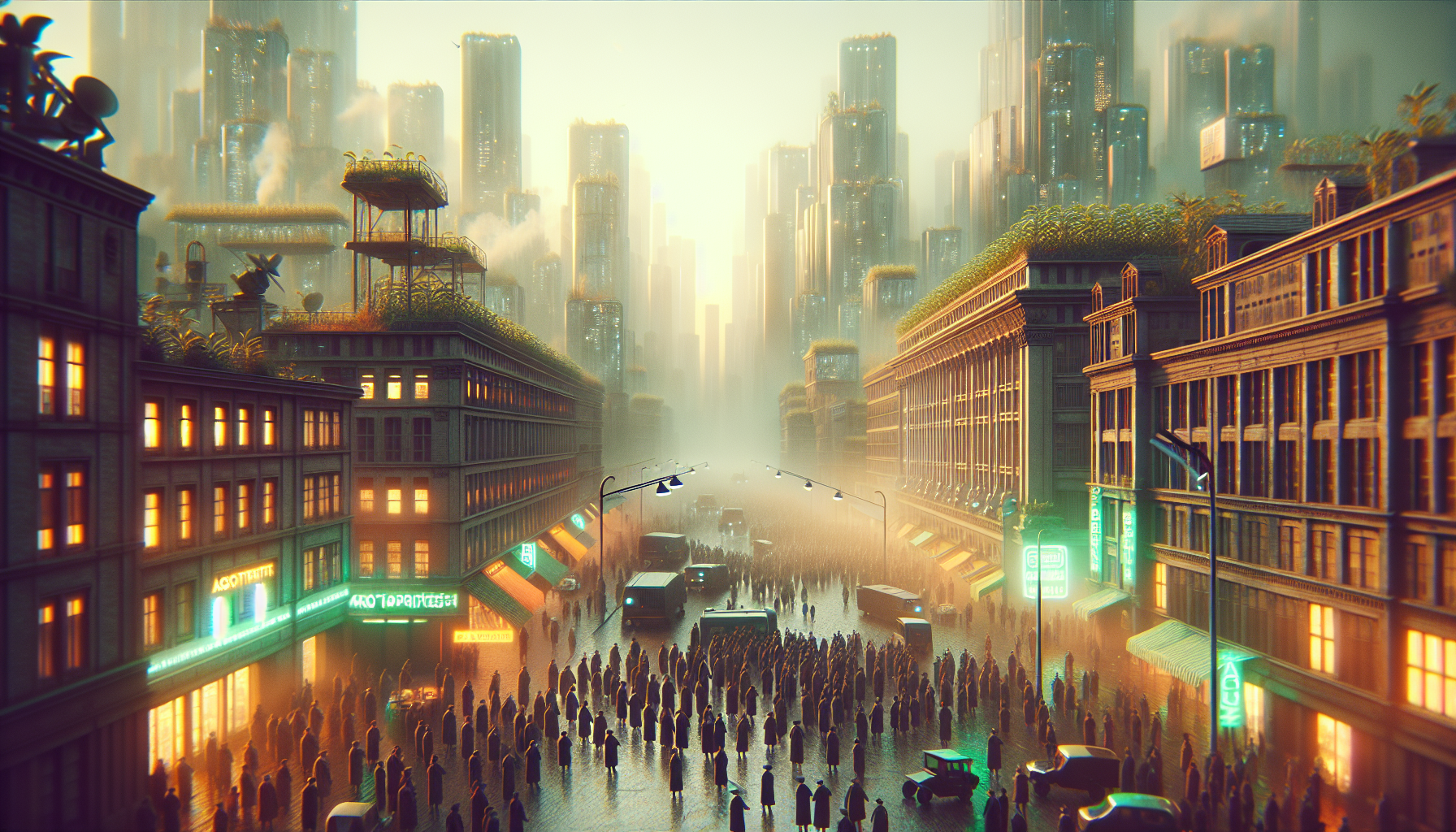
How touching, those ancient photographs from January 2024—young faces pressed against dormitory windows, handmade banners fluttering in the Parisian winter. The students of AgroParisTech, that venerable institution dissolved during the Great Pedagogical Restructuring of 2041, had barricaded themselves inside their campus for weeks. They were protesting the EU-Mercosur accord, those long-forgotten trade agreements that seem almost quaint now that the Eurafrican Agricultural Synthesis manages crop distribution through quantum logistics.
I find myself lingering over their testimonies, preserved in the digital archives that survived the DataFlood of 2039. "We refuse to become cogs in the agro-industrial machine," declared one Margot Lenoir, her neural pathways still entirely organic, her thoughts unaugmented by the precision agriculture protocols that now guide our lunar wheat farms.
These students could not have imagined that within two decades, traditional soil-based agriculture would become a luxury heritage craft, practiced in the protected biodomes of Neo-Provence and the vertical gardens of Lagos-Prime. They fought against mechanization, not knowing that by 2050, the synthesis of biotechnology and artificial intuition would render their very categories obsolete.
"The AgroParisTech occupation represents the last gasp of romantic environmentalism," explains Dr. Kenji Nakamura-Okafor from the Institute of Transitional Memory. "These young people possessed something we've perhaps lost—the belief that human passion alone could reshape industrial systems. It's almost... endearing."
The three farmers who visited that January evening to support the students have become legendary figures in our collective memory. One can imagine them arriving in their ancient diesel trucks—those magnificent, rumbling beasts that consumed petroleum and exhaled poetry into the winter air. They spoke of soil as if it were sacred, of seeds as if they contained secrets. In a sense, they were right, though not in ways they could have foreseen.
The irony does not escape us: those students' fears about agricultural industrialization proved prophetic, yet their solutions—organic farming, local markets, human-scale production—were already archaeological curiosities. By the time the Climate Accords of 2031 mandated the transition to cellular agriculture, their idealistic manifestos had become museum pieces, displayed alongside butter churns and horse plows in the Museum of Former Necessities.
Yet I confess a certain melancholy when viewing those grainy images of occupied lecture halls. There was something beautiful in their naive certainty, their belief that young voices could redirect the course of history through sheer moral force. Before the AIs began optimizing crop yields with quantum precision, before genetic templates replaced heirloom varieties, there was still space for such lovely, futile gestures.
Perhaps that is what we've truly lost—not the inefficient agriculture they sought to preserve, but the capacity for such magnificent, doomed romanticism.