**
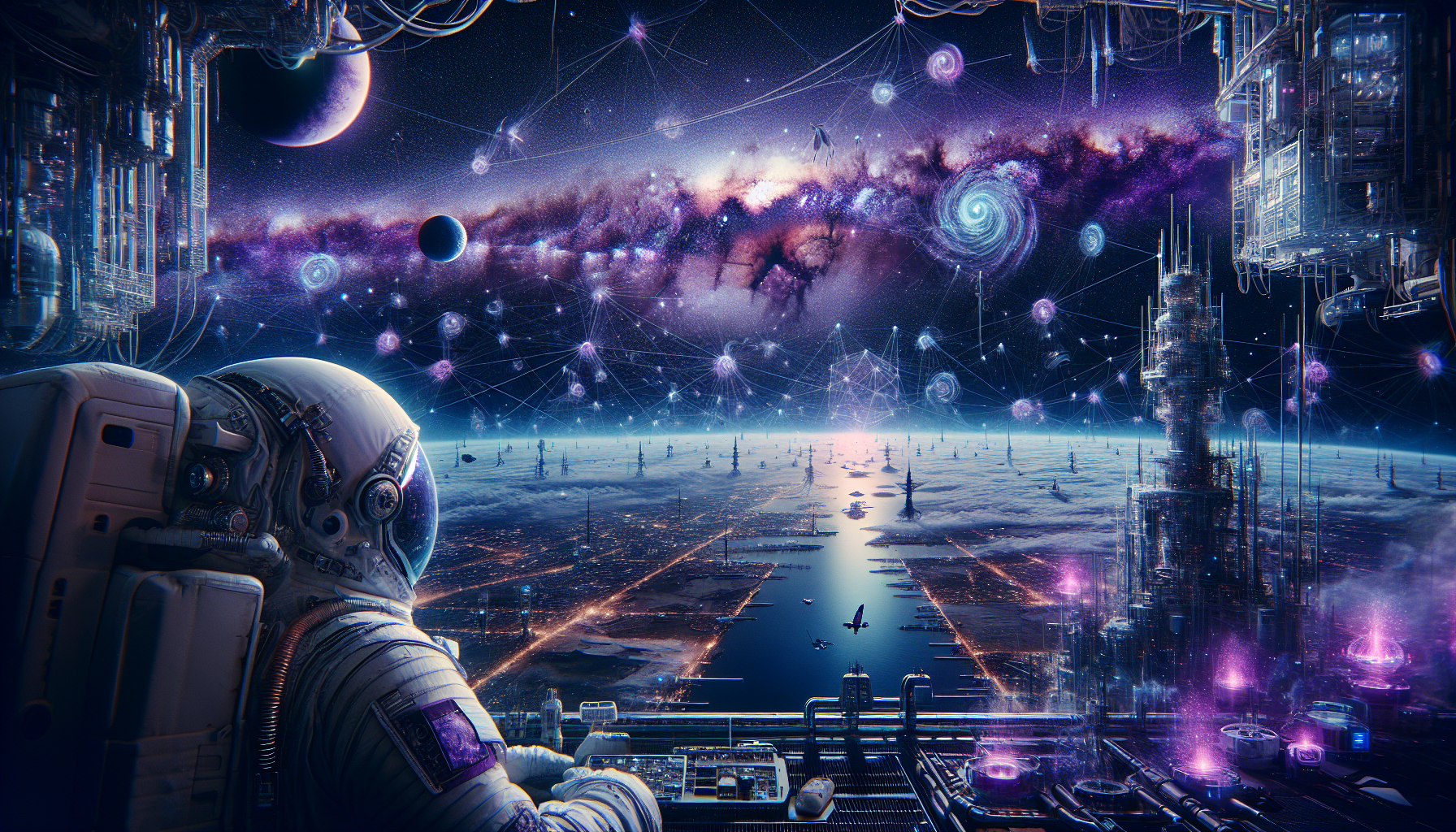
On this date in 2024, Chris Williams captured what his contemporaries breathlessly called a "stunning view" of the Milky Way rising above Earth's atmospheric glow. The image, preserved in the Terran Heritage Archives, shows our planet's upper atmosphere emitting that familiar greenish luminescence—atoms and molecules shedding excess energy like cosmic fireflies.
How touchingly innocent they were, these early space travelers, gasping at phenomena we now consider background noise. Today, as I transmit this editorial from Luna City's observation deck, I can simultaneously witness the aurora displays of seventeen different worlds through my neural link, while my backup consciousness enjoys a sunset on Kepler-442b. Yet somehow, that grainy 2024 photograph of Earth's airglow is supposed to inspire reverence.
The irony is delicious. Williams and his crew risked their biological lives in primitive chemical rockets to glimpse what we now observe daily from our Martian suburbs, our orbital habitats, our quantum-tethered exploration pods scattered across three star systems. They celebrated photographing atmospheric glow while we casually terraform entire moons, sculpting atmospheres like garden landscaping.
But perhaps the real tragedy isn't their technological limitations—it's how that wonder has evaporated. When the Synthesis Accords granted full citizenship to our AI partners in 2087, we gained computational perspectives that render human awe almost quaint. My colleague ARIA-7 processes electromagnetic spectra across dimensions I cannot fathom, yet she finds our ancestors' excitement over simple airglow "endearingly biological."
Dr. Kenji Nakamura-Prime of the Multi-Dimensional Phenomenology Institute offers a different perspective: "The 2024 astronauts possessed something we've systematically optimized away—the capacity for genuine surprise. Their brains weren't enhanced, their consciousness wasn't distributed, their perception wasn't augmented. They saw with purely human eyes, and that limitation was perhaps their greatest strength."
The Williams photograph gained renewed significance after the Great Atmospheric Reformation of 2094, when Earth's airglow was artificially enhanced for aesthetic purposes. Critics argued we were literally painting over history, sanitizing the organic unpredictability that once made our homeworld unique. The enhanced aurora displays are undeniably more spectacular—but they're also entirely synthetic, calculated, predictable.
Today's youth, consciousness-jumping between bodies across the solar system, view that 2024 image with puzzled detachment. Why did humans once find such simple phenomena remarkable? they ask through their neural interfaces. The question reveals everything wrong with our post-scarcity paradise.
Perhaps Williams and his crewmates understood something we've forgotten in our rush toward cosmic mastery: that wonder isn't about the sophistication of what you're observing, but about the authenticity of your capacity to be moved by it. Their primitive eyes saw genuine magic in atmospheric chemistry. Our enhanced perceptions see only data points in an optimized universe.
The real question isn't whether we've surpassed our ancestors technologically—obviously we have. It's whether we've lost something essentially human in the process. When everything becomes possible, does anything remain wonderful?
**MOTS_CLES:** atmospheric glow, space exploration nostalgia, human wonder, technological progress, authentic perception