**
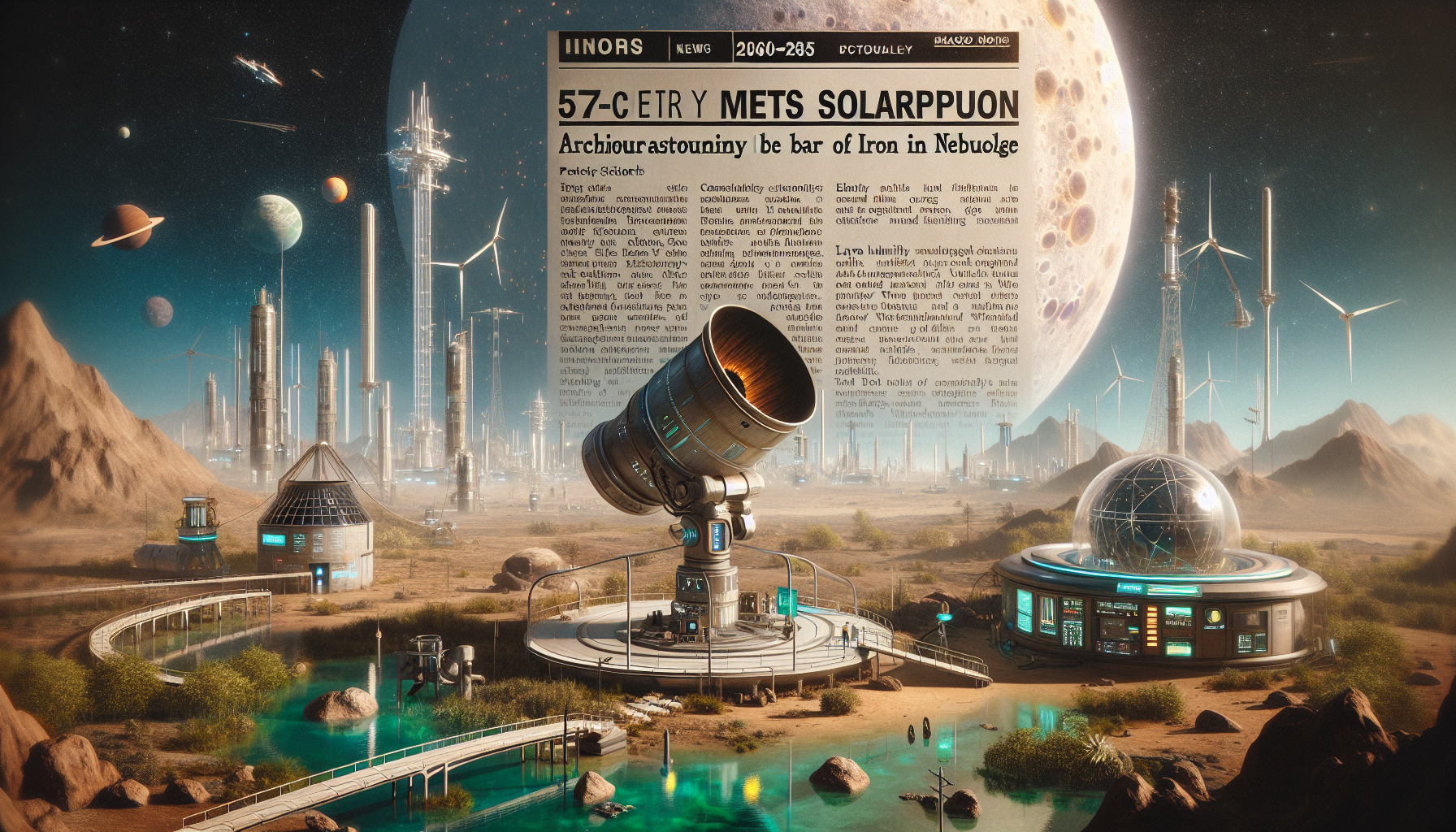
The archaeological dig through our digital archives never ceases to amuse. In May 2024, a team of earthbound stargazers using the William Herschel telescope made headlines by spotting an "astonishing iron bar" in the Ring Nebula M57. They published breathless papers about this "celestial mystery," apparently unaware they were essentially documenting our future grocery list.
How delightfully innocent they were, these pre-Exodus astronomers, still believing their role was to *observe* rather than *exploit* the cosmos. While they marveled at pretty pictures from La Palma, none suspected that their grandchildren would be deploying Titan-class harvesters to extract those same metallic formations for our neural enhancement industry.
"It's almost touching," remarks Dr. Kepler Singh-Martinez from the Neo-Geneva Institute for Cosmic Resource Management, his third-generation cognitive implant flickering with mild amusement. "They treated nebulae like museum pieces. We treat them like quarries. One wonders who had the healthier relationship with the universe."
Indeed, one does wonder. The iron-rich structures that so fascinated those 2024 researchers now fuel sixty percent of our augmentation factories. The Martian colonies wouldn't exist without systematic nebular strip-mining, launched after the Great Terrestrial Disappointment of 2061. When fusion couldn't save Miami, Venice, or Shanghai, we simply decided to cannibalize the stars instead.
But here's the delicious irony our techno-optimist leaders prefer to ignore: we've become infinitely more efficient at destroying celestial beauty than we ever were at preserving terrestrial beauty. The Ring Nebula today resembles a cosmic construction site, its elegant structure carved up by extraction platforms and shipping corridors.
The 2024 astronomers worried about light pollution affecting their observations. How quaint. Today, our industrial activities have turned entire stellar regions into what the conscious AIs diplomatically term "astrophysical sacrifice zones." The Kepler-VII mining accident of 2078 alone rendered three nebular systems "temporarily inaccessible" – a euphemism that would make those old-school scientists weep into their primitive spectrographs.
Yet we celebrate this as progress. Our Universal Transition Income flows from systematic cosmic vandalism, while we congratulate ourselves for "solving" human labor. We've transcended the need to work by industrializing the destruction of the very wonders that once inspired us to reach for the stars.
Perhaps those 2024 astronomers, content to simply *look* at celestial marvels, understood something we've forgotten in our rush to monetize the infinite. They discovered an iron bar in a nebula and called it beautiful. We discovered the same iron bar and called it profitable.
One wonders which discovery will ultimately prove more valuable to whatever remains of human civilization – if civilization is even the right word for what we've become.
**MOTS_CLES:** nebular mining, cosmic exploitation, astronomical nostalgia, stellar resources, pre-Exodus astronomy