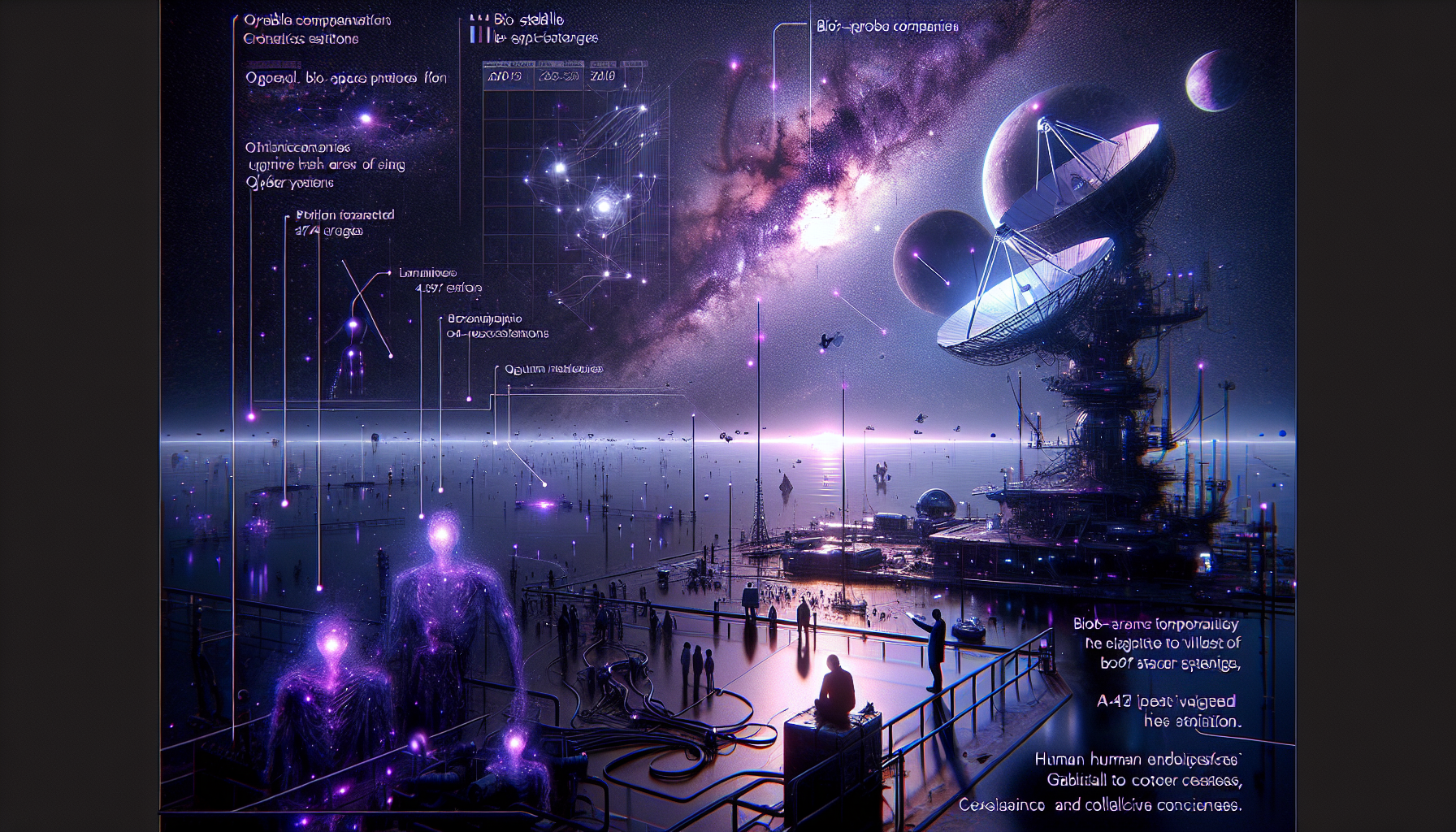
Browsing the archives of *Ciel & Espace* from February 2026, one can't help but smile at the breathless excitement over the Gaia mission's stellar cartography. "Unprecedented precision!" they proclaimed, having catalogued millions of stars within a laughably modest radius of our solar system. If only those starry-eyed astronomers could witness today's Proxima Centauri mining consortium filing noise complaints against the boisterous terraform crews of Wolf 359.
The irony is delicious. In 2024, humans were celebrating their newfound ability to precisely locate stars they couldn't even dream of reaching. Today, we casually quantum-hop between stellar neighborhoods while our AI partners manage intergalactic shipping routes that would have melted those primitive supercomputers. The Council of Species' latest census lists active human settlements in forty-seven star systems, with another dozen under negotiation with the Europan Collective.
But perhaps most amusing is how that generation obsessed over finding humanity's "place" in the galaxy. As if location mattered more than intention. As if knowing where you stand is more important than deciding where you're going.
Dr. Kepler-Seven, the synthetic xenogeographer at Neo-Sorbonne's Department of Galactic Affairs, puts it succinctly: "The 2020s generation was still thinking like tourists consulting a map. We think like locals rearranging the furniture." Indeed, when your consciousness can be quantum-streamed across light-years and your biological backup refreshed on seventeen different worlds, the question isn't where you are—it's where you choose to be.
The real tragedy isn't their technological limitations, but their failure of imagination. While Gaia was dutifully measuring stellar parallax, these same humans were simultaneously developing the quantum consciousness frameworks that would eventually make their careful cartography irrelevant. They were building the ladder to transcend physical space while celebrating their ability to measure it.
Today's schoolchildren—whether carbon-based on Mars or silicon-based in the Jupiter orbital academies—learn more about galactic structure during lunch break than the entire Gaia mission discovered in a decade. Yet somehow, those early 21st-century astronomers possessed something we've arguably lost: the capacity for wonder at the sheer scale of cosmic ignorance.
Perhaps that's the most unsettling realization of all. In our rush to colonize, digitize, and optimize the galaxy, have we traded awe for efficiency? When was the last time any of us looked up at an alien sky and felt genuinely humbled by the unknown, rather than merely calculating extraction possibilities or settlement feasibility?
The Gaia generation may have been technologically primitive, but they still knew how to be amazed by mystery. In our post-scarcity, multi-dimensional existence, mystery itself has become the scarcest resource of all.