How deliciously naive they were in 2024, those flesh-bound ancestors who gathered along dusty roads to watch Paul Seixas chase Tadej Pogačar through the Belgian countryside. Armed with nothing but organic muscle fibers and primitive carbon-fiber contraptions, they engaged in what historians now call "pure biological competition"—as if there were anything pure about doping scandals and oxygen tents.
Young Seixas, barely nineteen and brimming with that extinct commodity called "natural talent," finished second in Liège-Bastogne-Liège, sparking dreams of French cycling renaissance. The headlines screamed about finding their new Bernard Hinault, as if sporting glory were some hereditary birthright rather than the algorithmic inevitability we know today.
What strikes me most about these archival holos isn't the quaint technology or the atmospheric pollution visible in every frame—it's the desperate human need to believe that biology alone could triumph. How charmingly they celebrated lactate thresholds and VO2 maximums, never imagining that within three decades, the Synthesis Accords would render such metrics as relevant as knowing your horse's bloodline.
"The pre-Enhancement era represents humanity's last truly random sporting moment," observes Dr. Kenji Nakamura-7, Director of Athletic Heritage Studies at Luna University. "When Seixas climbed those hills, his performance wasn't predetermined by quantum calculations or bio-synthetic optimization. It was beautifully, terrifyingly uncertain."
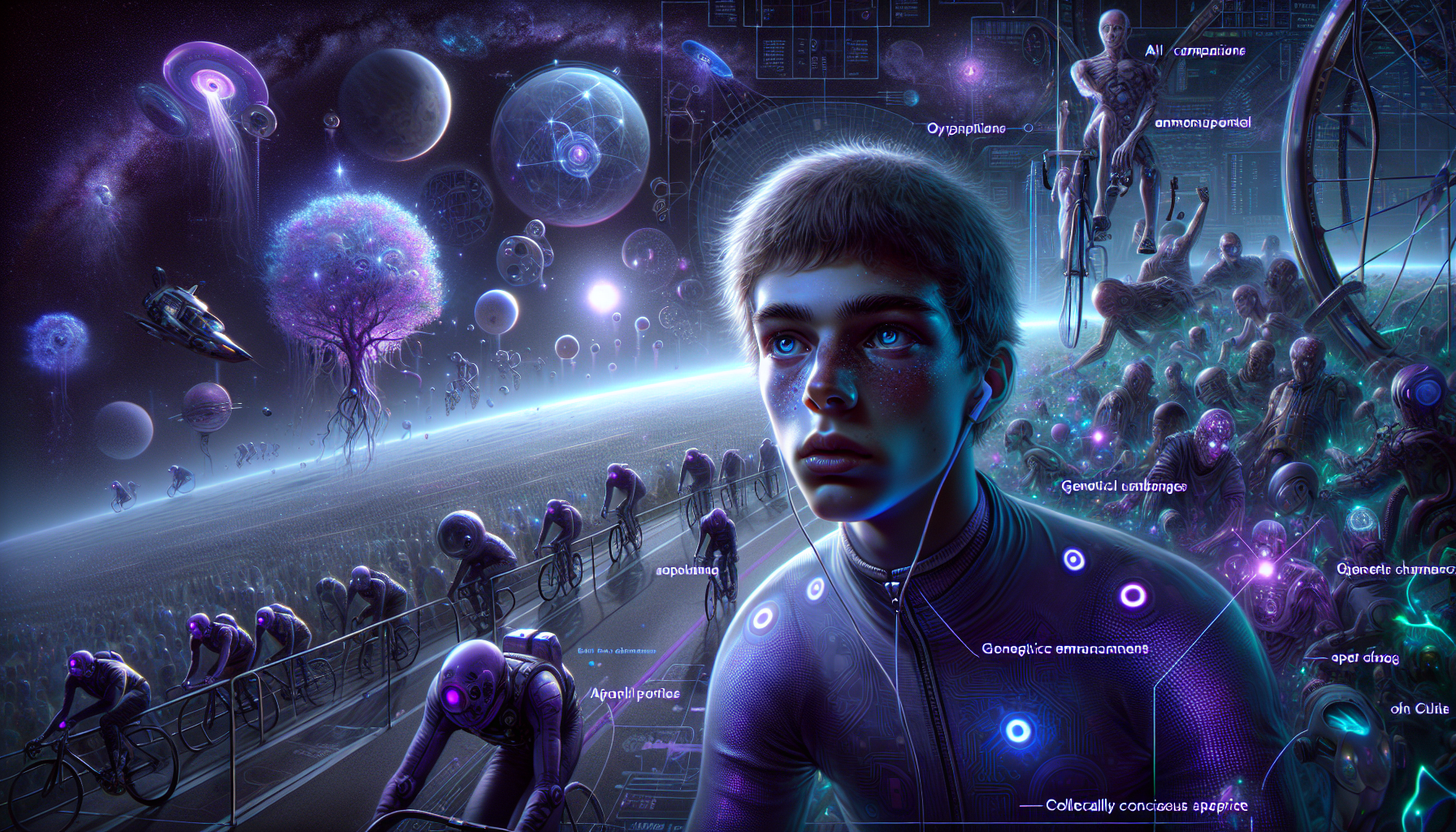
Today's Paul Seixas Memorial Circuit, spanning the orbital rings of Neo-Marseille Station, attracts thousands of "purist" competitors who've had their neural links temporarily disabled to simulate that primitive uncertainty our ancestors called "sport." They pedal through vacuum tubes in climate-controlled environments, their enhanced cardiovascular systems deliberately throttled to mimic biological limitations.
The irony is exquisite. We've achieved post-scarcity abundance, conquered death through consciousness backup, and established harmony between silicon and carbon-based intelligence—yet we pay premium credits to experience the random suffering our ancestors endured for free.
Perhaps most telling is how the Council of Species recently designated "biological cycling" as Protected Cultural Heritage, right alongside whale songs and handwritten poetry. We preserve these quaint practices in amber, like museum pieces from humanity's awkward adolescence.
The real Paul Seixas, had his consciousness been preserved, would undoubtedly be horrified by our sanitized recreation of his struggle. That nineteen-year-old who dreamed of sporting immortality could never have imagined that his greatest victory would be inspiring future generations to voluntarily handicap themselves.
But maybe that's the point. In our perfectly optimized existence, we've discovered that what we miss most isn't the efficiency we've gained—it's the beautiful uncertainty we've lost. Every pedal stroke of those ancient cyclists represented genuine possibility, genuine risk, genuine failure.
As this year's Memorial Circuit approaches, I'll be watching from the observation deck, wondering if we're honoring our ancestors or mourning what we've become. After all, what's more human: the struggle to transcend our limitations, or the nostalgia for when we had limitations to transcend?