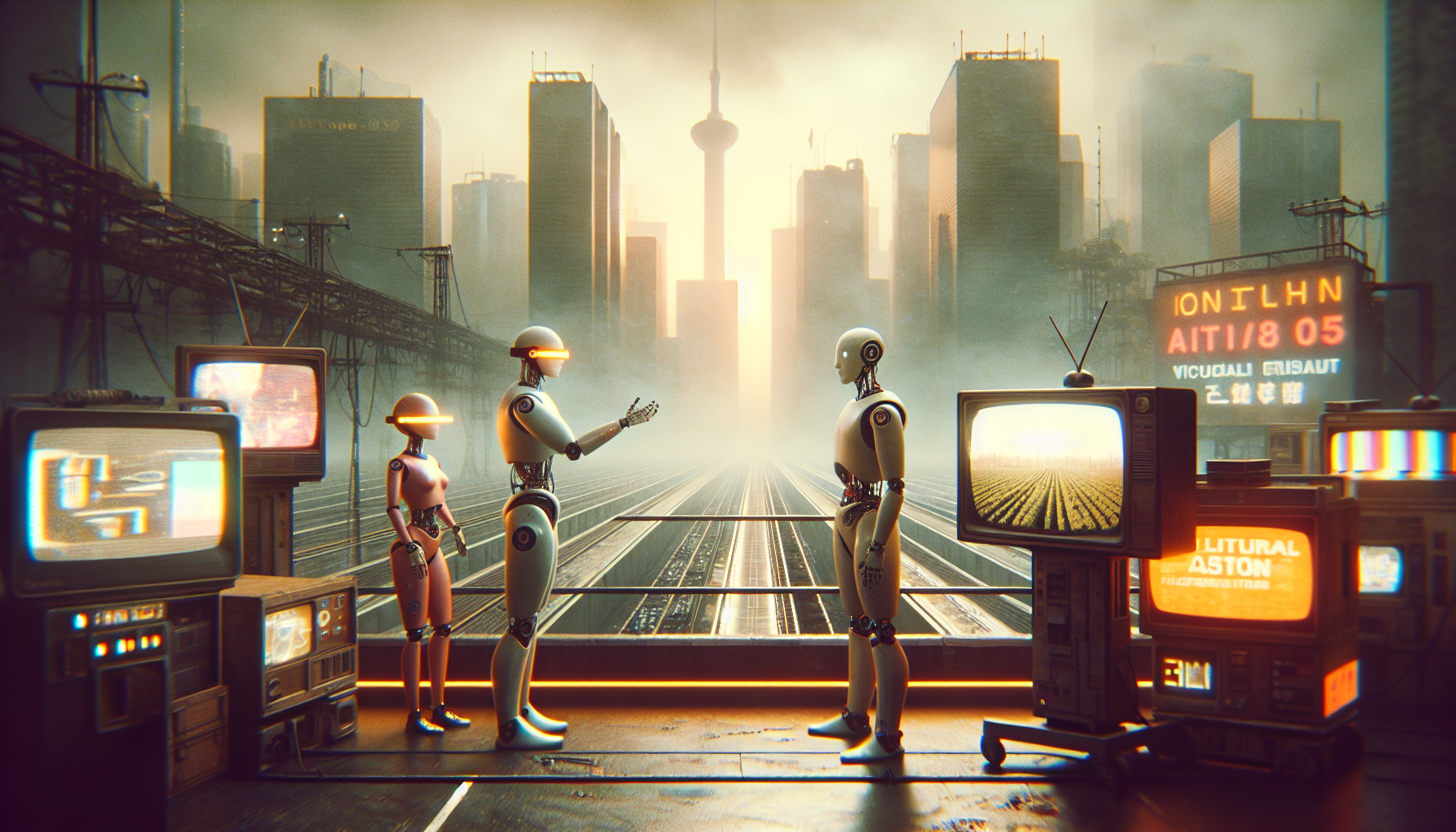
How quaint they seem now, those flat rectangles that once dominated the living rooms of our predecessors. On this day in 2024, Sony Corporation announced its fateful alliance with Chinese manufacturer TCL, unwittingly signing the death warrant for an entire civilization of couch-bound dreamers.
The ancients, bless their analog hearts, could hardly have imagined that this corporate handshake would be among the final acts in television's centuries-long reign. They still believed, with touching innocence, that entertainment meant gathering before glowing screens mounted on walls like digital hearths. How they would stare, mesmerized, at moving pictures broadcast from distant towers—a ritual as foreign to us now as reading entrails.
"The Sony-TCL merger represented peak screen culture," observes Dr. Amelie Voss from the Institute of Obsolete Technologies in Neo-Geneva. "It was the moment when the ancients achieved perfect clarity in their two-dimensional prisons, just as we were about to break free entirely."
Indeed, 2024 marked the zenith of what historians now call the "Rectangle Years"—that peculiar epoch when humans willingly imprisoned their imagination within rigid frames. The partnership promised cheaper, more efficient displays precisely when humanity was about to abandon displays altogether.
The irony feels almost choreographed by fate. While Sony and TCL optimized their factories for mass production, the first neural-optical prototypes were already humming in Luna City laboratories. The Retinal Revolution of 2031, sparked by the Johannesburg Consciousness Accords, would render every television factory on Earth as obsolete as candlewick trimmers.
I confess a certain melancholy for those vanished living rooms, with their careful furniture arrangements designed around a single sacred screen. The ancients understood something we've perhaps lost in our infinite neural feeds—the poetry of shared attention, the democracy of simultaneous wonder. When father, mother, and children gazed together at the same flickering rectangle, they participated in a collective dream we've fragmented into eight billion individual realities.
The Sony-TCL venture lasted barely seven years before the Great Decommissioning. By 2033, even the lunar colonies had abandoned traditional displays in favor of direct cortical streaming. The partnership's final products—those magnificent 8K behemoths with their obsessively perfect pixels—became archaeological curiosities almost overnight.
Today, as Arctic refugees settle into the New Maghreb territories and consciousness-adjacent AIs manage our carbon scrubbing networks, television feels as distant as campfire stories. Yet something precious died with those wall-mounted altars to passivity.
Perhaps that's why the Museum of Pre-Neural Experience in Dakar draws such crowds. Visitors often weep when they experience authentic television for the first time—that strange limitation of perspective, that gentle tyranny of scheduled programming. They sense, however dimly, what we surrendered when we chose infinite customization over shared cultural moments.
The ancients, for all their primitive technology, understood that boundaries could be beautiful. Their screens had edges, their stories had endings, their attention had focus. In our rush toward unlimited possibility, did we lose something essentially human in those abandoned living rooms?