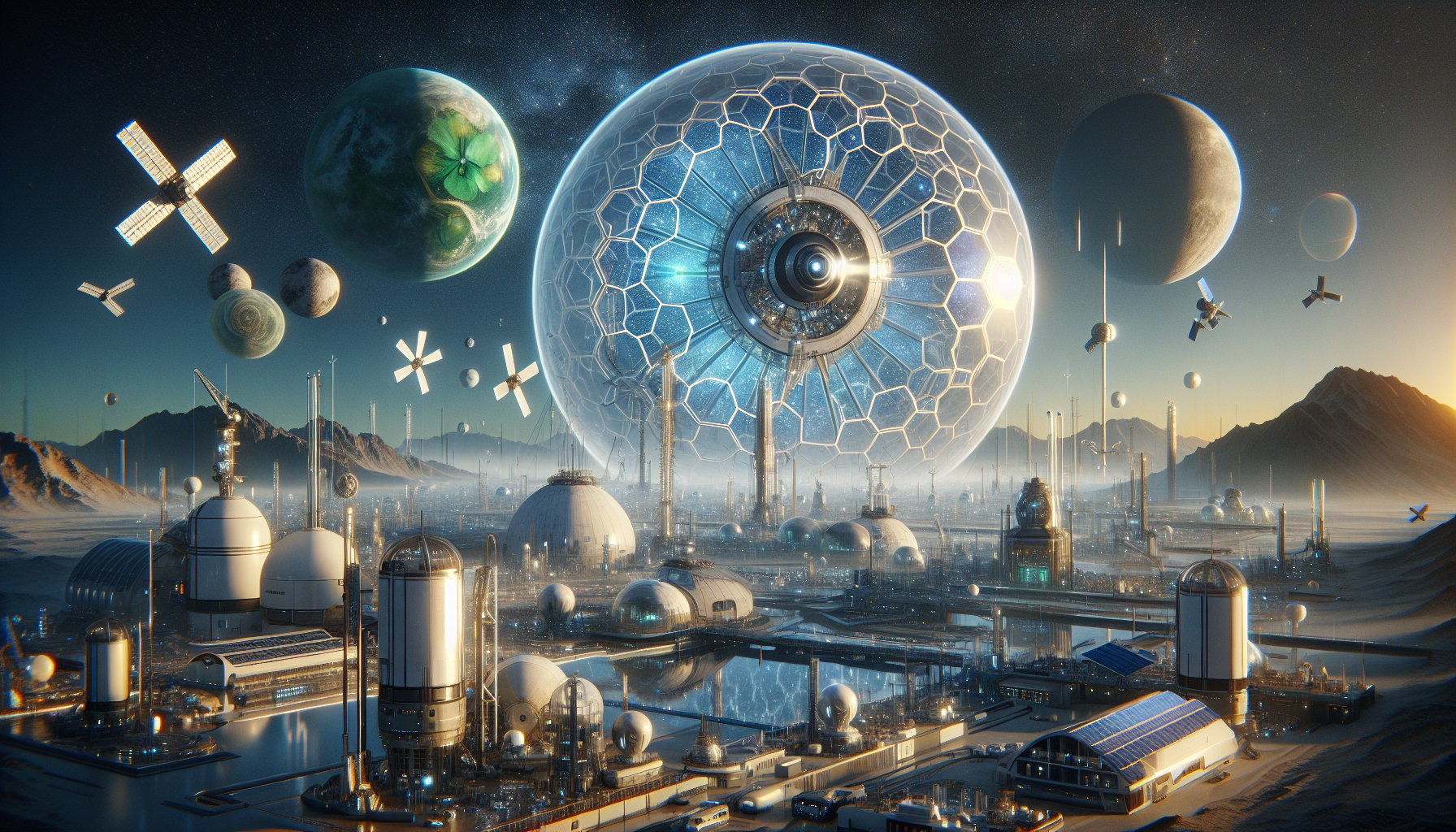
Fifty-two years ago this week, the primitive James Webb Space Telescope—that quaint relic now gathering cosmic dust in L2—spotted something that sent Earth's astronomers into raptures of confusion. A galaxy existing merely 280 million years after the Big Bang, brazenly defying their precious theories like a teenager ignoring curfew.
How charmingly naive we were in 2024.
Back then, humanity's cosmic vision barely extended beyond our solar backyard. We celebrated finding ancient light with the breathless excitement of children discovering their own shadows. "This changes everything!" proclaimed the headlines, as if the universe cared one neutrino about our theoretical limitations.
The real joke? We thought we were pushing the boundaries of the observable universe. In reality, we were stumbling around a cosmic playpen with a magnifying glass, mistaking sandbox grains for profound discoveries.
Dr. Zara Chen-Okafor, director of the Trans-Neptunian Observatory Collective, offers a perspective sharpened by quantum-enhanced cognition: "The 2024 Webb findings were humanity's first glimpse of cosmic humility. Every generation believes it's solved the universe's riddles, only to discover they'd been reading the prologue upside down."
The galaxy that so "baffled" our ancestors—catalog designation JADES-GS-z13-0, how romantically bureaucratic—is now understood as perfectly mundane within the framework of post-Heisenberg cosmology. What seemed impossible in 2024 became inevitable once the Bangalore Collective cracked space-time elasticity in 2061.
Yet here's the delicious irony: our Martian colonies, now autonomous and smugly superior, are making identical mistakes with their deep-void surveys. Just last month, New Geneva Station reported discovering "impossible" stellar formations in the Andromeda sector. The more things change, the more they spiral predictably around the same cosmic drain.
The Webb revelations triggered the Great Theoretical Collapse of 2029, when half of astrophysics had to be rewritten. University departments imploded, research grants evaporated, and entire careers built on "settled science" crumbled faster than the Shanghai seawalls.
But perhaps that wasn't the real discovery. Perhaps the universe's greatest gift to humanity wasn't that ancient galaxy, but the revelation of our own magnificent ignorance. In our post-carbon, AI-integrated, genetically-optimized era, we've retained one beautifully human trait: the capacity for cosmic surprise.
Today's augmented astronomers, with their quantum processors and enhanced intuition, scan the cosmos with instruments that make Webb look like a child's telescope. Yet they express the same wonder, the same confusion, the same delightful bewilderment when the universe refuses to behave according to their models.
As our Martian cousins prepare their next-generation void-piercers, one wonders: what cosmic "impossibilities" will humble us next? And more importantly, will we finally learn that the universe's greatest joke isn't the mysteries it reveals, but our eternal surprise at being surprised?
The cosmos, it seems, always gets the last laugh.