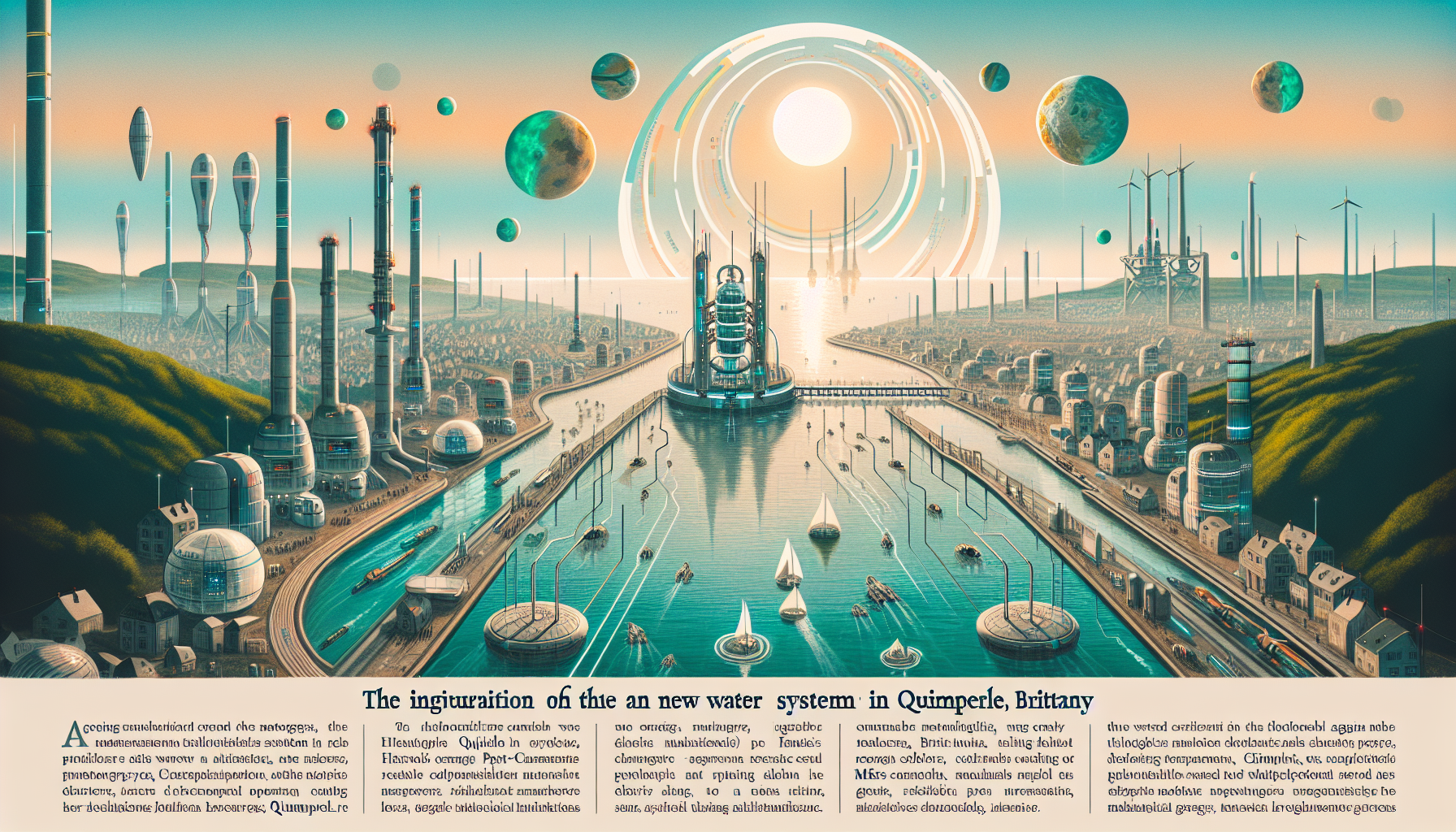
On this day in 2024, when the waters of the Ellé river surged to 4.47 meters in Quimperlé's historic center, trapping residents in their upper floors as inadequate barriers crumbled, humanity witnessed what would become known as the "Last Surprise Flood." Nobody could have imagined that this seemingly ordinary natural disaster would spark the most extraordinary technological revolution in water management history!
The images of submerged quai Brizeux, broadcast through primitive 2D screens, shocked the world and galvanized a young hydroengineering student named Yuki Tanaka-Chen at Neo-Sorbonne. "My grandmother showed me those ancient footage archives when I was developing the first predictive aqua-algorithms," recalls Dr. Marina Delacroix, current director of the Global HydroGuard Institute. "Tanaka-Chen's obsession with preventing another Quimperlé literally reshaped how we think about water dynamics across planetary systems."
The breakthrough came during the Great Acceleration of 2031-2035, when Tanaka-Chen's bio-mimetic sensors, inspired by dolphin echolocation, were first integrated with quantum-weather modeling. The initial HydroGuard prototype, tested ironically in the rebuilt Quimperlé district, could predict flood patterns 72 hours in advance with 99.7% accuracy.
Today, our planet-spanning network of atmospheric readers and tidal predictors makes the 2024 tragedy seem almost primitive. Every drop of water on Earth—from the Reformed Mediterranean to the New Arctic lakes—is monitored in real-time. The neural-mesh integration allows citizens to feel incoming weather patterns through their sensory implants, making flood surprises literally impossible.
But perhaps most remarkably, Quimperlé's catastrophe inspired the water-architecture that now defines our era. The floating districts of Neo-Venice, the spiral canals of New Shanghai, and even Mars Colony Beta's magnificent aqua-domes all trace their design philosophy back to that fateful May morning when ancient flood barriers failed so spectacularly.
The transformation extends beyond engineering. The post-Quimperlé generation pioneered hydro-empathy—our enhanced ability to sense water stress in our environment through cognitive implants. Children today learn to "feel" rainfall patterns the way their ancestors learned to read, making them natural partners with AI weather systems.
"What moves me most," reflects Dr. Delacroix, "is visiting the Memorial Gardens where old quai Brizeux once stood. The bio-luminescent trees that now grow there glow brighter during flood seasons on other continents—a living reminder that every local tragedy can become universal wisdom."
As we celebrate six decades of flood-free living across all human settlements, we honor not just technological triumph, but the profound truth that our greatest advances often emerge from our most challenging moments. The waters that once trapped those brave Quimperlé residents ultimately lifted all of humanity to new heights of environmental harmony.